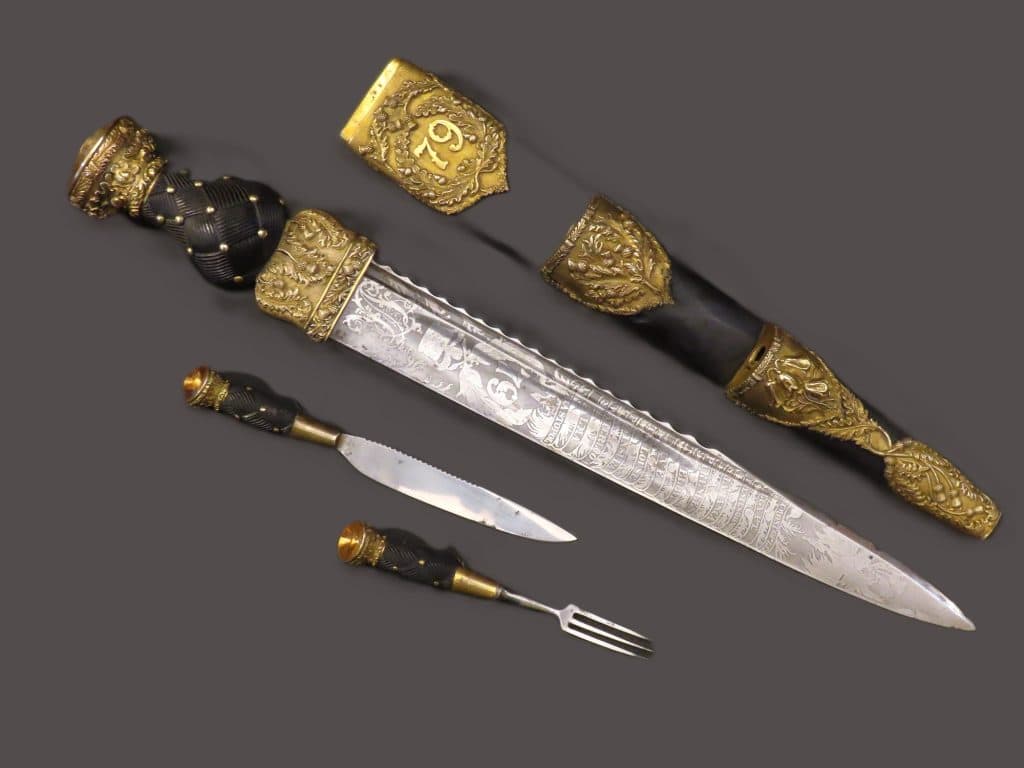
A Very Fine Victorian Scottish Dirk for a 79th (Cameron) Highlanders Officer dating to between 1855 to 1881
To enquire about this itemplease click here
Price: £4,650
Ref: 52111234
Item Description
A very fine and impressive Scottish Military Dirk made for an Officer in the 79th Regiment of Foot (Cameron Highlanders) between 1855 and 1871. The dirk is in excellent condition and of fine quality. The blade retains its original polish which highlights the etched and engraved regimental emblems, the VR cipher, battle honours and other Scottish military symbols. It is housed in its black wooden leather covered scabbard with its bi-knife and fork. The Ormolu bronze mounts retain all of the original detail.
The baluster shaped grips of the dirk, bi-knife and fork are fashioned from black hardwood or ebony, carved with a pattern of basket weave with brass dome-headed studs mounted at the intersections. The raised ornate pommel tops are canted slightly forwards, and swollen at the rear, mounted with finely cut uniformly amber coloured multifaceted Citrine pommel stones, with decorative rims featuring bands of thistles, acorns and foliage (thistles and to a lesser degree acorns are symbolic components of Scottish heraldry). The dirk grip base mount is decorated in the same manner. This mount is raised into a panel at the front enhanced with further decoration. The grip base behind this mount is carved with a Scottish military bonnet.
The cone shaped grip bases of the bi-knife and fork are plain and mounted with blued sprung steel clips on either side to secure the grips into the scabbard pocket tops. The bi-knife blade has a scalloped back edge and is marked by the blade making business “John Sellers” which first appeared in the Sheffield Directories in 1833.
The leaf shaped blade is 11 inches (28 cm) long and has a scalloped back edge under which a deep fuller extends towards the tip and terminates just after the scallop line ends. After this the blade is double edged to the tip. A wider fuller extends from the hilt along the middle of the blade to just before the end of the scalloped line.
The dirk blade is profusely etched and engraved in the typical high-quality manner of the late Victorian era and retains its original polished finish. On the “point up” side, with the cutting edge facing to the right, the “VR” cipher with a crown above is present near the hilt. Above this the number of the regiment “79” is featured inside a laurel wreath. Above the wreath pennants mark 12 battle honours of the regiment interspersed with foliage. The oldest is the Battle of Egmontopzee fought in 1799 in the Anglo-Russian Helder Campaign and the most recent is the Siege of Sebastopol in the Crimean War in 1854-1855. Towards the tip the decoration features a flamboyant Scottish thistle.
On the reverse side the blade base features the “VR” cipher, with a crown above, followed by a “79” inside a wreath similar to the same designs on the first side. Above the wreath a flamboyant Scottish thistle is present followed by a stand of arms centered with the Cross of St Andrew, surrounded with basket hilted swords, lances, muskets and banners. The area near the blade tip accommodates a panel of Scottish bluebells (harebells) which like thistles and acorns are symbols in Scottish heraldry and are the traditional plant badge for some clans.
The dirk is housed in its wooden scabbard covered with black leather on top of which the scabbard mounts are applied. The mouthpiece to the front contains the regimental number 79 inside an oak and thistle leaf garland in raised relief. The bi-knife and chape mounts have thistle sprays and the bi-fork mount is of bluebells. The mounts at the back are plain and the back of the mouthpiece retains its raised bar suspension mount. The overall length of the dirk in its scabbard is just over 16.5 inches (just over 42 cm).
The 79th or Cameron Highlanders was one of the most famous regiments of the British Army. The regiment was originally raised in 1793 as the 79th Regiment of Foot (Cameronian Volunteers) in the Highlands of Scotland and in 1804 was renamed the 79th Regiment of Foot (Cameron Highlanders). The regiment took part in many major engagements in the Napoleonic period including battles in Egypt, the Peninsula War and Waterloo. The thistles and acorns featured on the dirk are elements of the traditional arms of Clan Cameron.
This dirk dates to the period shortly after the Siege of Sebastopol which lasted from 1854 to 1855 in the Crimean War. This is the last / latest battle honour depicted on the blade. In 1881, Childers Reforms to the British Infantry led to the regiment being renamed the 1st Battalion Queens Own Cameron Highlanders. Dirks made for the regiment were marked in this manner from then on.
The regiment had embarked for the Crimea towards the end of the Crimean War in 1854 and completed its service there by participating in the end of the Siege and in the battles of Alma, Balaclava and the expedition to Kerch. Shortly after returning to the UK the regiment sailed to India to help suppress the Indian Mutiny and in 1858 took part in the Capture of Lucknow and the Battle of Bareilly. The dirk is not marked in its battle honours with this service in India which probably means the dirk had been made before this campaign took pace. The regiment returned to the UK in 1871. In 1873 Queen Victoria presented the regiment with new colours and directed that the regiment be known as the 79th Regiment, The Queen’s Own Cameron Highlanders. The regimental number of 79 was dispensed with in 1881. Hence the dirk dates to the period between 1855 and 1881.
Condition:
The condition of the dirk is excellent with only minor wear to the Ormolu backs of the scabbard mounts caused by the rubbing of clothing when the dirk has been worn. The pommel stones are in excellent condition with no cracks, chips or interference to the mount housings. The grips are in fine order and the studs are complete as are the sprung retention clips for the bi-knife and fork.


