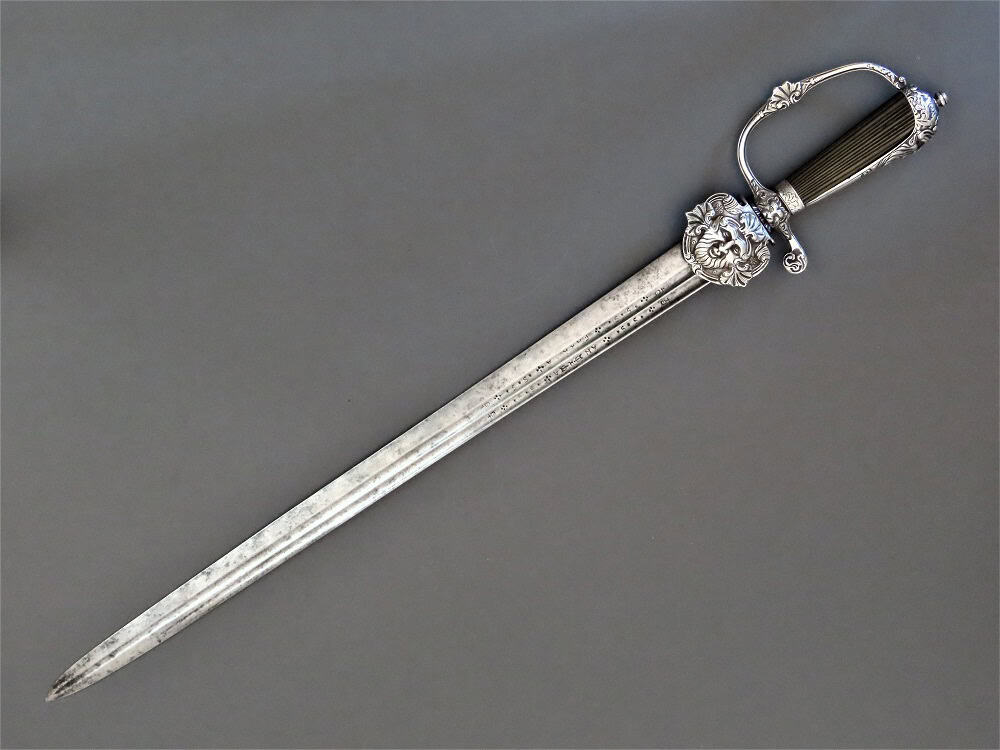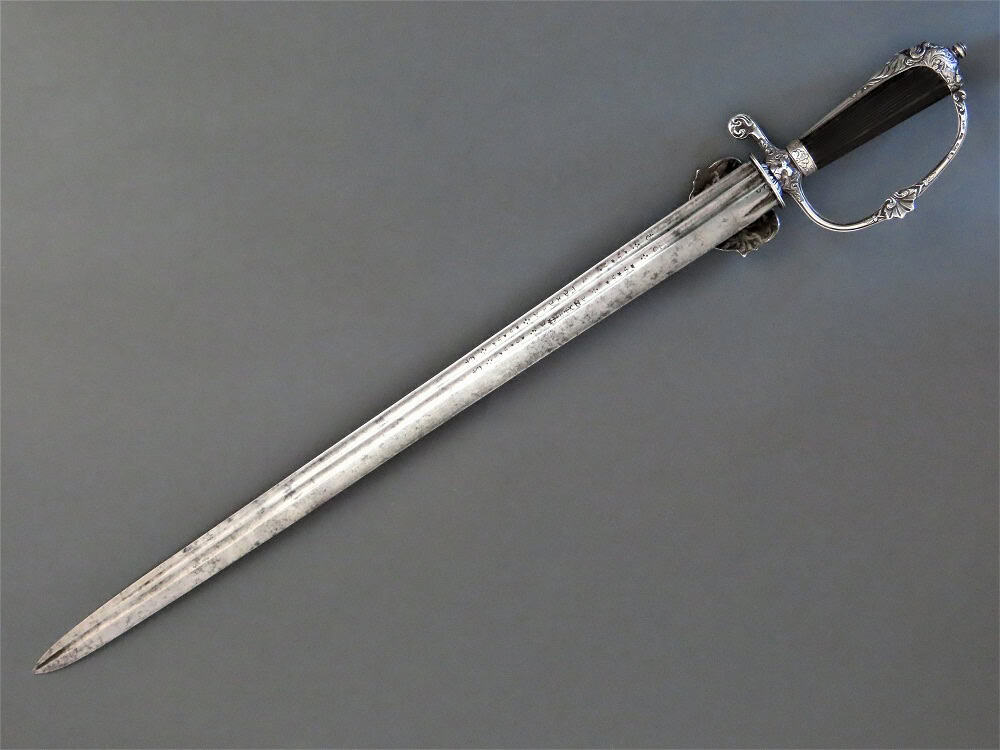
A fine English Silver Hilted Hunting Sword by Thomas Bass of the City of London hallmarked for 1742/3
To enquire about this itemplease click here
Price: £2,600
Ref: 52120239
Item Description
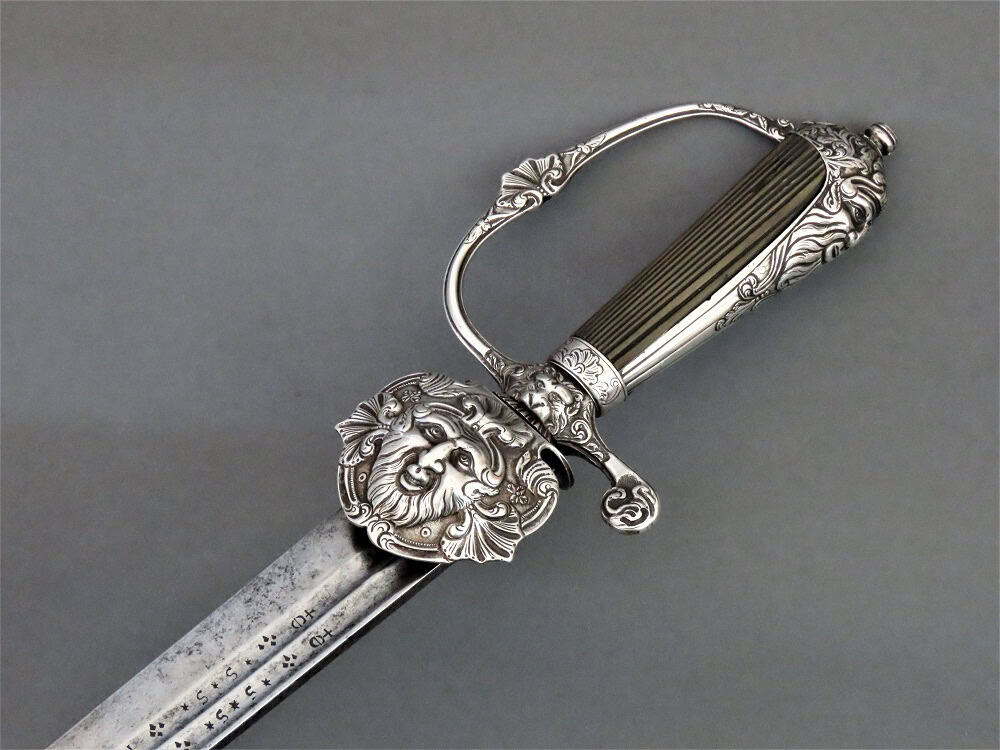
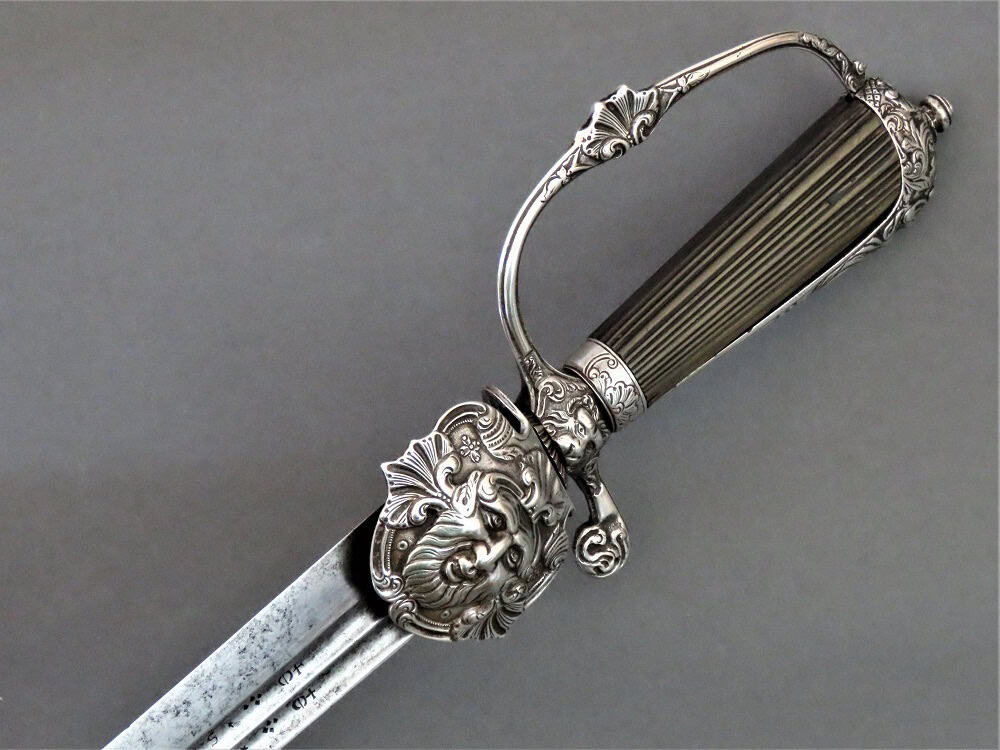
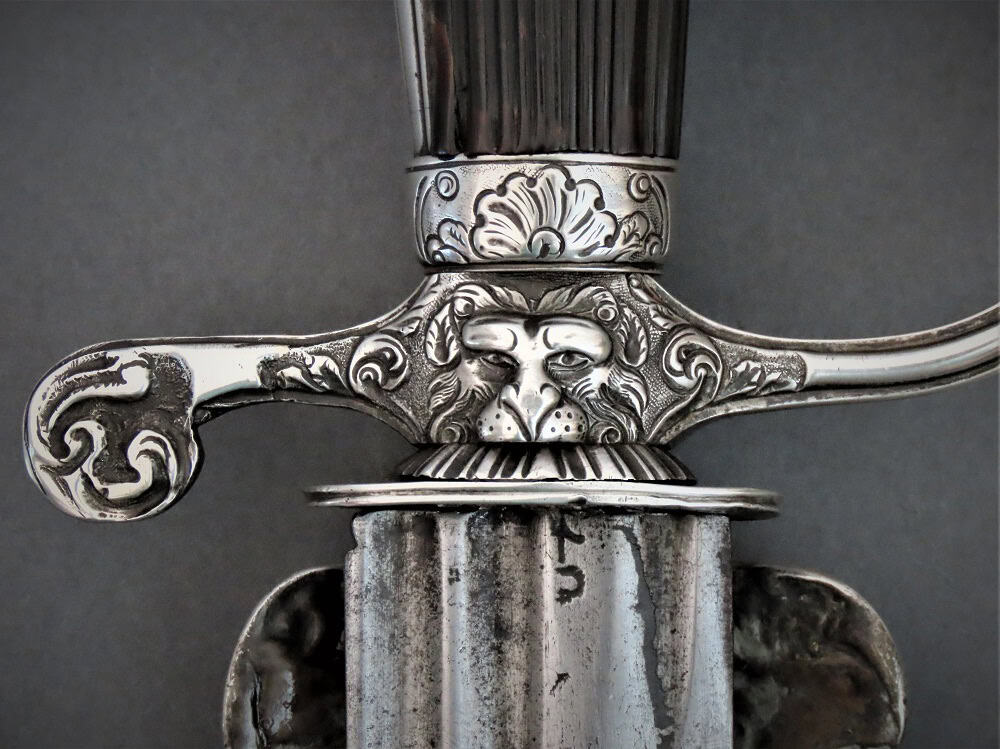
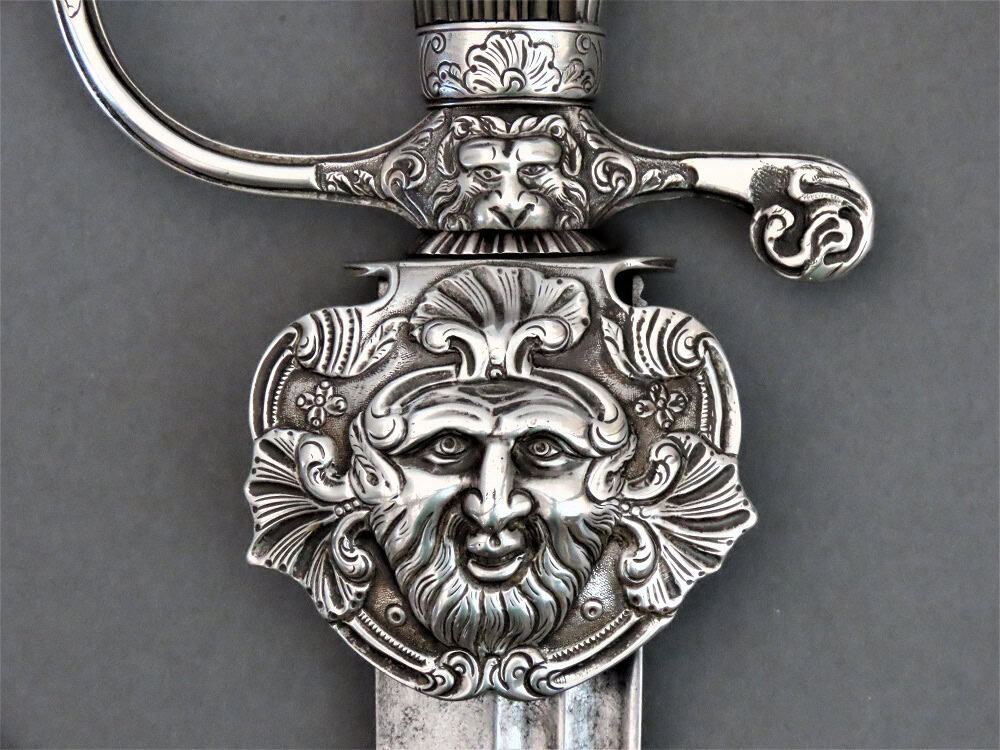
An attractive English silver mounted hunting sword with London Hallmarks for the year 1742 /1743, made by the silver smith and cutler, Thomas Bass of The City of London. The hilt is of exceptional quality and condition applied with fine decorative panels of masks and foliage.
During the 17th and 18th centuries, when swords were a popular weapon for gentlemen, hunting swords and hangers were a robust, shorter, secondary side arm used for self defence when walking about town and travelling in general. Although referred to as “hunting” weapons, they probably had minimal use in hunting. Self defence in crowded areas, and in the tight confines of dangerous alleyways in cities, required a weapon which was shorter than a full length sword for close-in use in these confined spaces.
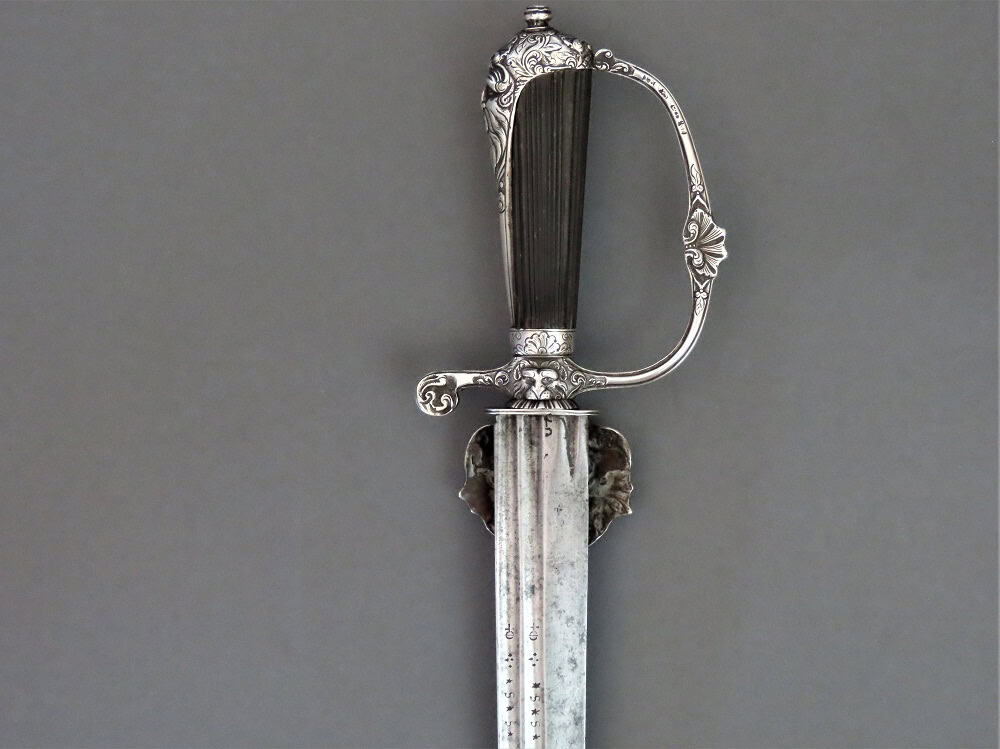
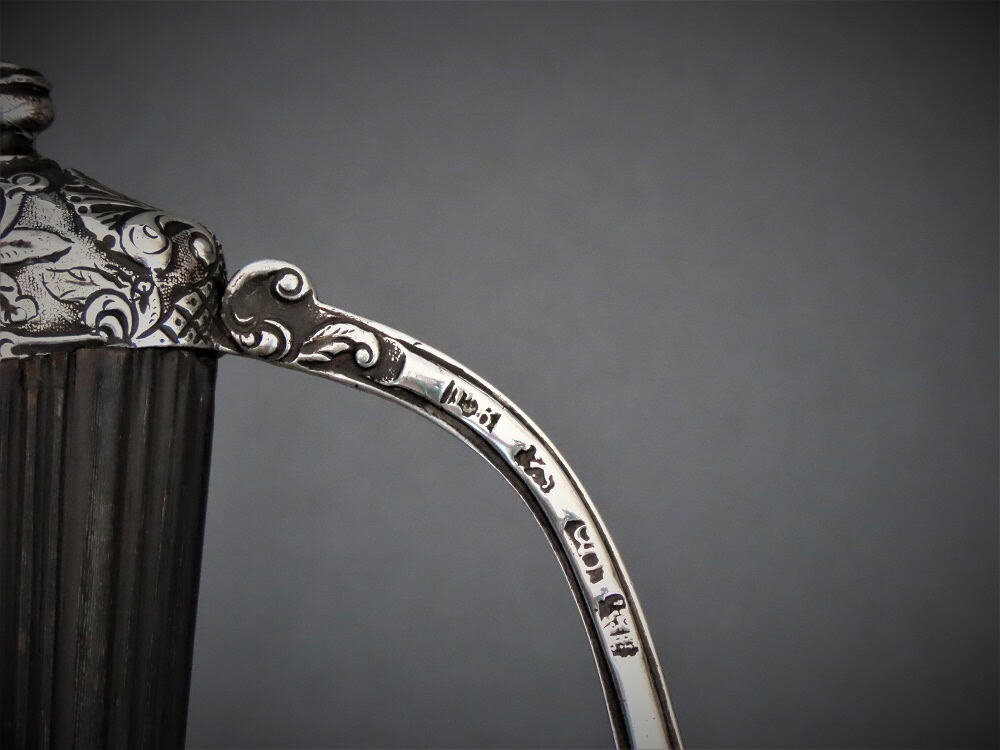
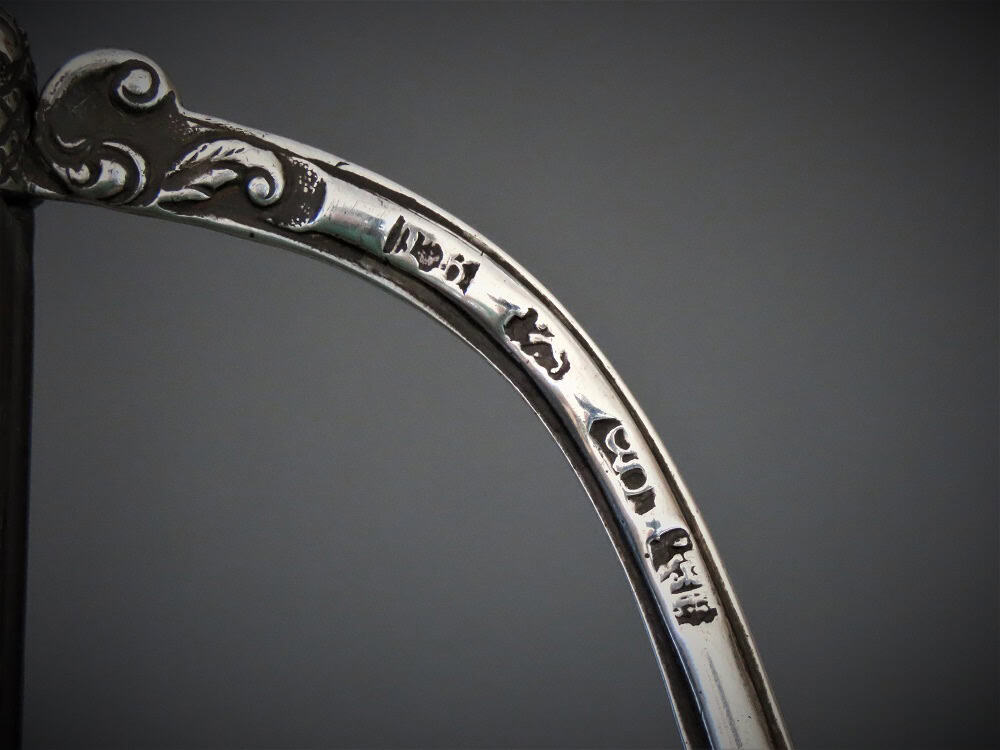
The high quality hunting sword described here was a gentleman’s weapon. The knuckle bow towards the pommel is stamped with “T B” in raised relief inside a depressed panel on the convex curve of the bar. This mark is most certainly that of the London cutler and hilt maker Thomas Bass recorded by him at Goldsmiths’ Hall in 1720. Marks for the Lion Passant royal standard and the Leopard’s Head silver standard mark plus the date stamp lie alongside.
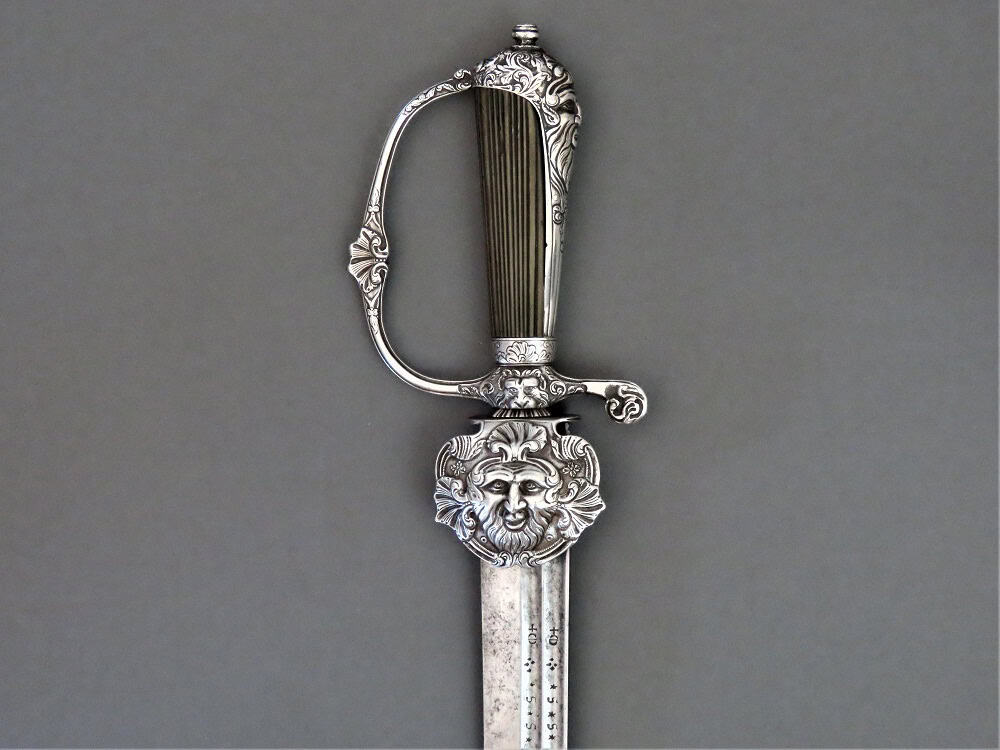
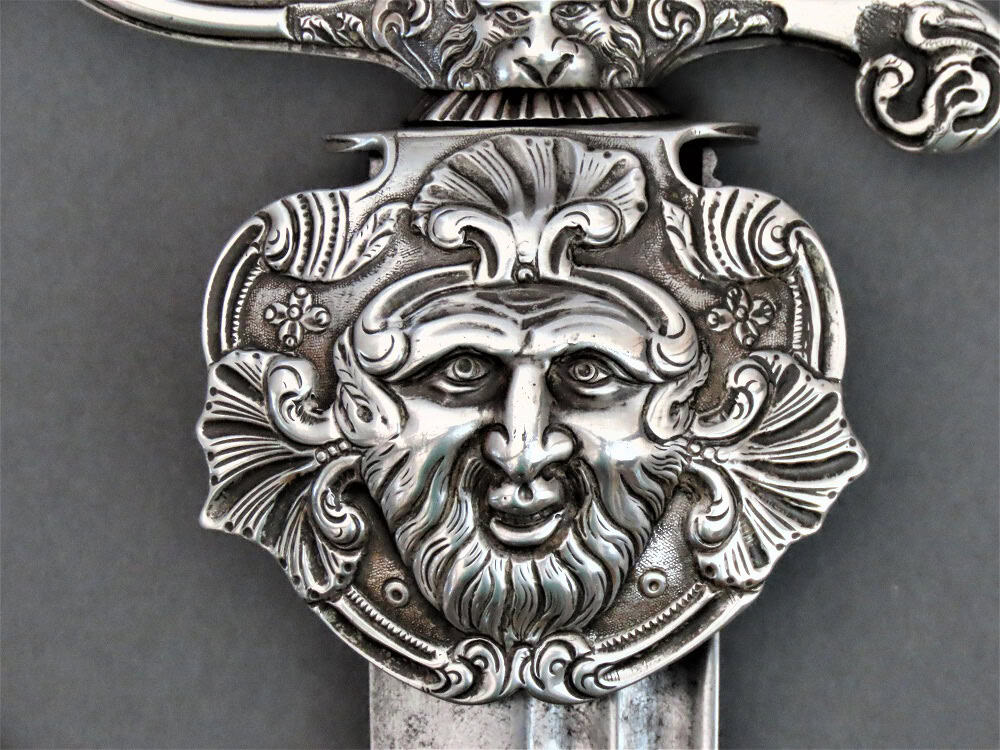
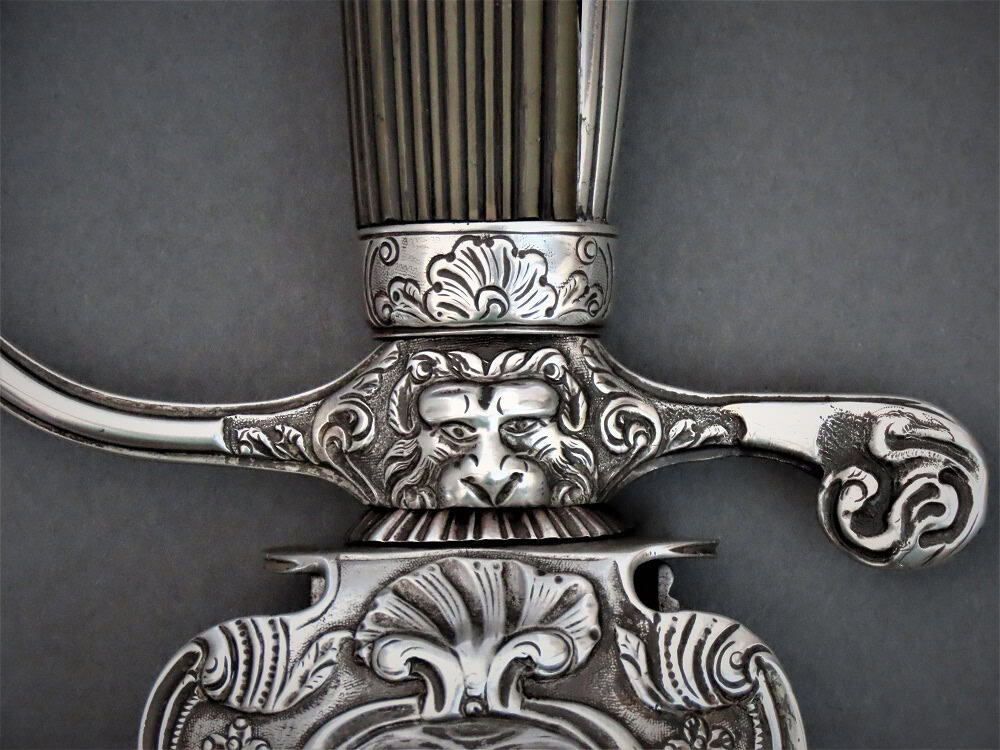
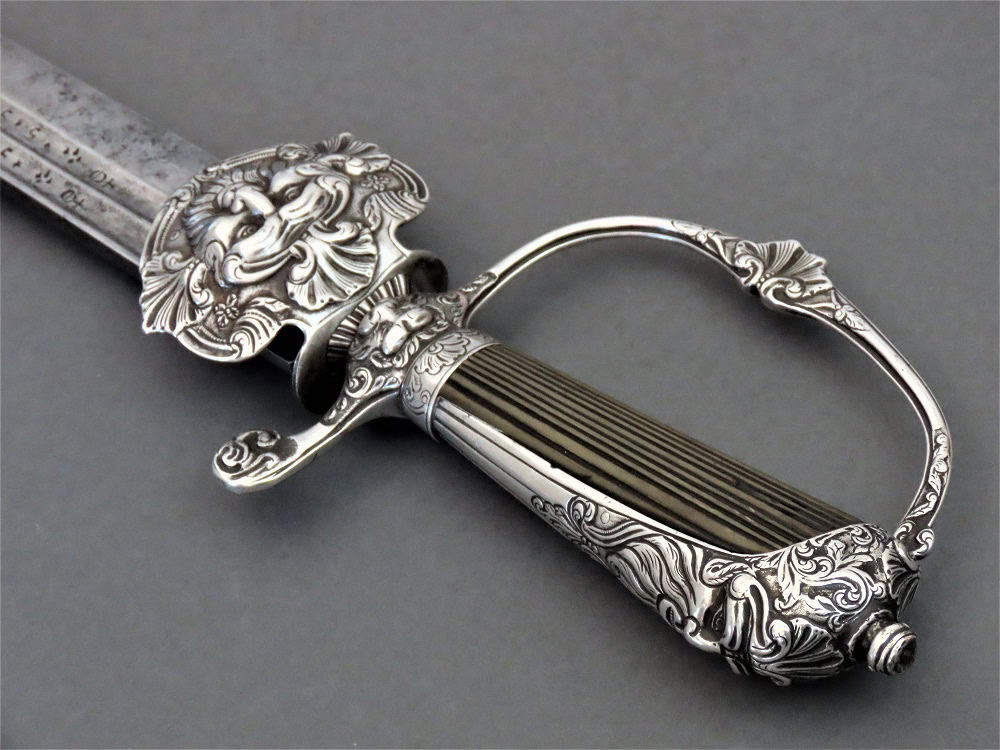
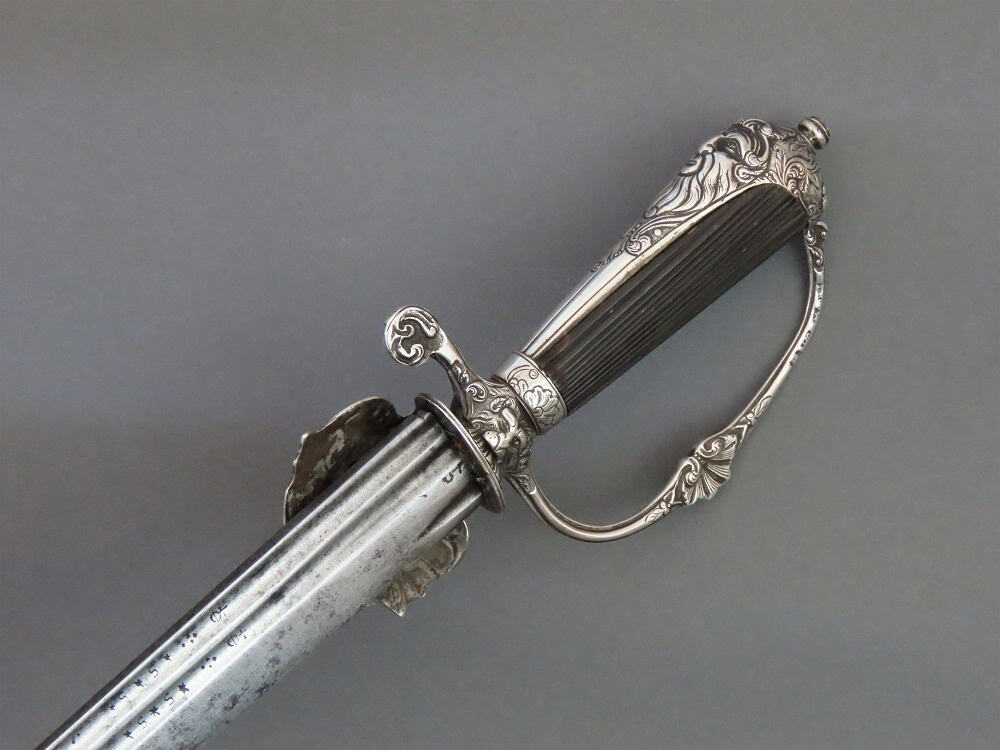
The most distinctive feature of this sword hilt is the large convex scallop-shaped shell guard which emanates from the cross guard and extends parallel to the blade towards its point. Inside the moulded border the wild staring face of a “Green Man” has been applied with fans of feathers each side and on top. Above this the cross guard is decorated in the middle in raised relief each side with the mask of a lion. The cross guard terminates in a flattened downward facing disc-like wristguard decorated with foliage.
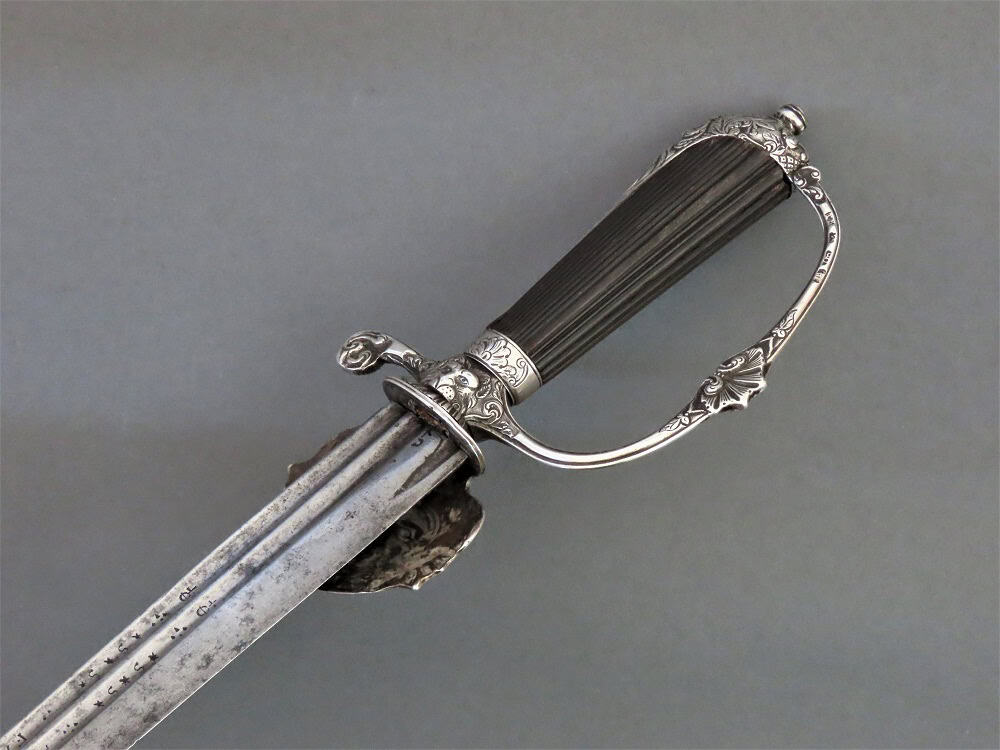
To the front the well formed knuckle bow extends from the cross guard to terminate in a flattened leafy scroll each side and an extension which secures the top of the bow into the pommel front. Mid way along the knuckle bow a swelling appears decorated on each side with a feathered fan similar to those which surround the Green Man mask on the shell guard. The grip is of shaped fluted horn which narrows from the top towards its base where it is secured with a silver ferrule engraved with the same feathered fan on each side.
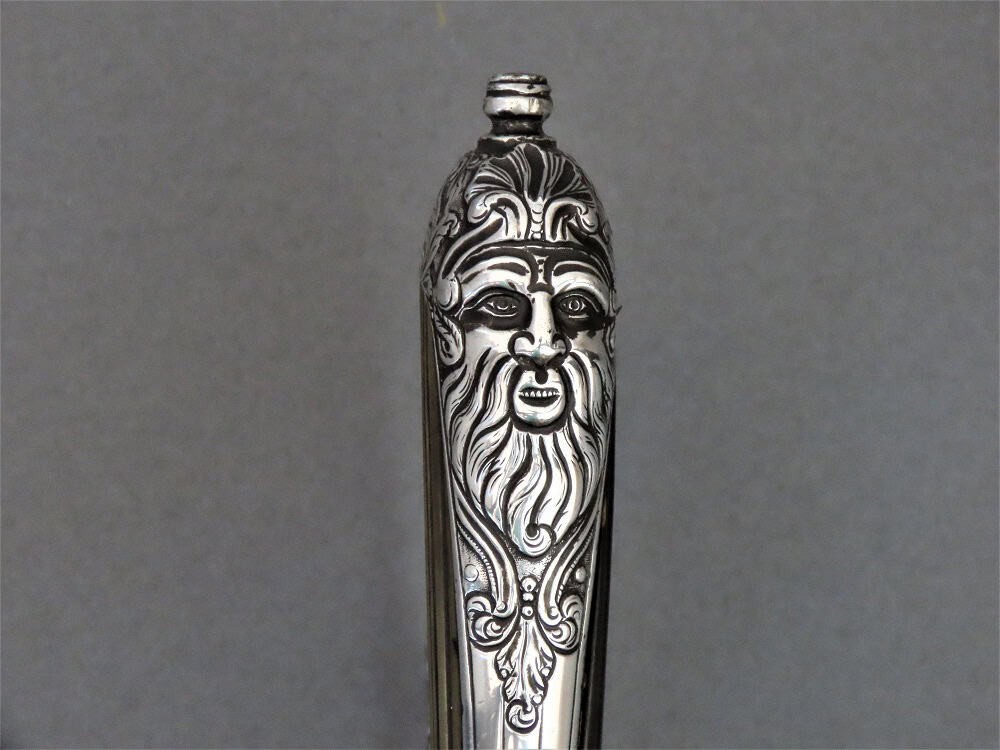
The backplate of the grip and the pommel are formed from a single shaped piece of silver. Towards the pommel the plate is decorated with a further grotesquely grimacing Green Man and a further feathered fan on top and decorous foliage and scrolls on the pommel. A pronounced ribbed pommel button protrudes from the top.
The Celtic “Green Man” has origins in English folklore. These grotesque, bearded, wild-eyed faces are often carved on English weapons of the 17th and 18th centuries. As well as on weapons, the Green Man is depicted in medieval English churches carved on fonts, pillars and lintels. In history the Green Man appeared in traditional springtime rural village fetes and ceremonies as a symbol of growth and fertility for the coming farming season. The figure, dressed in green garlands, was exhibited then sacrificed by ritual decapitation, hence the appearance of the head separated from the body in later designs. The roots of the ceremony lie in Pagan England and the practice was so embedded in rural communities that it survived into the Christian era. Embedded with the ideal of “renewal” the Green Man may have been thought to embody some form of spiritual protection for the owner then later became more of a “good luck” charm in the 17th and 18th centuries as it appears on the sword discussed here.
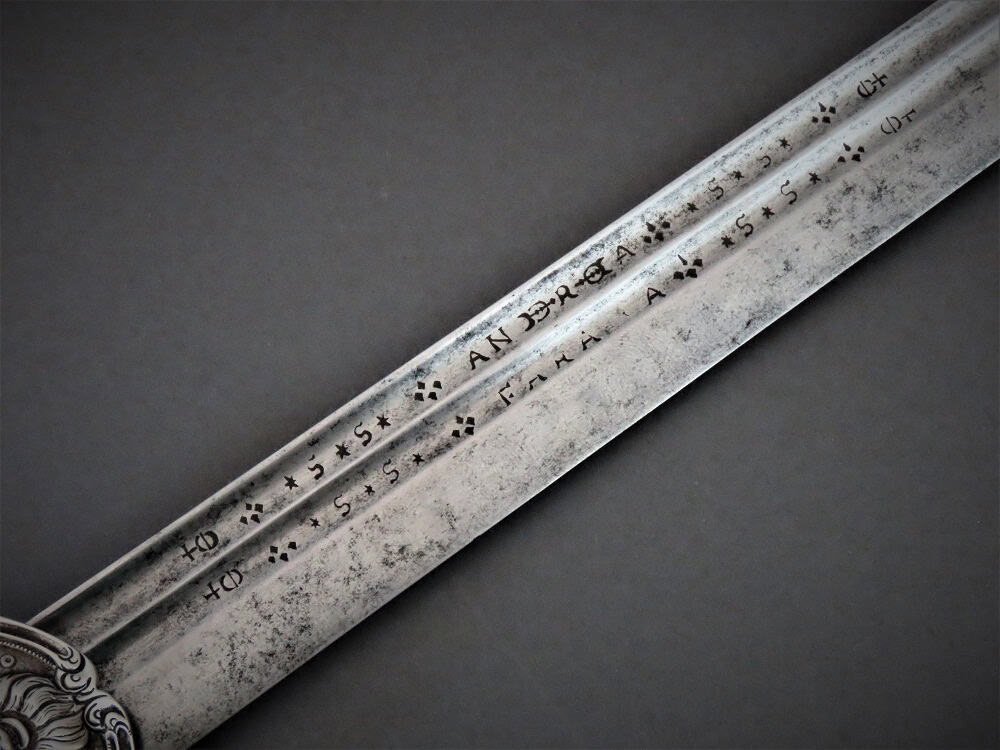
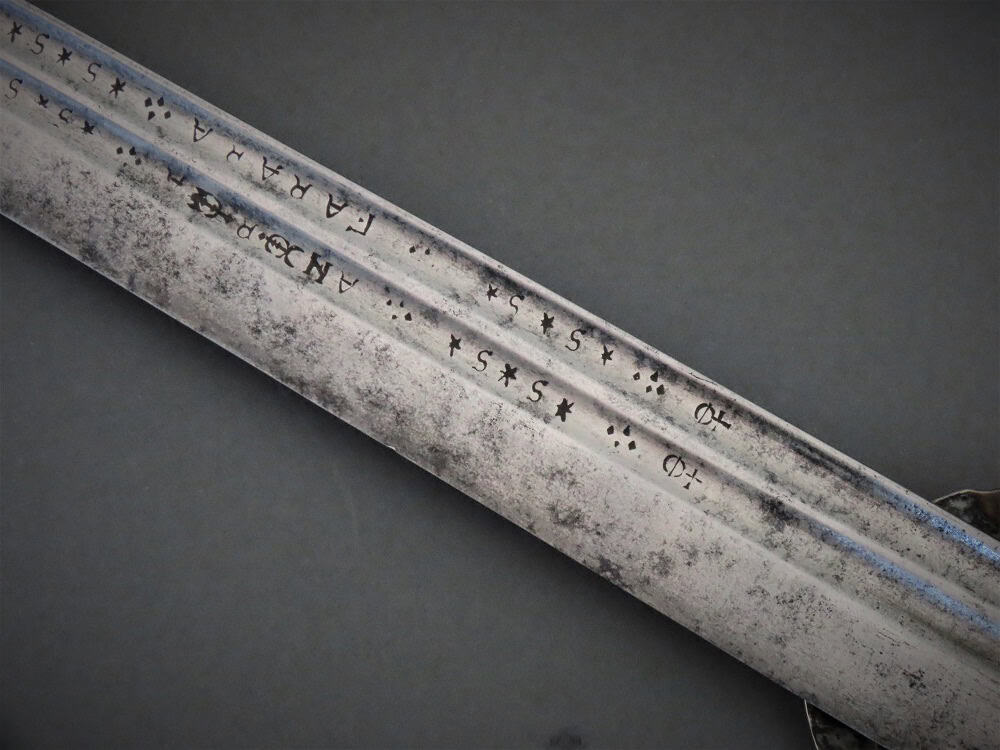
The straight single edged gently tapering blade is 22.25 inches (56.5 cm) long and of the highest quality. It is most likely of Solingen manufacture. It has two pronounced fullers. One extends from the hilt underneath the spine for 17 inches after which the blade becomes double edged to its pointed tip. The second fuller extends from the hilt underneath the first to the tip. On each side the upper fuller is stamped with individual letters which form the name ANDRIA with FARARA in the fuller beneath, each flanked by symmetrical arrangements of quatrefoils of dots, orb and cross marks, stars and the letter “S” repeatedly.
A feature of the lives of London silver hilted sword makers of the 18th century was that talent in working with silver was not necessarily a guarantee of commercial success. To succeed they also needed business acumen. Some silversmiths were very successful and became wealthy men. However, the records show that many talented silversmiths, evidenced by the quality of their surviving works, lived a sparse existence and sometimes ended their lives in penury. Thomas Bass seems to have one such unfortunate case.
Thomas is recorded from 1701 to 1760 as a silver hilt maker and sword cutler. He was indentured to the profession by the cutler Joseph Reason for seven years and sworn “free” of the Cutlers’ Company on 15th April 1708, after which he is recorded as working in Fetter Lane in the City of London where he remained for the next 50 years and registered his first mark. He indentured his one known apprentice, Isaac Stewart, in 1712, and registered his second (Sterling) mark in 1720. On 5th October 1721 the Court of Assistants of the Cutlers’ Company excused Thomas from taking livery due to his “mean” circumstances. A year later he was excused again:
“Thomas Bass being sumon’d did not appear but several Members knowing him to be poor the Court doth think fit to excuse him till he is in better Circumstances”.
It seems that Thomas struggled with poverty all his life and spent his last years in a workhouse to be buried at St Andrew’s Church, Holborn, on 22nd February 1760. The above reference work borrows from Leslie Southwick 2001, p.41. The maker’s mark, which was his second mark, can be seen in Grimwade reference 2685. The total length is 27.75 inches (70.5 cm).