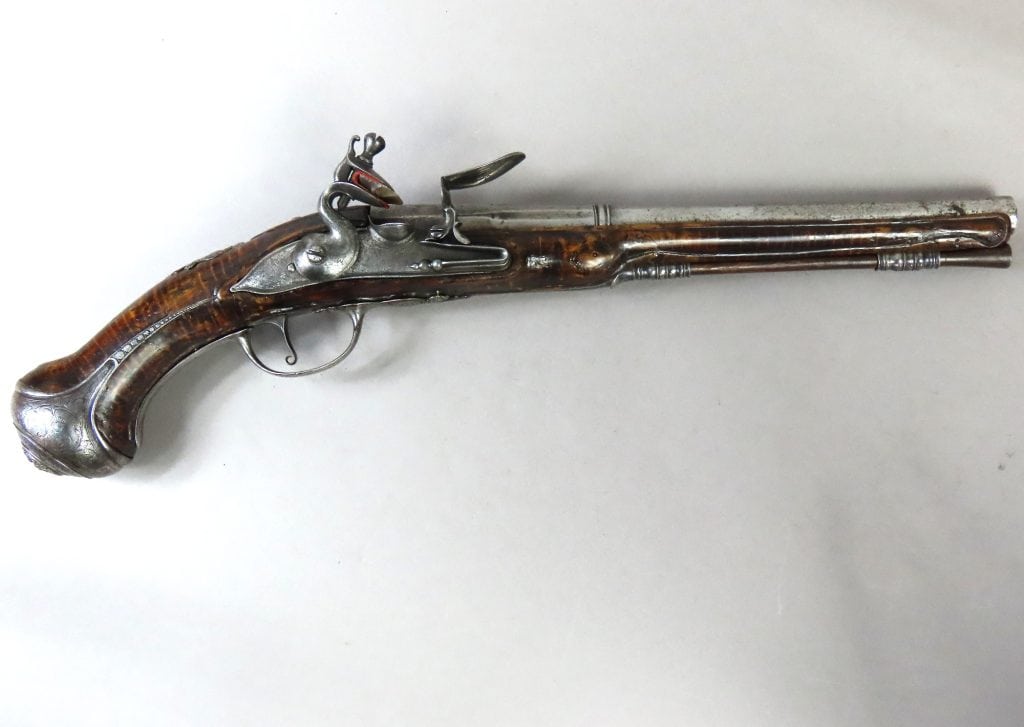
A Scarce and Intriguing Flintlock Holster Pistol by John Cosens of London, Gunmaker to King Charles II, dating to circa 1670 to 1680
To enquire about this itemplease click here
Price: £4,000
Ref: 52092427
Item Description
An attractive fine quality flintlock holster pistol by John Cosens dating to circa 1675. Cosens was one of London’s finest gunmakers and the pistol is an example of the exceptional quality of his work with an important place in the revolution in English gun making which took place in the late 17th century.
In his paper “John Cosens, Gunmaker of London”, published in the 1999 Park Lane Arms Fair catalogue, John Cooper explains how London gun making blossomed after the Restoration in 1660 with the end of the austere years of the Commonwealth. Our pistol is referred to in the paper which outlines the quality of the work of John Cosens and his importance at this time.
At this time the London Gunmakers’ Company was keen to expand its numbers. Cosens, trained in Winchester, was welcomed into the Company as a result of the quality of his work and had an address in London in the Parish of St Clement Danes in 1663 where he stayed for the rest of his life. He employed members of his family and established a thriving gunmaking business in the third quarter of the 17th century despite the ravages of the Plague in 1665 and the “Great Fire” in the following year. Although he spread his wings in taking on ordnance contract work his main interest was in expensive high quality guns for private sale to his increasing base of wealthy clients. As a mark of his success in 1670 Cosens was given the prestigious appointment of “gunmaker in ordinary” to the King. The last record for John Cosens is in his poor rate payments in 1706 when then, or shortly after, it is assumed he died.
Clearly Cosens was a talented gunmaker, as shown by the pistol described here, who rose above stiff competition in the Reformation period to a position of preeminence. Cosens was one of only 19 gunmakers to be granted Royal appointments in the 25 year reign of Charles II. These appointments represented the hiatus of 17th century English gunmaking. He was a colourful character, and an arrogant and conceited individual, which is also evidenced in this pistol. His skills combined with his high profile and reputation allowed him to intentionally flout some of the most important regulations of the Gunmakers’ Company for which gunmakers of lesser standing would have faced severe penalties. These were hardly acts of gratitude given that his success in London was mainly due to the welcome the Company had given to him on his arrival. It seems he would ignore the well-honed regulations to suit the requirements of his customers.
These infringements included most notably the use of unproved barrels of which the barrel on our pistol is an example and forms a direct link with the character of the man. The Company blustered about these offences and confiscated his guns in raids on numerous occasions and although “guilt” was proven no firm action was ever taken despite various orders for compliance and fines being made – even from the King himself. Cosens also altered the dimensions of barrels after proving which invalidated the proof test and explains the variability in surviving barrel lengths and thicknesses for his pistols when more uniformity was being sought elsewhere in the trade. Cosens was also responsible for other breaches including “imploying Straingers” – men who were not sworn members of the Company. In order to “rein in” their recalcitrant member the Company tried on numerous occasions to promote him to positions of responsibility within its ranks in the hope that this would initiate a sense of discipline – but this failed.
Pistols made by Cosens, like the pistol described here, achieve an unusually high standard of design and workmanship including the engraving and chiselling of the steel mounts. Like most surviving guns by Cosens ours is a holster pistol with a markedly graceful profile.
It has a three-stage 18 bore barrel with an octagonal section breech, becoming 16 sided then round with baluster mouldings. The forward round section tapers gradually towards the muzzle which is slightly swamped showing that it retains its full length as mounted by Cosens. The barrel is engraved with symmetrical foliage at the rear and signed by the barrel maker ‘SHARPE’ along the top flat. The border engraved tang is finely decorated with scrolling foliage.
The furniture is all of steel. The rounded lock plate has a pronounced downward curve at the rear, a slender engraved raised border and a nipple shaped tail. It is decorated with strawberry foliage containing a bird on the tail and is signed in capitals I.COSENS. The signature style matches another Cosens signature illustrated in John Cooper’s paper which is a drawing taken from another pistol and shown below in our photographs. Some auction houses in the past have mistaken the widened double struck stems on the letters “I”, “E” and “N” to be evidence of “refreshment” which seems not to be the case.
The steel is engraved in a similar foliate style. The exquisite side-plate is pierced and chiselled with a grotesque “Green Man” mask in scrolling foliage. The contoured escutcheon is engraved with a worn device and around the edge is pierced and chiselled with a foliate border and another “Green Man” mask above. The bulbous butt cap has long tapering spurs which follow the contours of the stock and is finely decorated with a grotesque mask in the middle surrounded by a band of acanthus. On each side at the base of the spurs the space is decorated with engraved strawberry foliage centred with a winged grotesque. The trigger guard is chiselled with a foliate finial and engraved with strawberry foliage on the bow. The trigger is of early scroll style and the hardwood ramrod is iron capped contained in two ribbed ramrod pipes. The figured full stock is carved with an apron around the barrel tang, and outline carving around the sideplate, lockplate and along each side of the ramrod groove.
The barrel is just over 12 inches long (30.8 cm) and the overall length is 19 inches (just over 48 cm). The pistol is in good attractive condition for its age with crisp working parts. There is a repair to the stock at the fore end tip and to a small section between the trigger guard and the underside of the lockplate, both visible in the photos.
Note: There are various spellings of Cosens in the records including Cosens, Cosins, Cozens and Cussens. “Cosens” is used in this description and replaces other spellings of the name where they occur in the references.
References:
The butt cap, escutcheon and side plate of our pistol are illustrated in the paper referred to above by John Cooper, ‘John Cosens, Gunmaker of London’, The Sixteenth Park Lane Arms Fair supplement, February 1999, pp. 39-40, figs. 12-15
The butt cap is also featured in a paper by Professor David S. Weaver and Brian Godwin, ‘A Transformation in English Gunmaking 1670-1770’, London Park Lane Arms Fair Guide, Spring 2010, p. 72, fig. 6(A)


