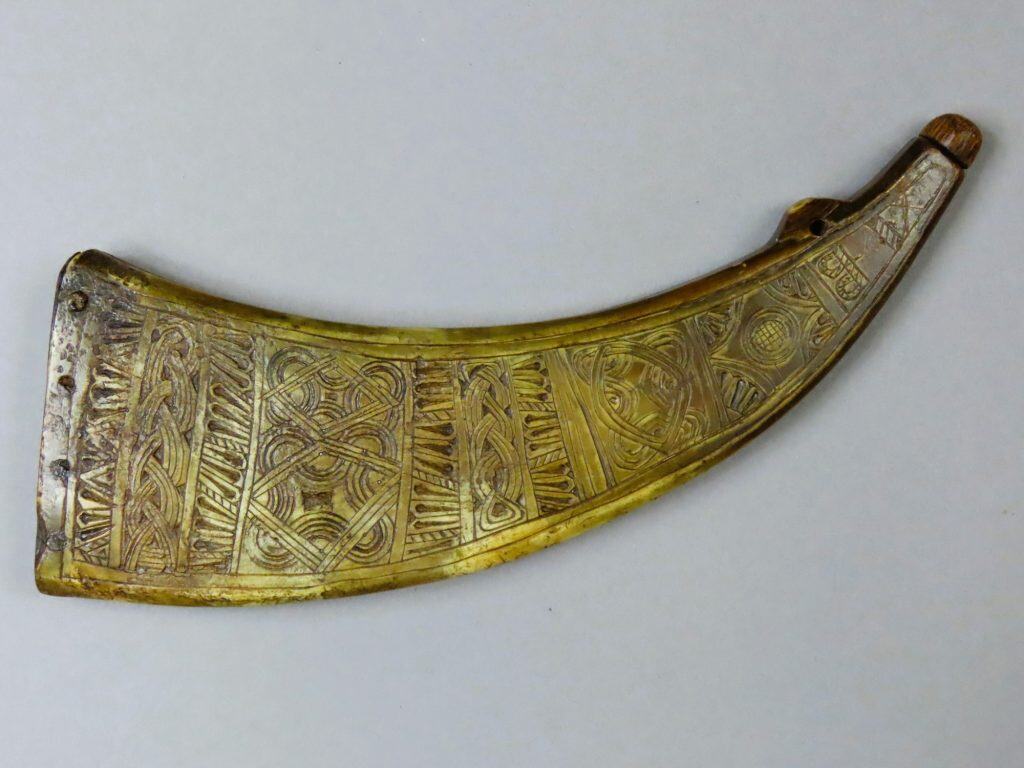
A Late 17th Century Engraved Highland Scottish Powder Horn
To enquire about this itemplease click here
Price: £2,500
Ref: 52082114
Item Description
A well-formed and nicely engraved late 17th century Highland Scottish powder horn. Horns like this were made by traditional craftsmen settled in the Highlands, and around the fringes, near markets and on established drove roads, in a period when firearms were gaining popularity and becoming more available. Some horns carry dates which indicate that the peak period of the best quality manufacture was from the 1660s to circa 1700. The engraved patterns present on horns of this type are like other Celtic / Gaelic cultural motifs which appear on contemporary targes, dirk handles, sporrans and plaid brooches associated with Gaelic Highland craft and art of the time. The prohibitions and persecutions carried out against the Highland clans after the failure of the 1745/6 Jacobite Rising all but erased traditional Highland craft. A horn like this is a rare reminder of that culture.
The flask is fashioned from the pointed end of a cow horn which has been heat-softened, pressed into shape then allowed to re-harden into a flattened curved shape with faceted sides. The base plug is made of wood which is pegged into place. A raised moulded rib near the nozzle is pierced for a suspension loop. Originally a second suspension loop was attached to the base plug on the concave side which is now missing.
The primary side is profusely decorated with panels of typical Celtic / Gaelic fans and interlace within lined borders. Near the nozzle the owner’s initials “I B” are incised. Typically, the reverse side is more sparsely decorated with four saltires in panels which emulate the Scottish flag and which was also the banner / standard for a number of Highland clans at the time. The nozzle retains its mushroom shaped wooden plug.
For further examples of Highland powder horns see “The Swords and the Sorrows”, National Trust for Scotland, 1996, pages 73 to 75, and the accompanying article by Jackie Mann.
Overall the horn is in good condition compared to its surviving contemporaries. The overall length, measured from extremity to extremity, is 10.75 inches (27,25 cm). The base is 3.5 inches across (9 cm) wide.
Provenance: The John Kirk Collection


