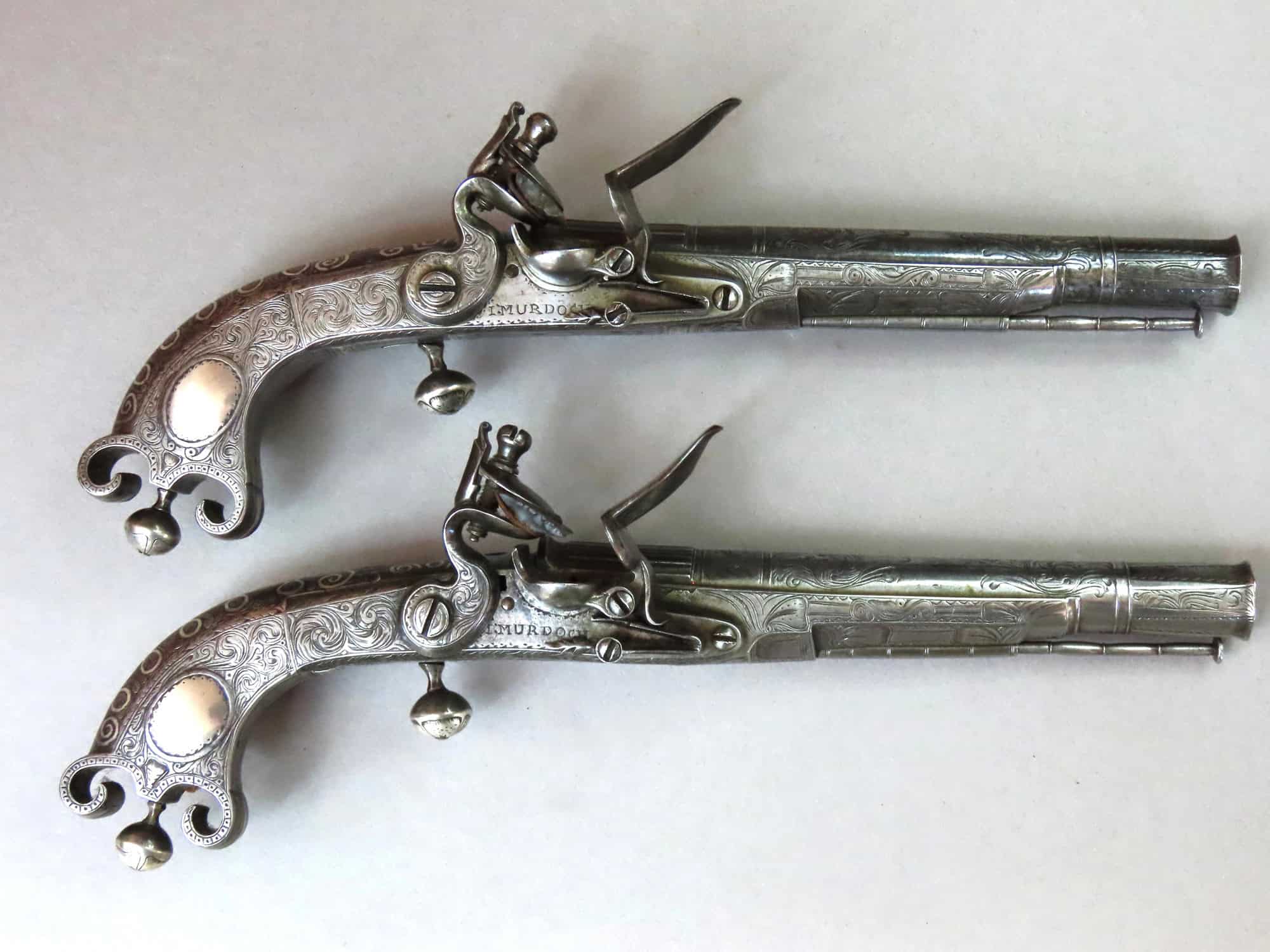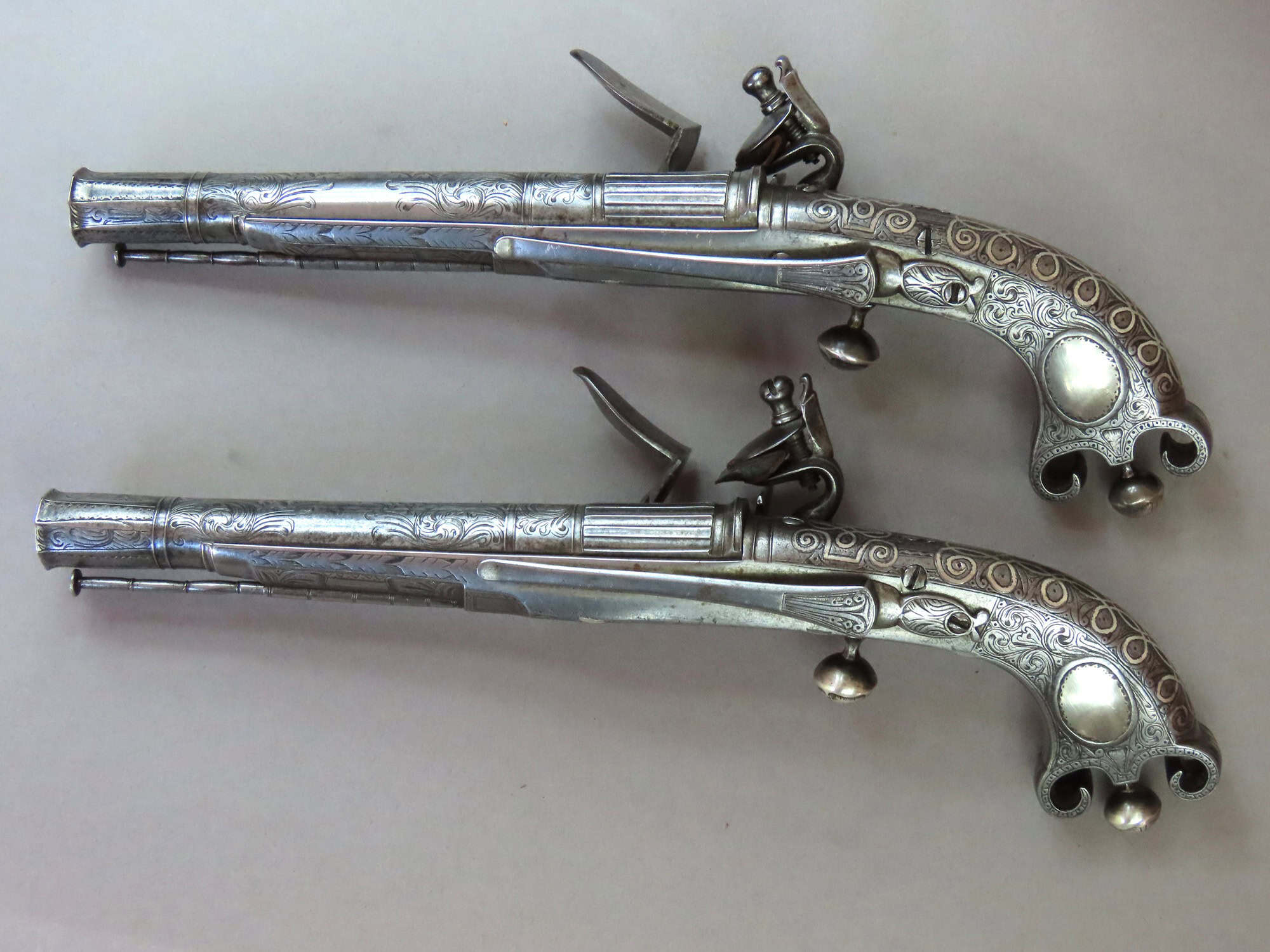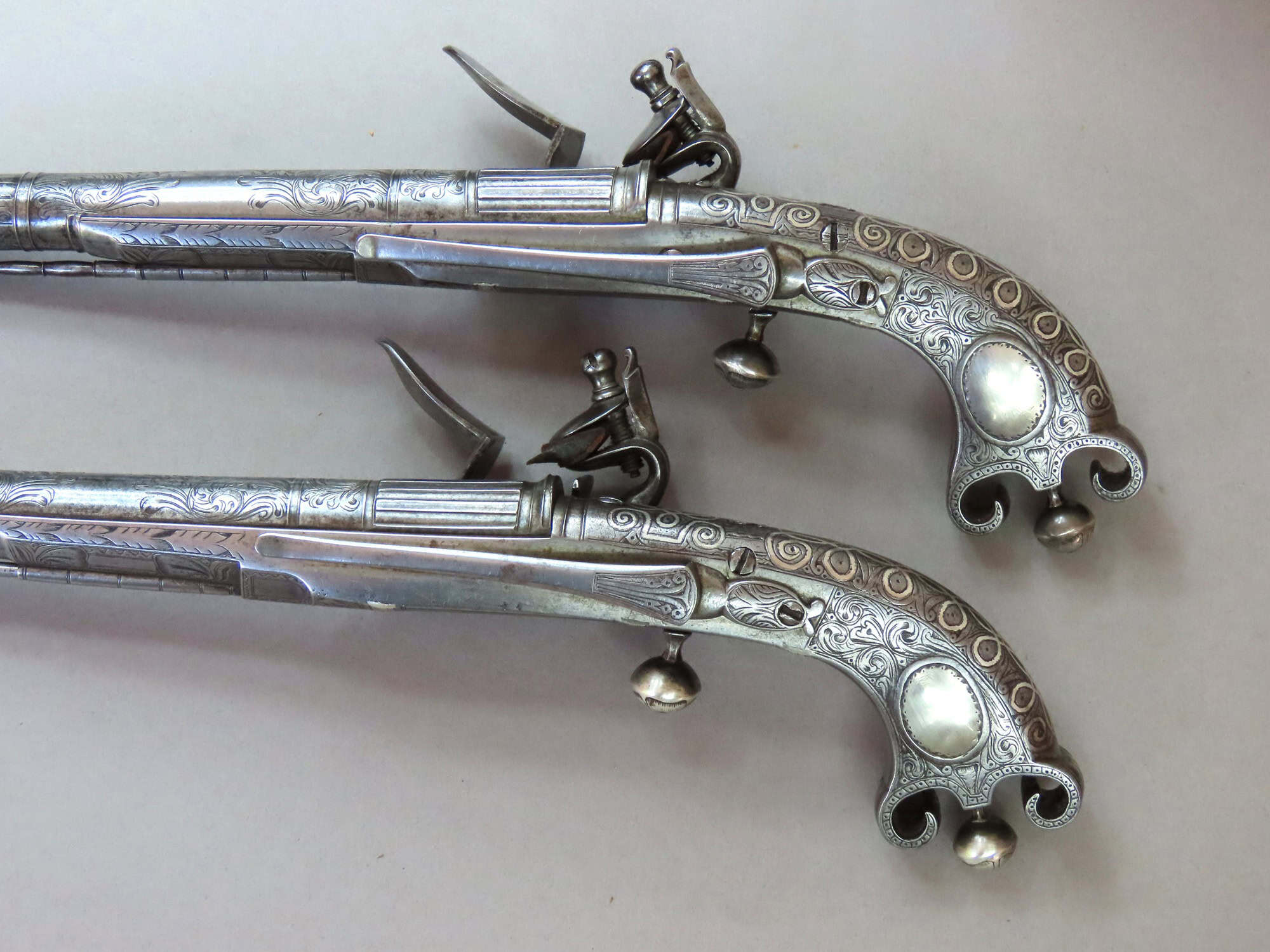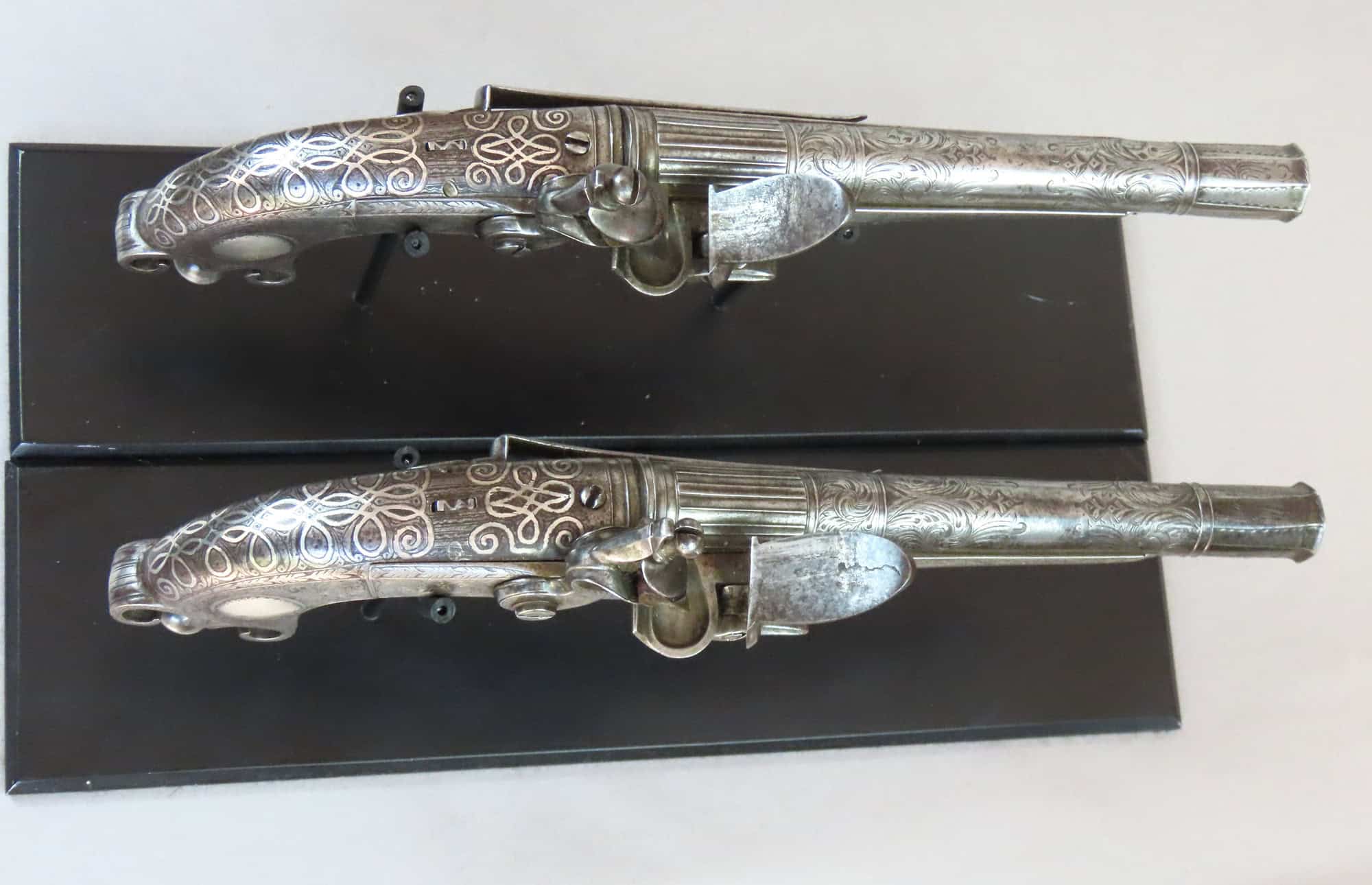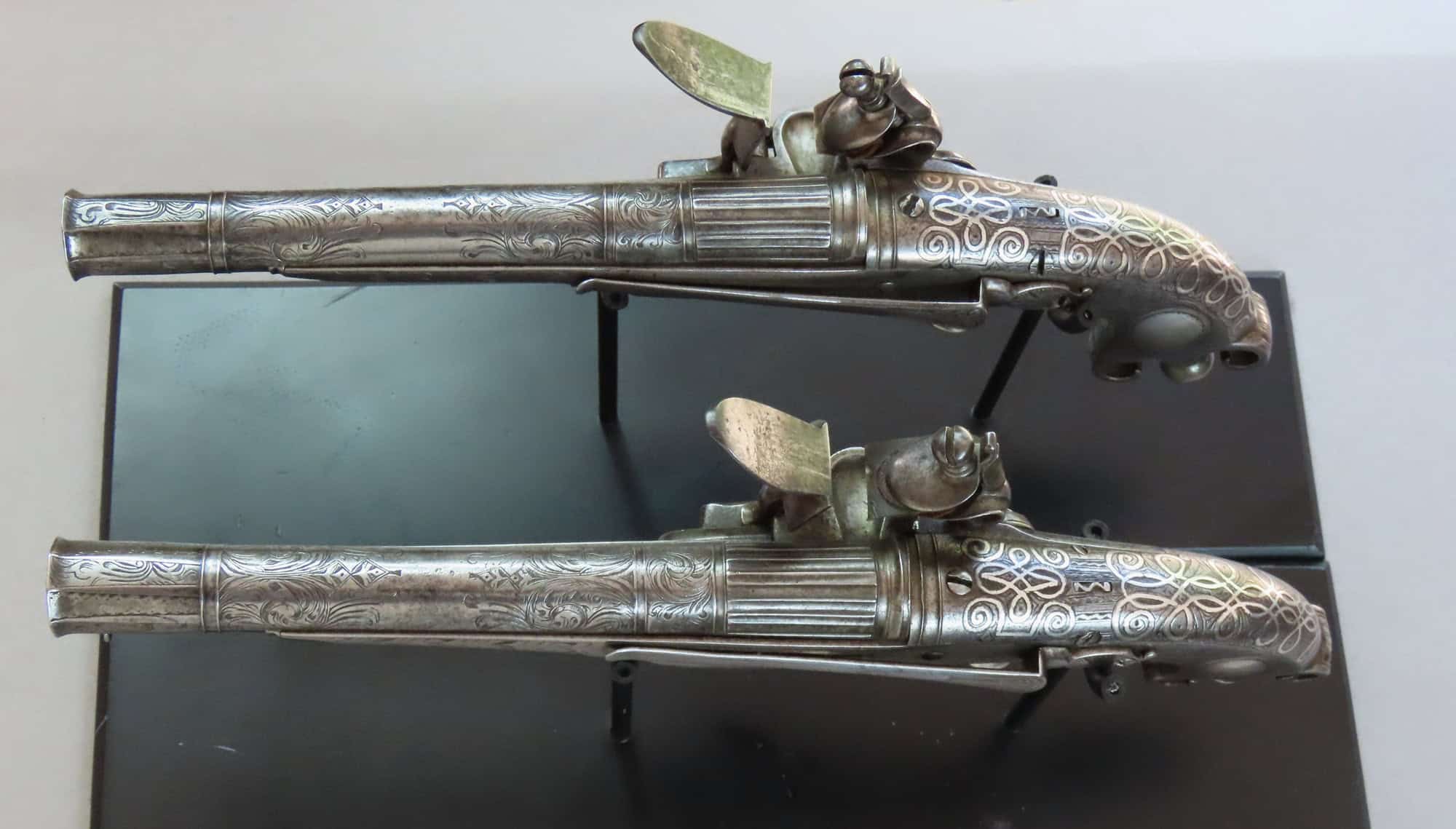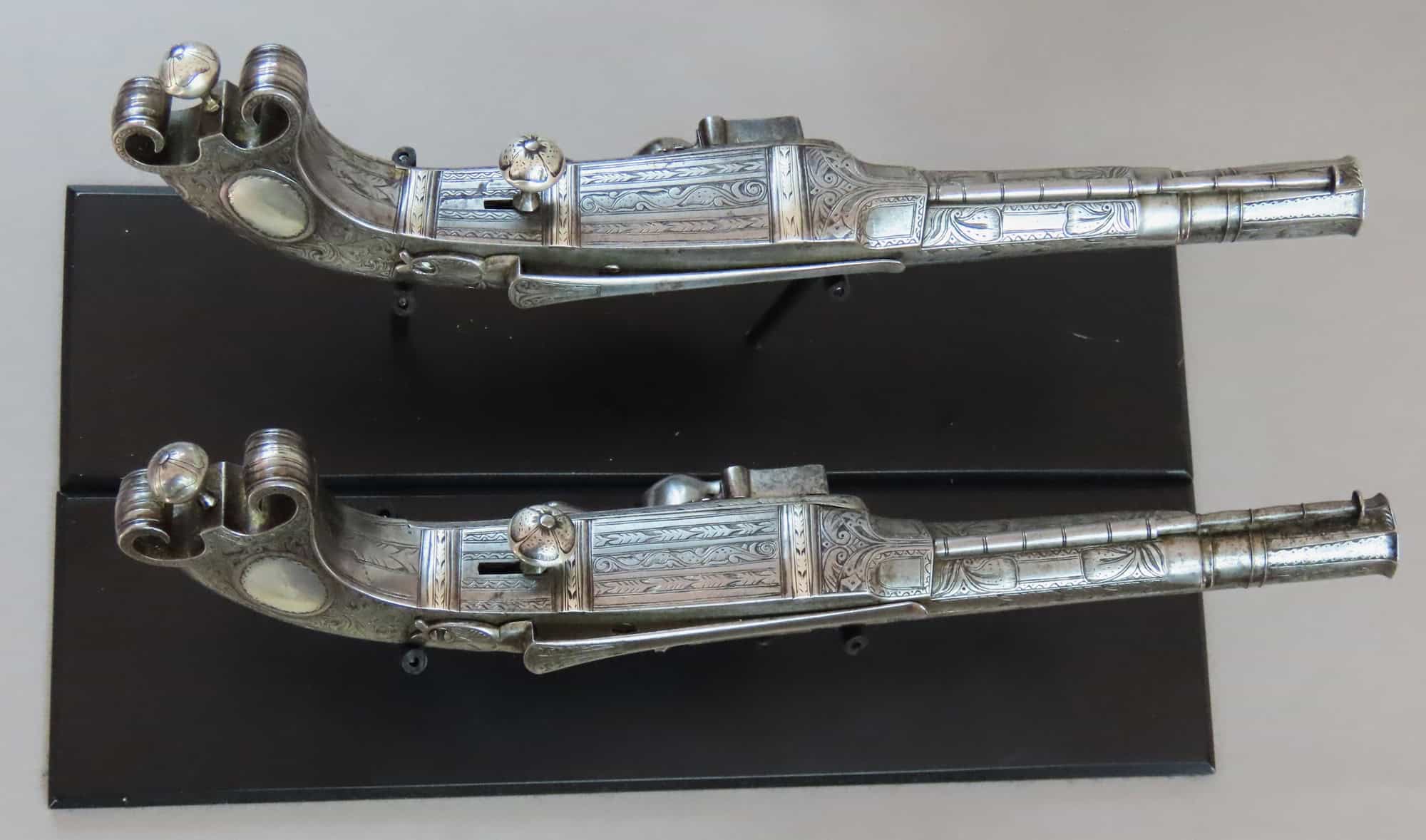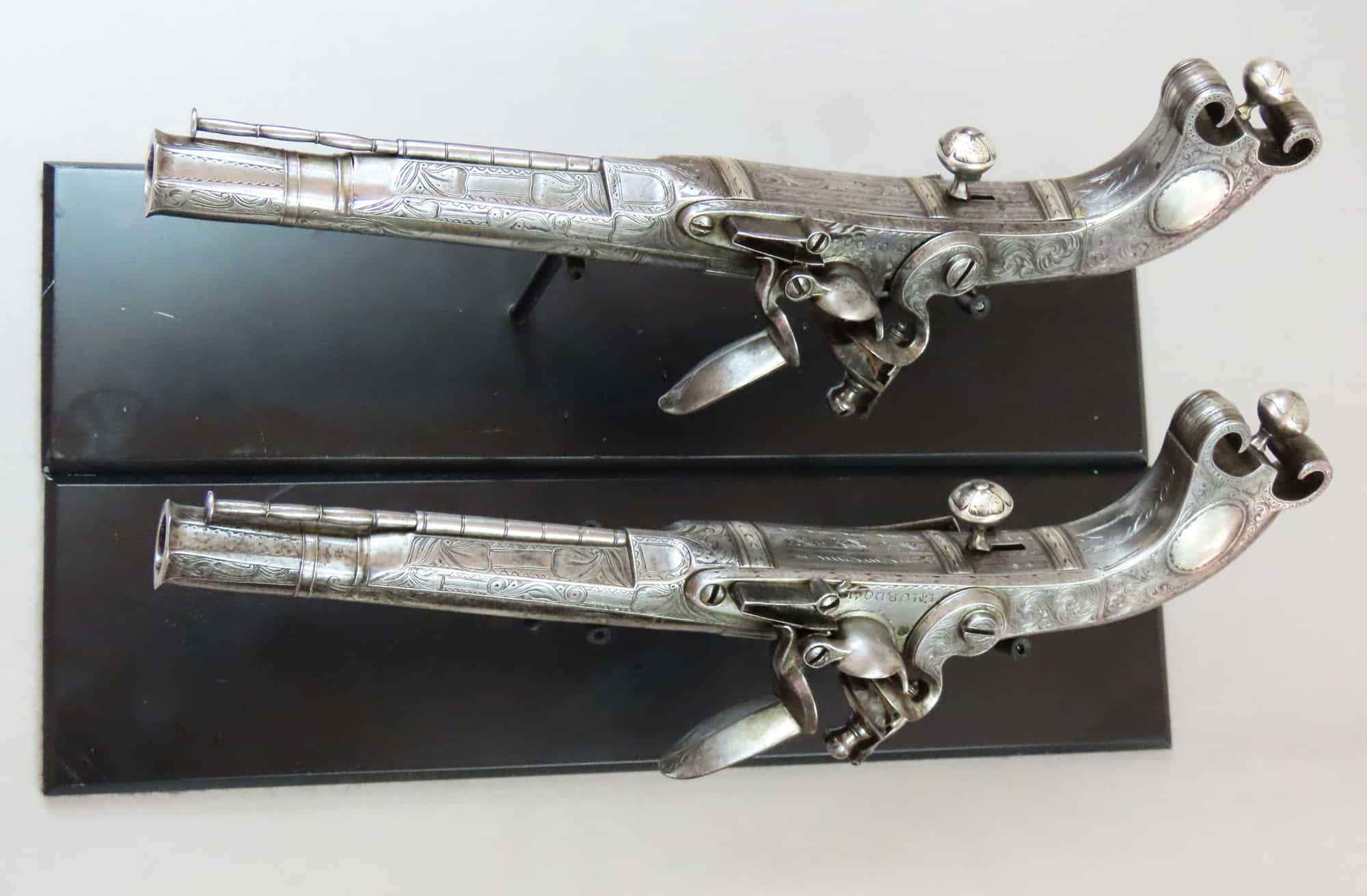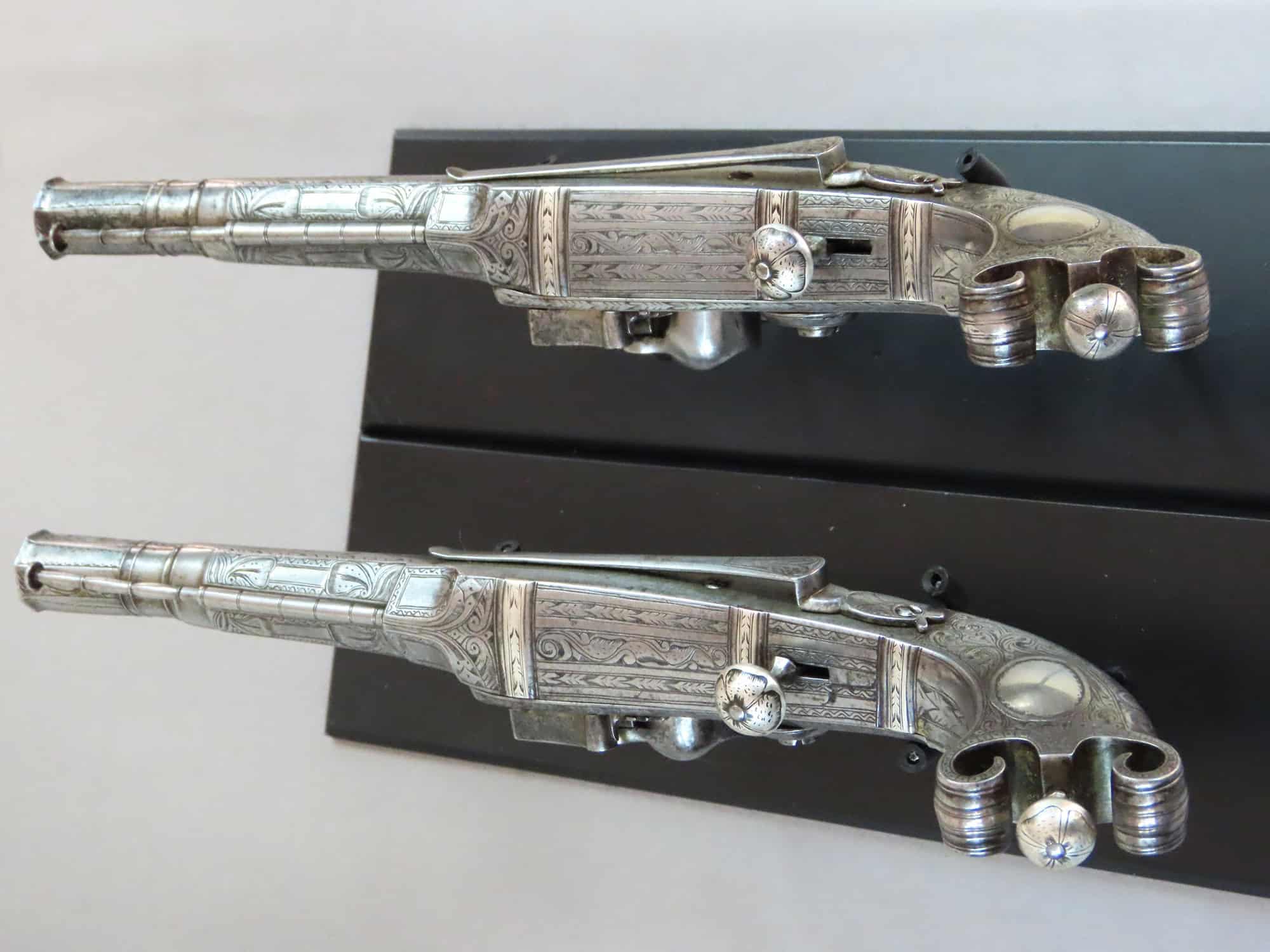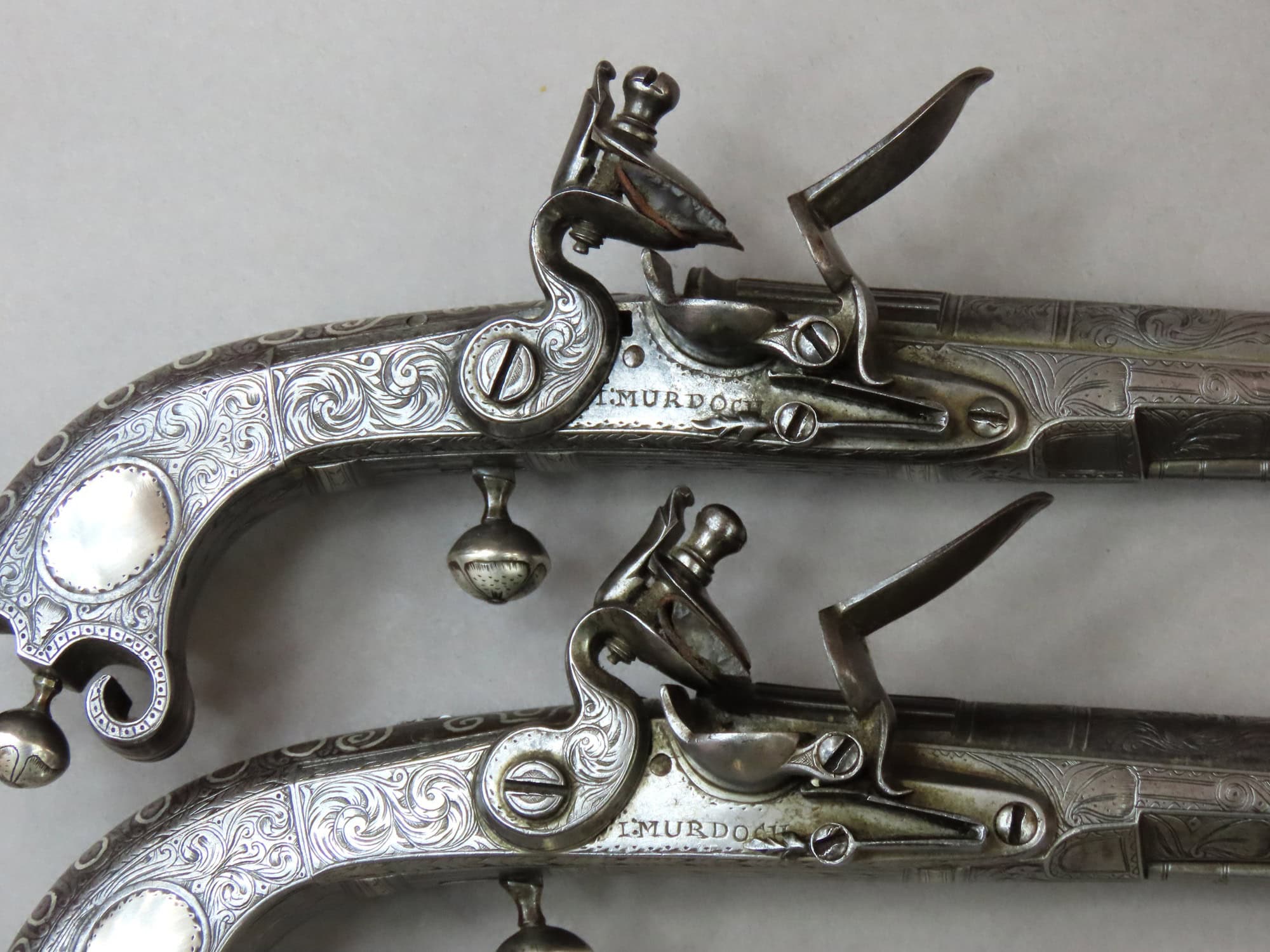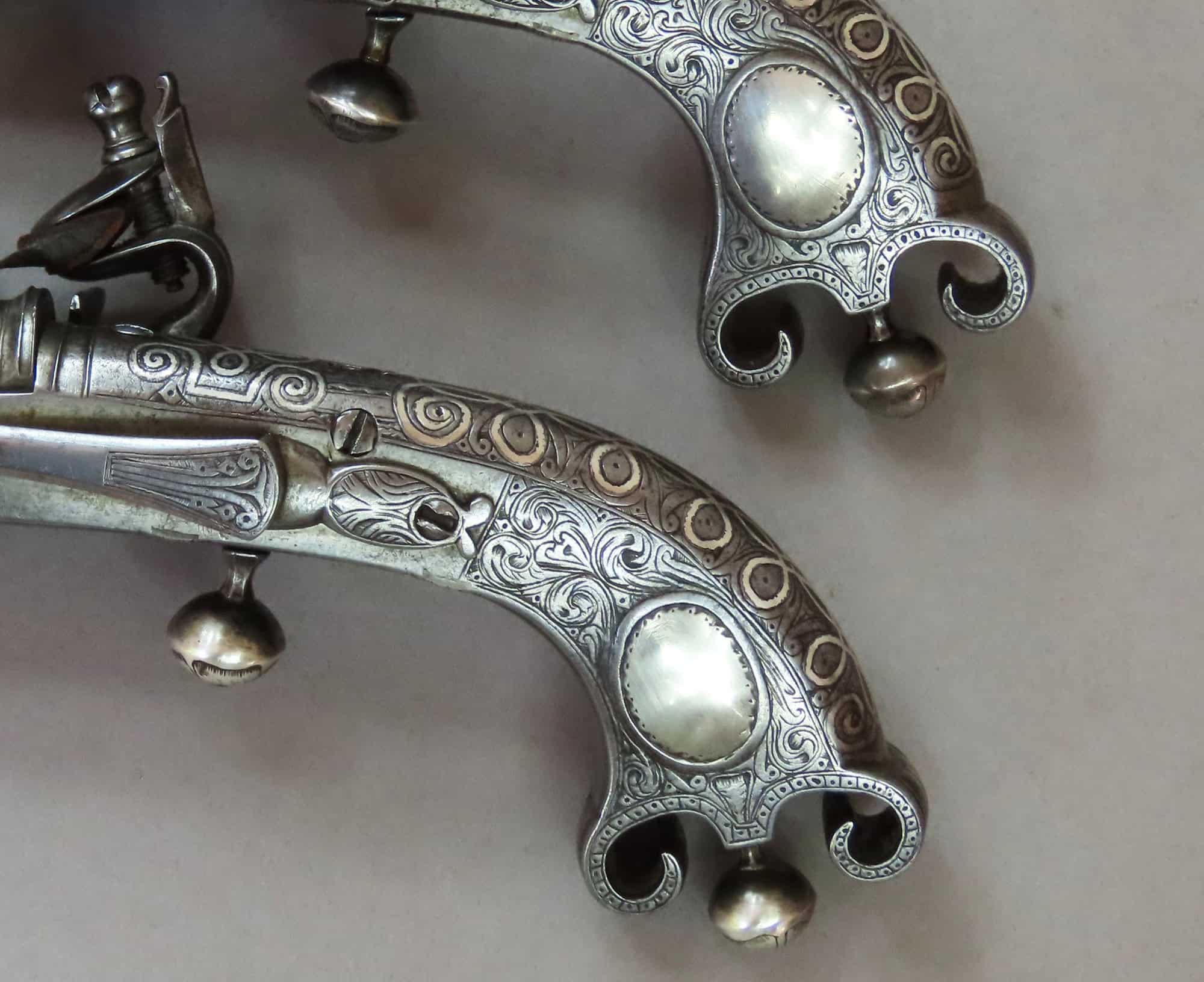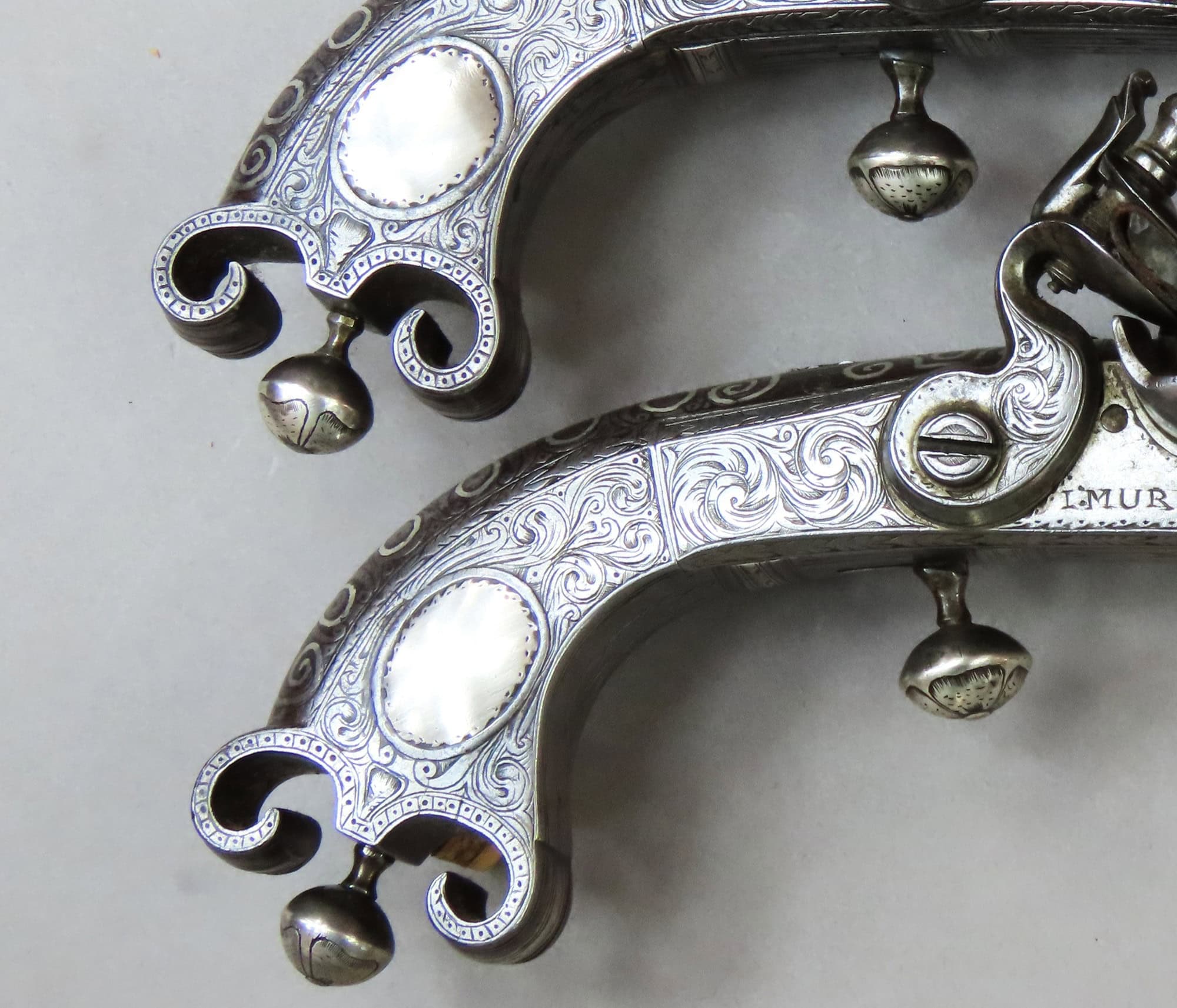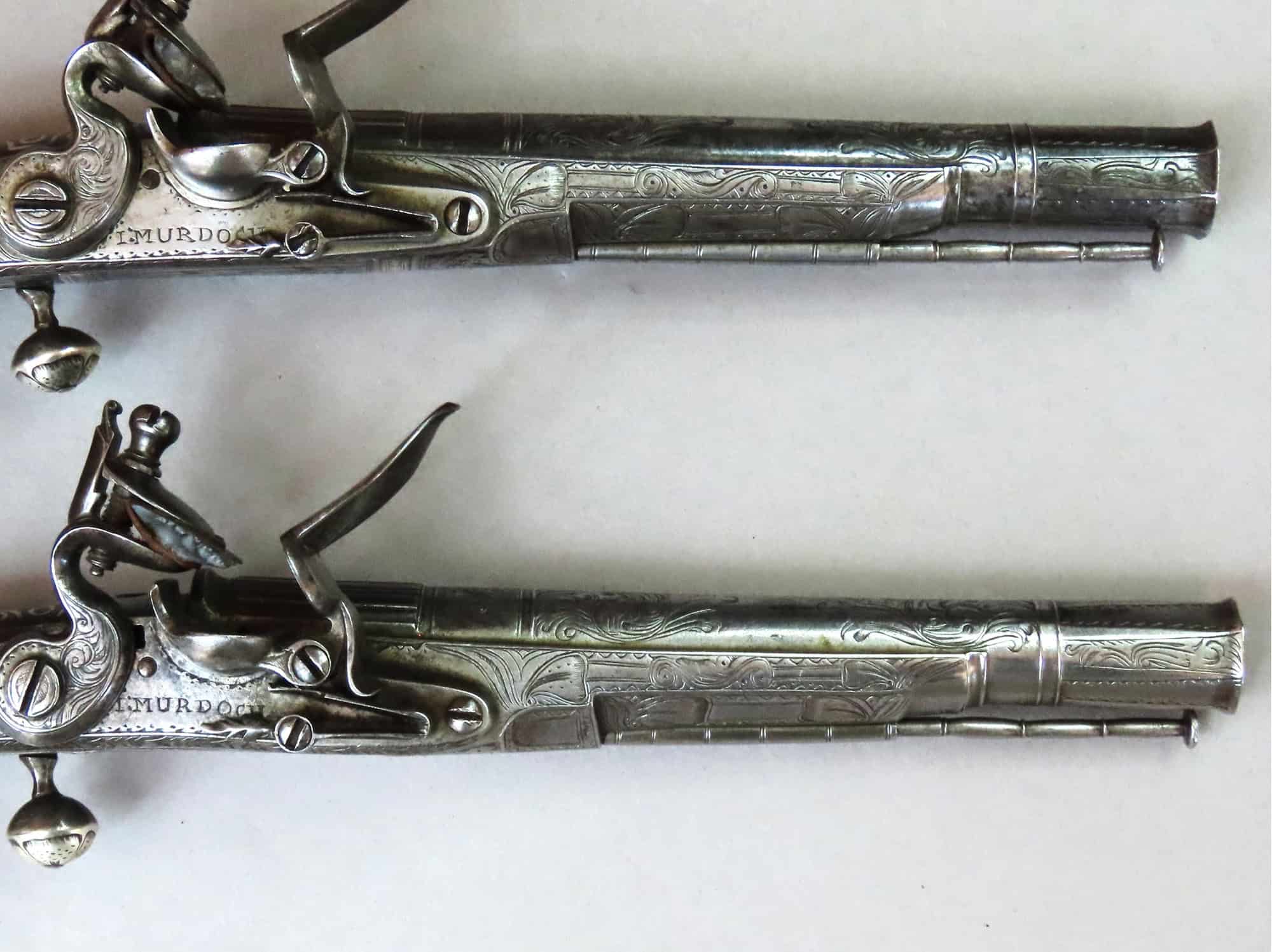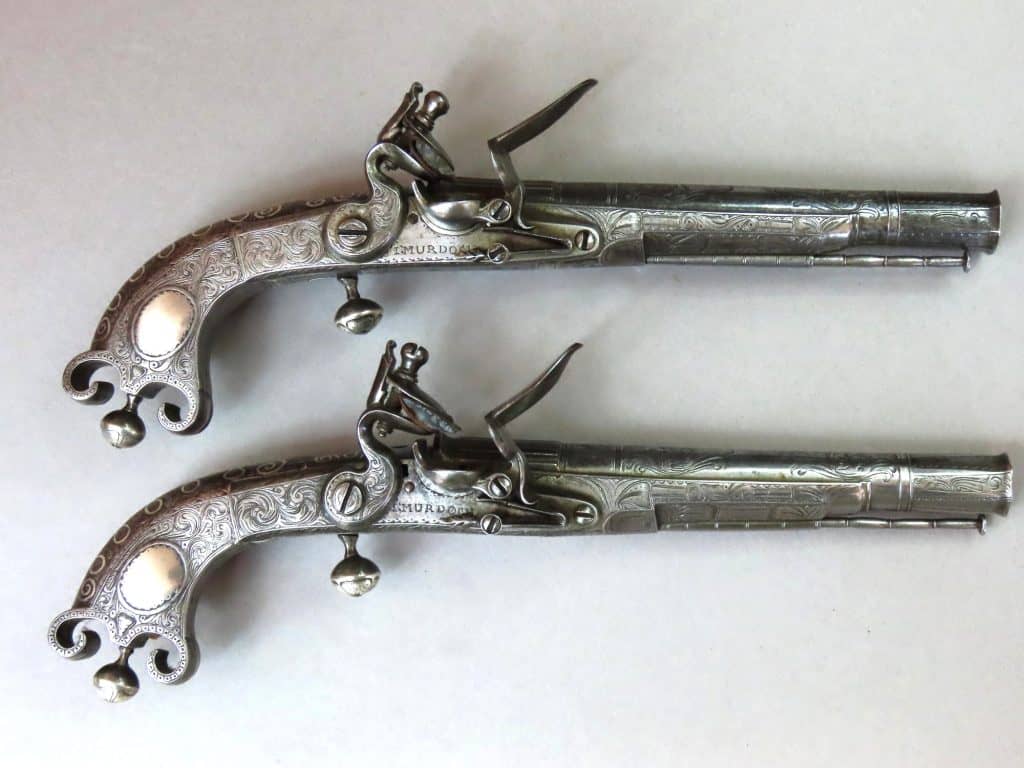
READY A fine pair of Scottish Scroll Butt Pistols by John Murdoch of Doune dating to the third quarter of the 18th century.
To enquire about this itemplease click here
Price: £29,500
Ref: 62080719
Item Description
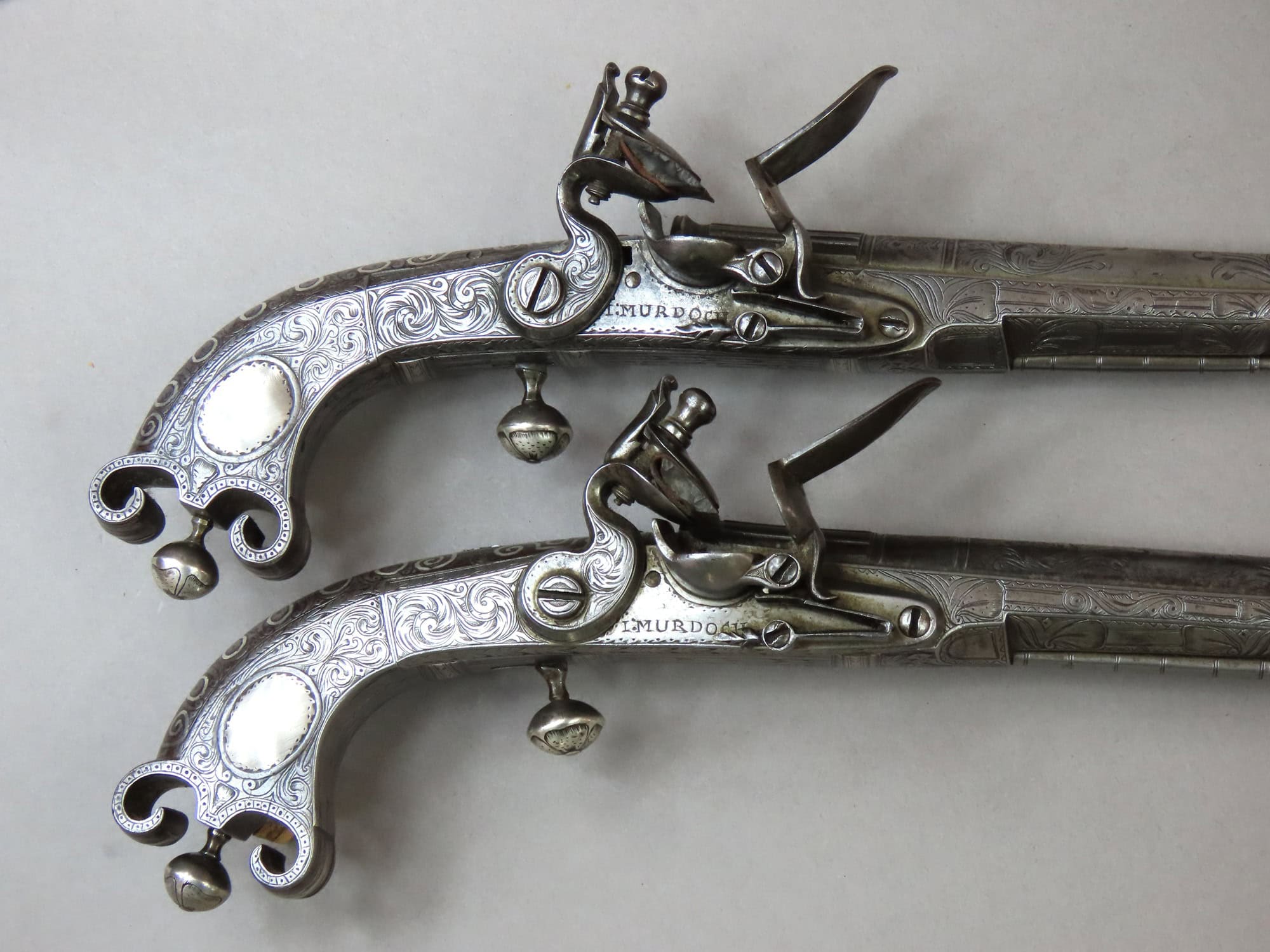
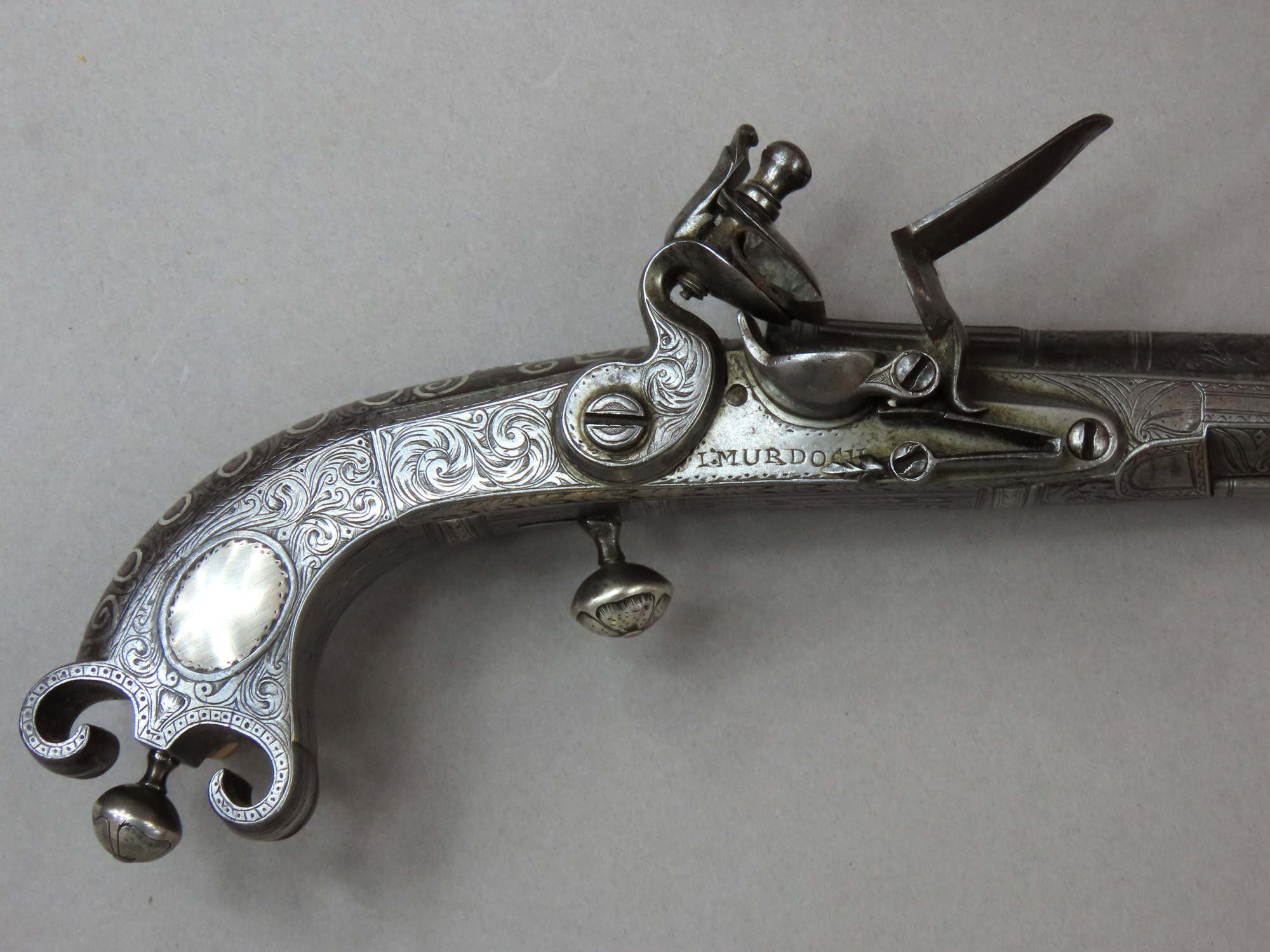
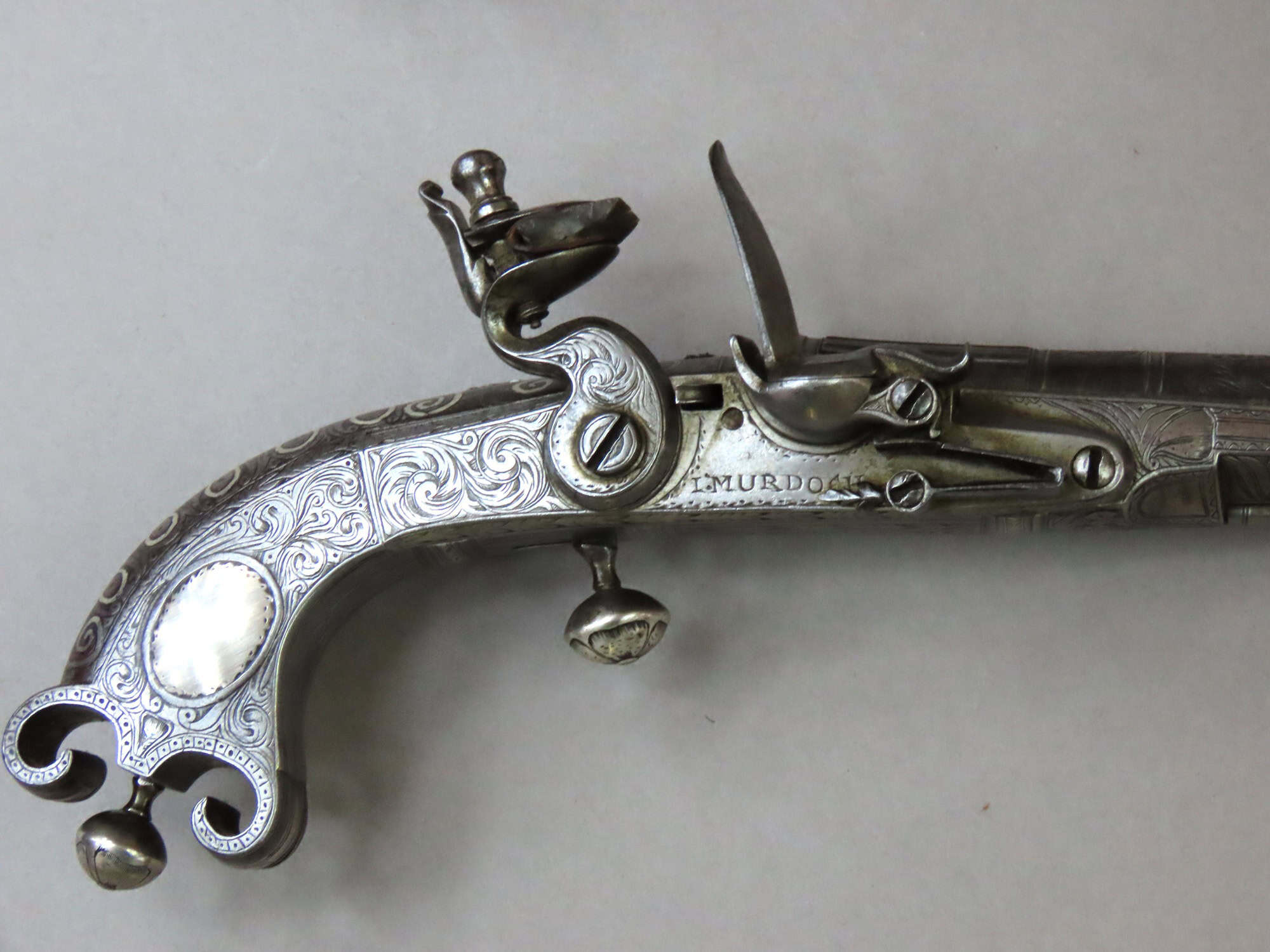
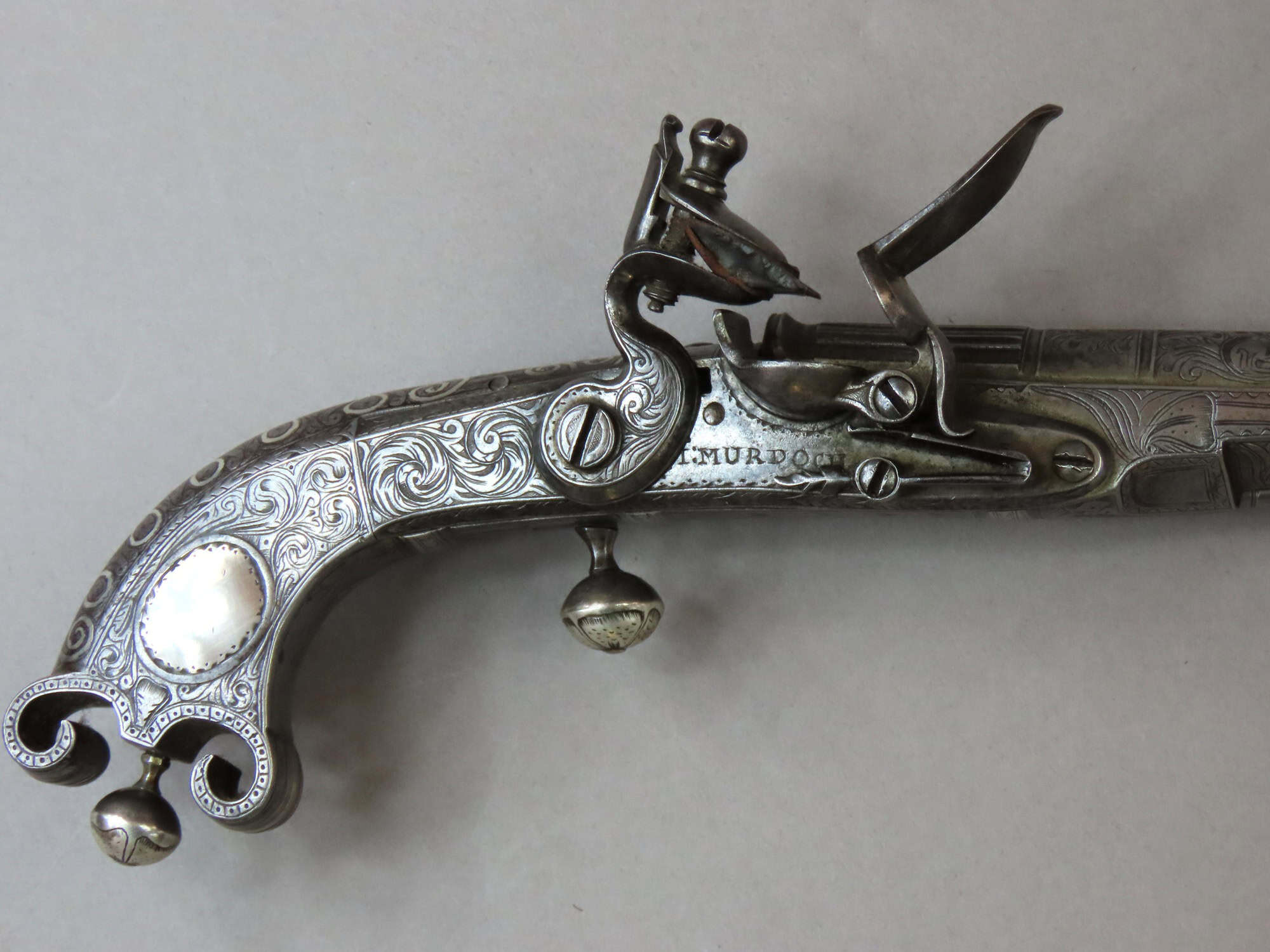
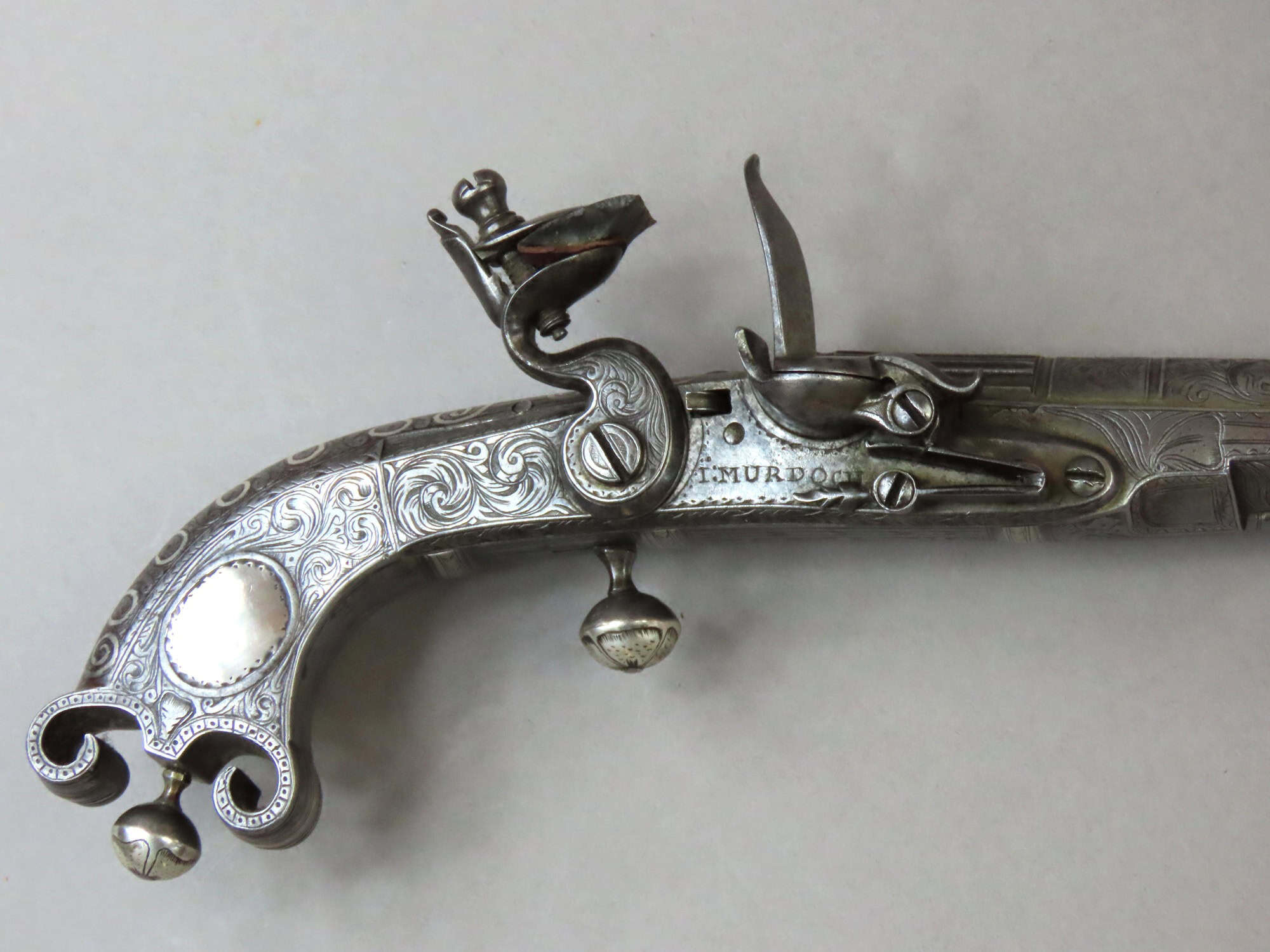
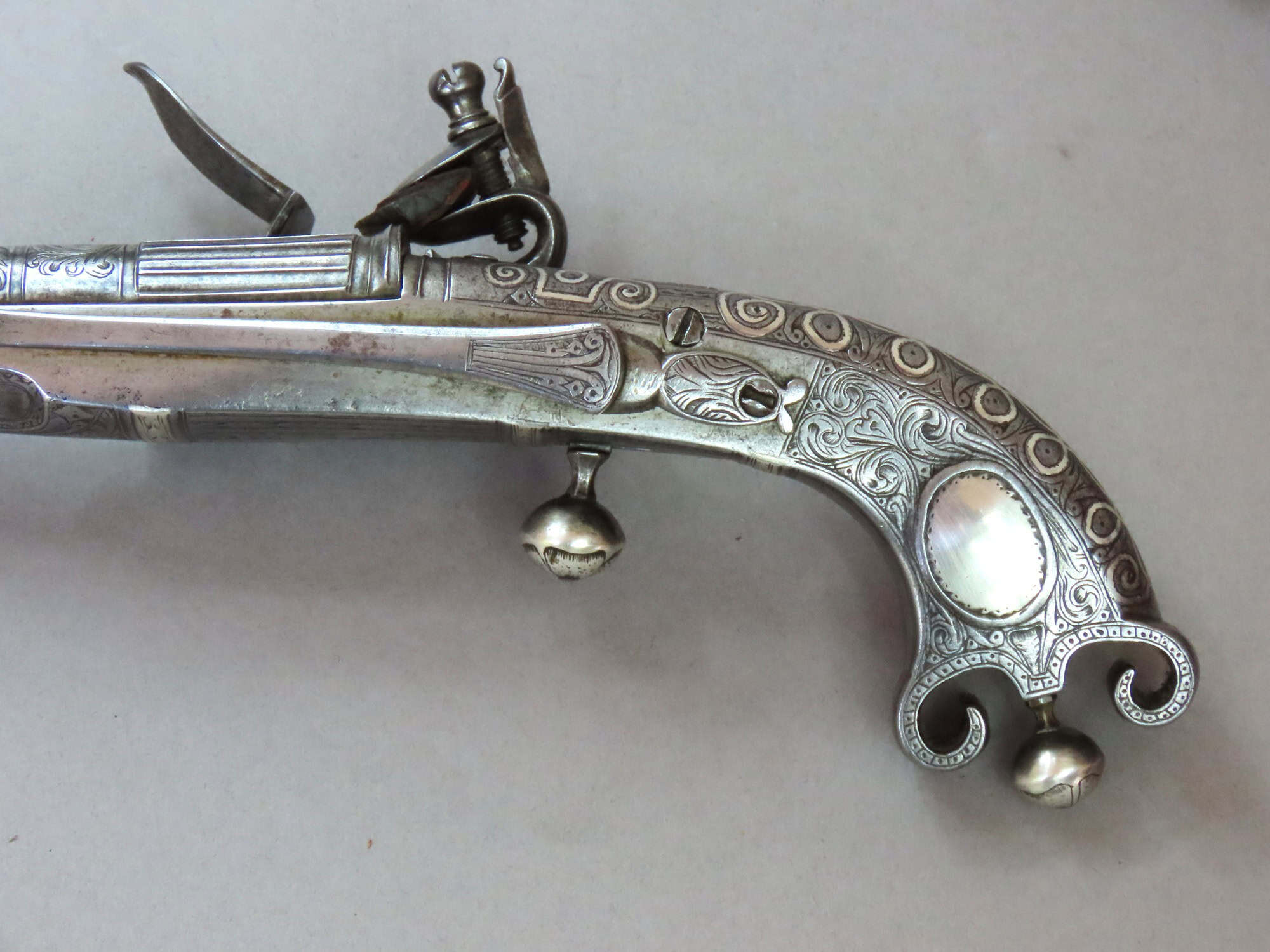
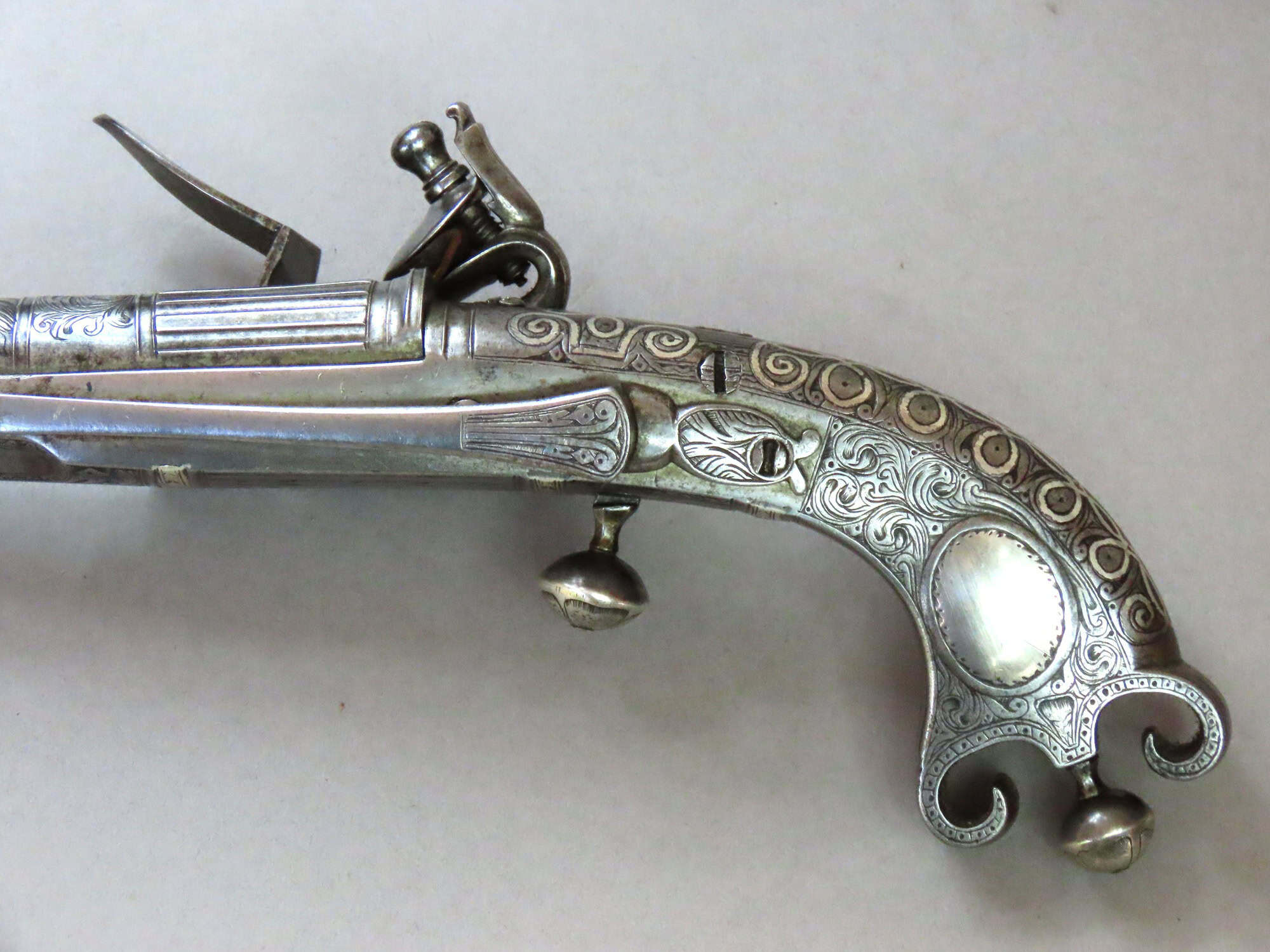
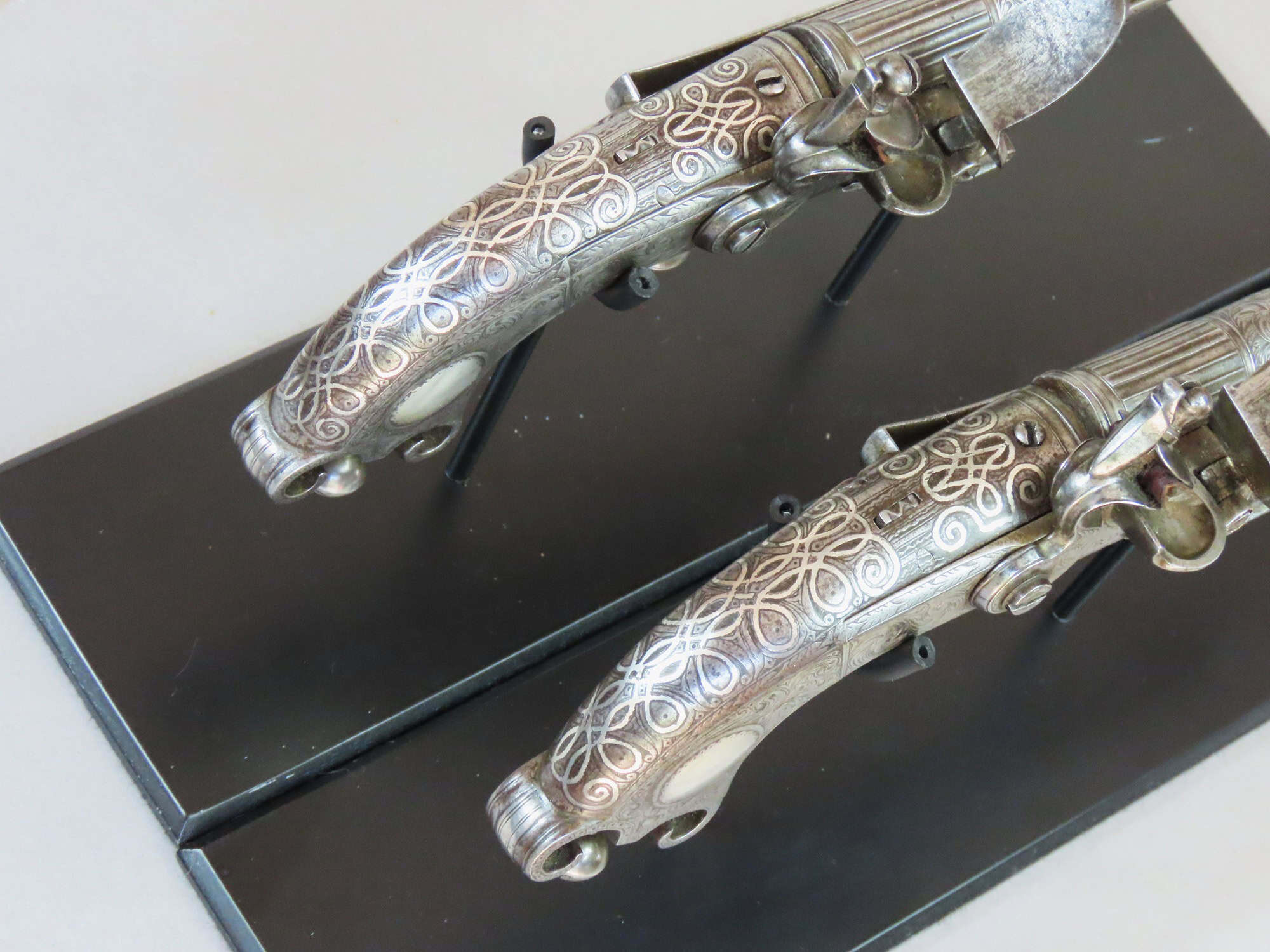
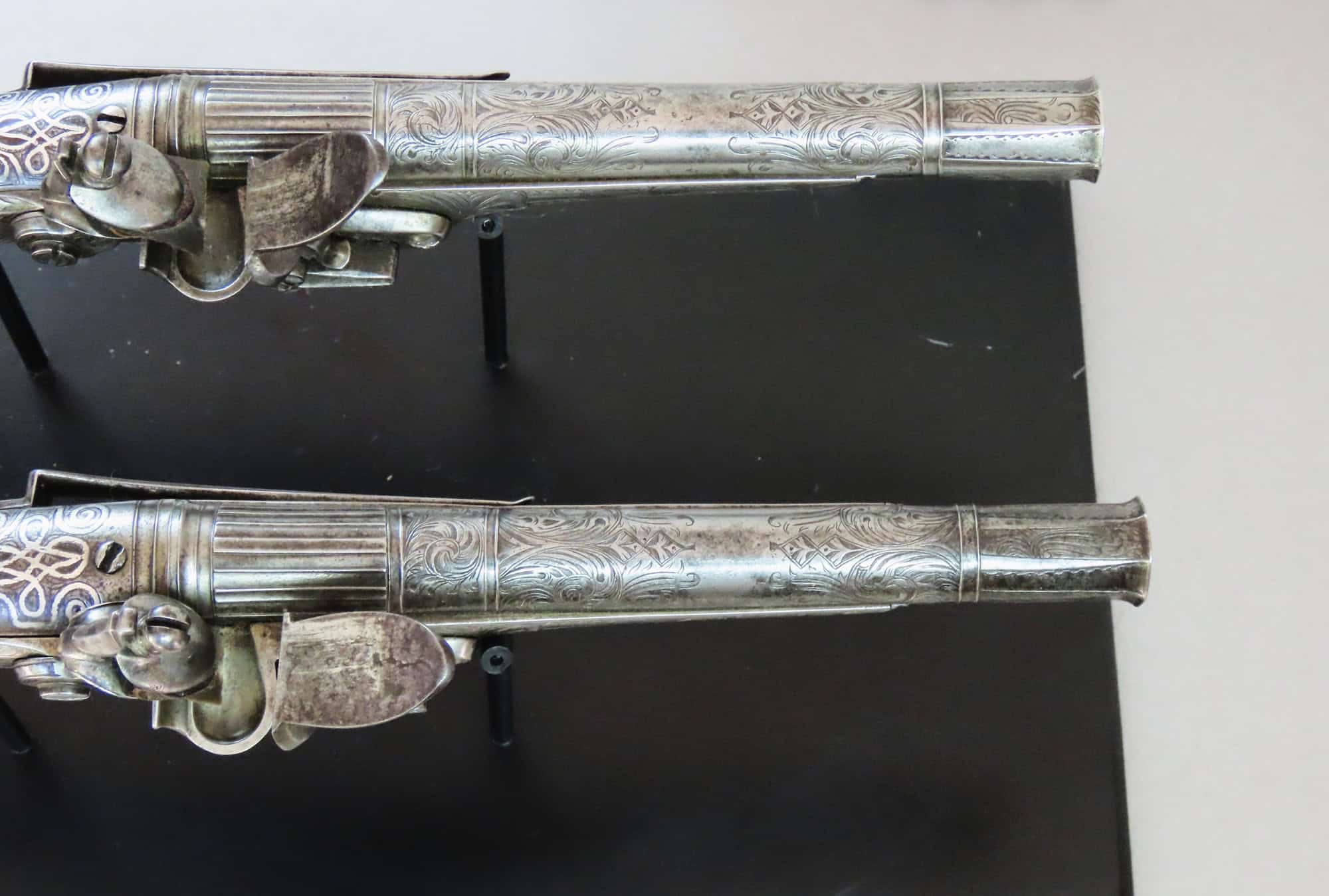
The all-steel construction of this fine pair of pistols is typical of the high standard of workmanship of the Doune pistol makers and of the “Doune style”. The distinctive Celtic engraved decoration enhanced with silver inlay is prominent on the locks, stocks, fore ends, barrels and undersides of the pistols.
As evidenced by surviving portraits of the time, Scroll Butt pistols made in Doune were popular with officers serving in Scottish Highland regiments. Some made by John Murdoch are known to have been carried by British officers in North America during the American Revolutionary War period (1775 to 1783) as evidenced by the Pitcairn pistols and those carried by Lord Percy. Prior to this such pistols were carried by some Scottish officers serving in the Seven Years War (1756 to 1763) in Europe and North America where it was known as the French and Indian War.
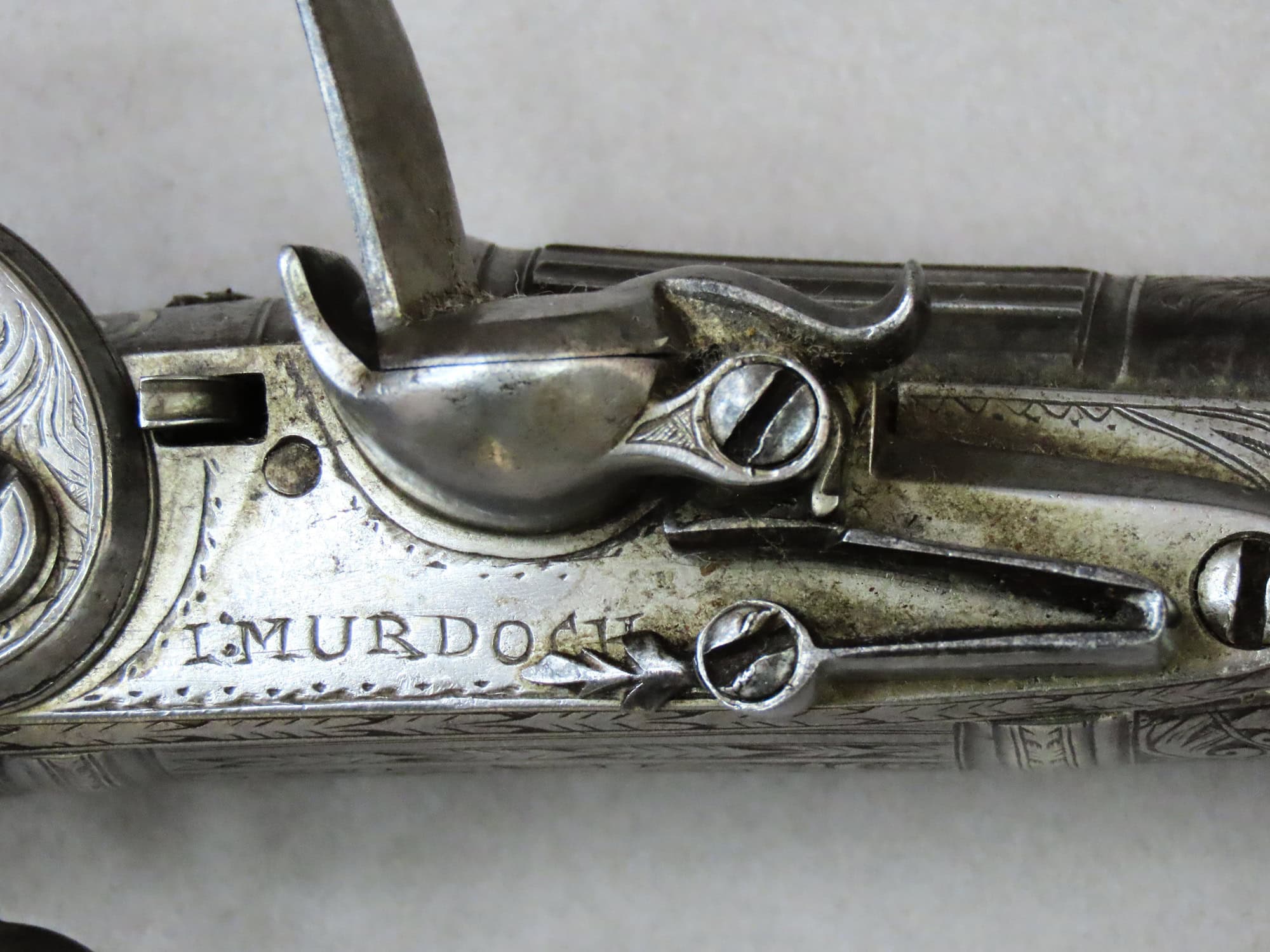
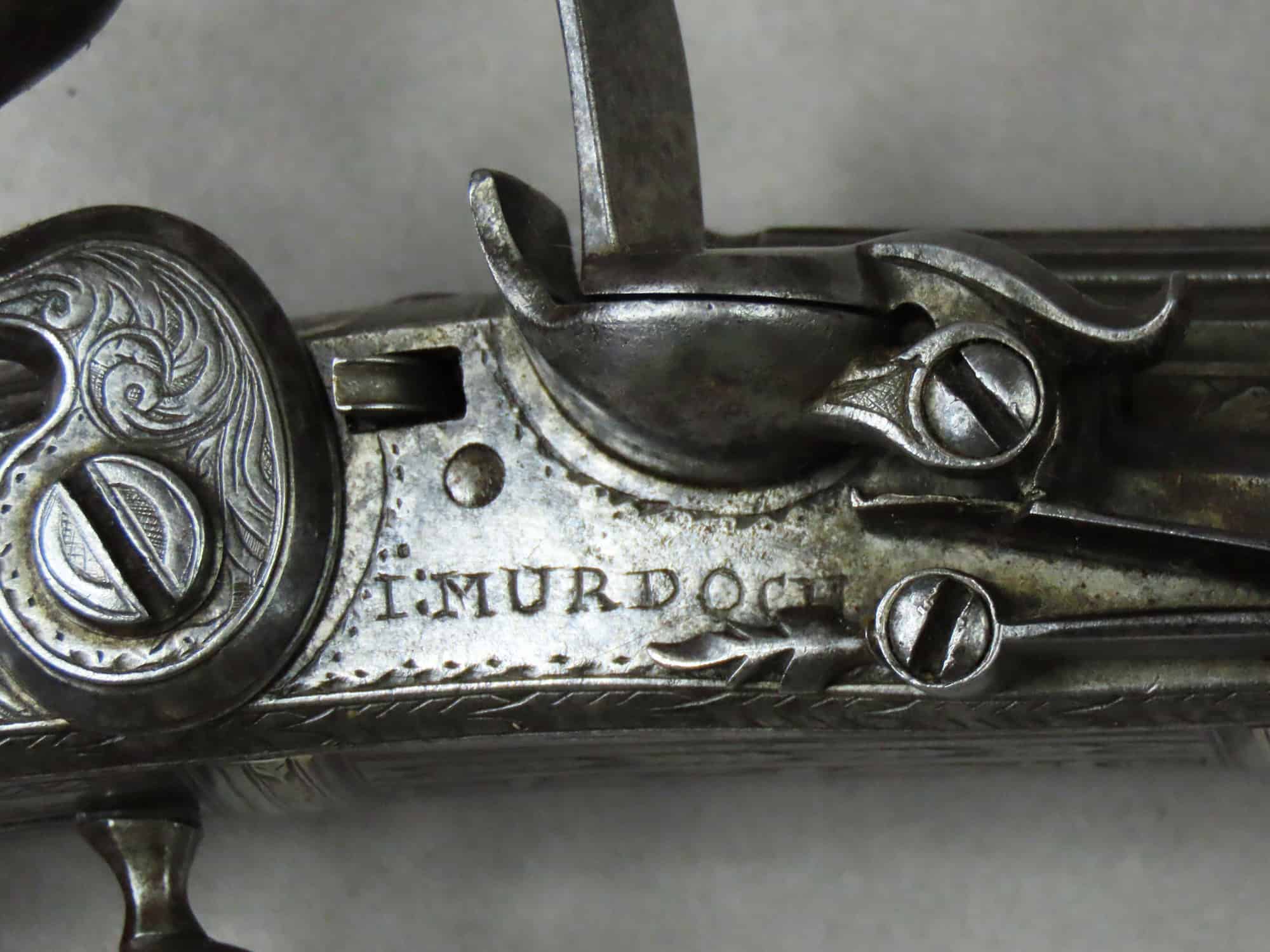
The border engraved flat bevelled locks are of typical “Highland” form, sometimes called “Doune locks”, made with horizontal sears extending through each lock plate which hold the cocks in the half cock position, and vertical sears extending from the top of each trigger plate through small oblong apertures in the centre of the upper surface of each butt. Each lock plate is decorated with scrolling foliage on the tail, cocks en suite and the faceted steels are engraved with lines. The lock plates are each signed “I : MURDOCH ”
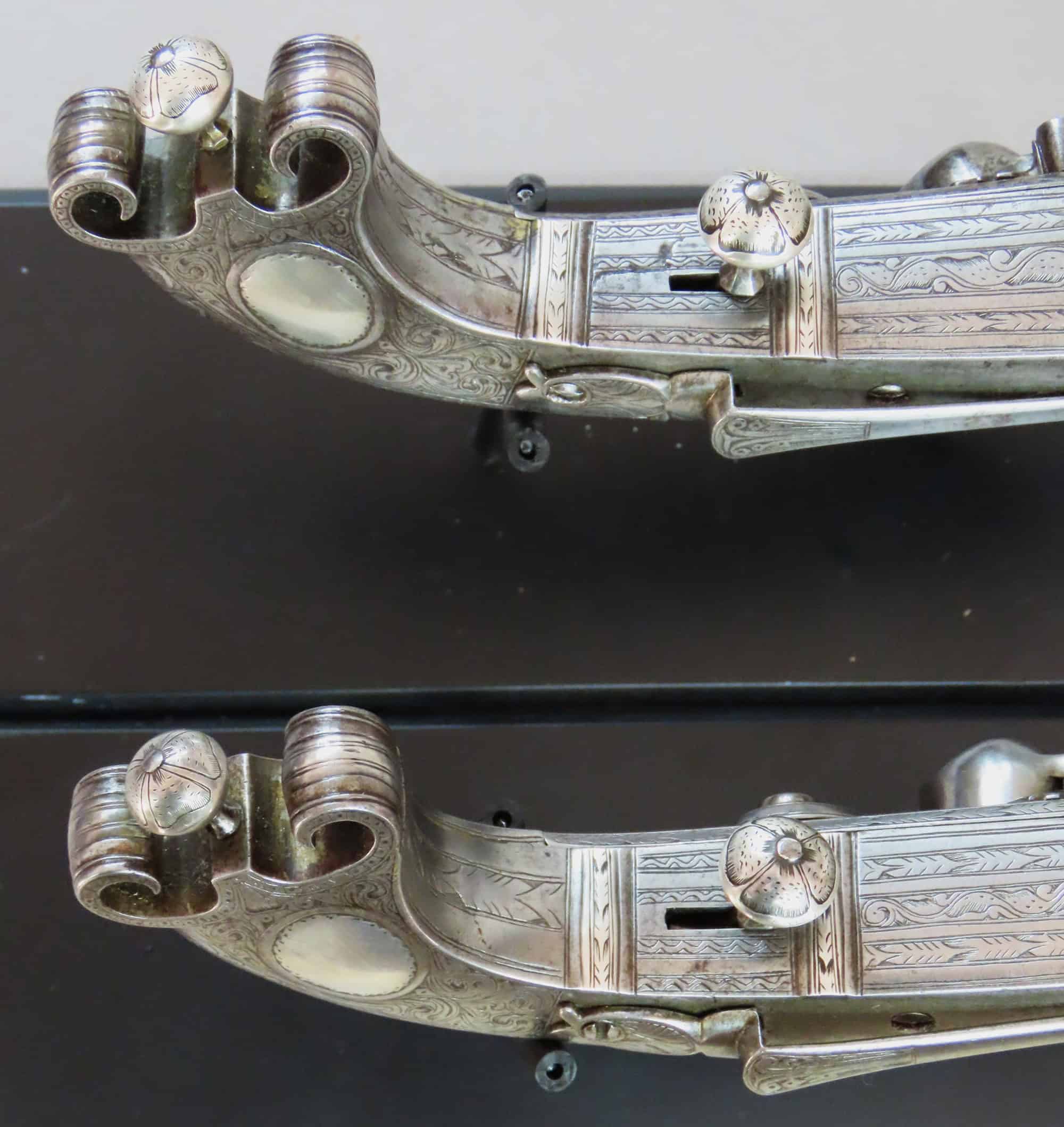
The spines of the butts are profusely engraved and inlaid with a pattern of intertwined silver Celtic scrolls of descending width in contour with the stocks to terminate at the scroll butt terminals which are enhanced with further incised scrolls and silver inlay. The fore ends are engraved with scrolls, acanthus leaves and linear designs.
The pistols are mounted with iron ramrod tubes with slender moulded ramrods with flattened terminals and threaded ends. Each side of each stock is decorated with a silver escutcheon, any original engraved monogram or crest now absent.
Underneath each pistol the space is decorated with fine linear engraving of scrolls and waves inside parallel border lines, crossed by three bands of inlaid silver engraved with chevrons. The slender tapering belt hooks are screwed into the stocks through a roundel, are engraved at the base, curl slightly outwards and swell towards the flattened terminals. The button triggers and prickers are formed from cups of silver brazed together and engraved with four petals which radiate from the tang ends on the outside.
The four stage 32 bore tapering barrels are 7 and 3/4 inches (just over 17 cm) long with fluted sections near each ramped breech. A grooved back sight is cut into each ramp and the flared muzzles are of octagonal shape engraved with fine scrolls inside borders. The middle sections of the barrels are rounded and boldly engraved with panels of scrolls and foliage.
Doune was one of a number of Scottish market towns with established arms making industries located in the borderland between the “Highland” and “Lowland” regions of Scotland. The town developed a quality of workmanship which set it aside from many other Scottish gunmaking centres from the late 17th century onwards. Traditionally the gun makers there had supplied weapons to the Highland Clans up to the early 18th century, then after the failure of the 1745 Rebellion, they found a new market for a time with the British military.
A number of craftsmen established gunmaking businesses in Doune such as Caddell, Campbell, Christie, Michie and of course Murdoch. A second Murdoch, Thomas, was also in business there, unrelated to John. The high quality pistols they produced were expensive and afforded only by the Highland elite.
Little is known of John Murdoch. A note in the Statistical Account of Scotland, Vol. XX, p.86, for the year 1798, suggests that he was apprenticed to one of the Doune pistol makers in the family line of Caddell, the dynasty that established the pistol making industry there in 1646. It continues to say:
“The trade is now carried on by John Murdoch, also famous for his ingenuity in the craft and who has likewise furnished pistols to the first nobility of Europe. These pistols were sold from 4 to 24 guineas a pair… when Mr. Murdoch gives over business, the trade, in all probability, will become extinct’.
It seems likely therefore that John Murdoch was the last traditional pistol maker still in business in Doune at the end of the 18th century. It is not known precisely when he started and ended his career, but it was certainly a long one, a period covering the hiatus of Doune as a pistol making centre through to the end of its decline. The earliest pistols made by John Murdoch are thought to date to the early 1740’s and he probably worked into the early 1800’s, although may not have been producing traditional pistols by then. He died in 1812.
The pistols discussed here date to circa 1770 and the period of the American Revolutionary War. It was common practice for British Army officers on service in North America at this time to take with them privately purchased pairs of pistols. The supply by the Ordnance of munitions grade Scroll Butt pistols to enlisted men in Scottish regiments was already well established.
A few “officers'”pairs by John Murdoch have survived with provenance from this time. For example, one pair by John Murdoch captured by the Americans belonged to a Major Pitcairn who was an officer in the Royal Marines, and led the advanced guard of the British raid on Lexington and Concord, Massachusetts, on 19 April 1775. His pistols were captured after his horse threw him during the action at Fiske Hill near Concord and bolted into the American lines, where the pistols that he carried in his horse furniture were captured by an American militiaman. The pistols were acquired by Major General Israel Putnam who carried them further into the War. They are now in the Lexington Historical Society collection. Some witness accounts credit these pistols with being used by Pitcairn to discharge the first shot of the War. Another pair by John Murdoch came to light in the UK a few years ago which belonged to Lord Percy who was a senior officer with the British Army in the early part of the conflict.
The pistols are in fine condition and mechanical working order.