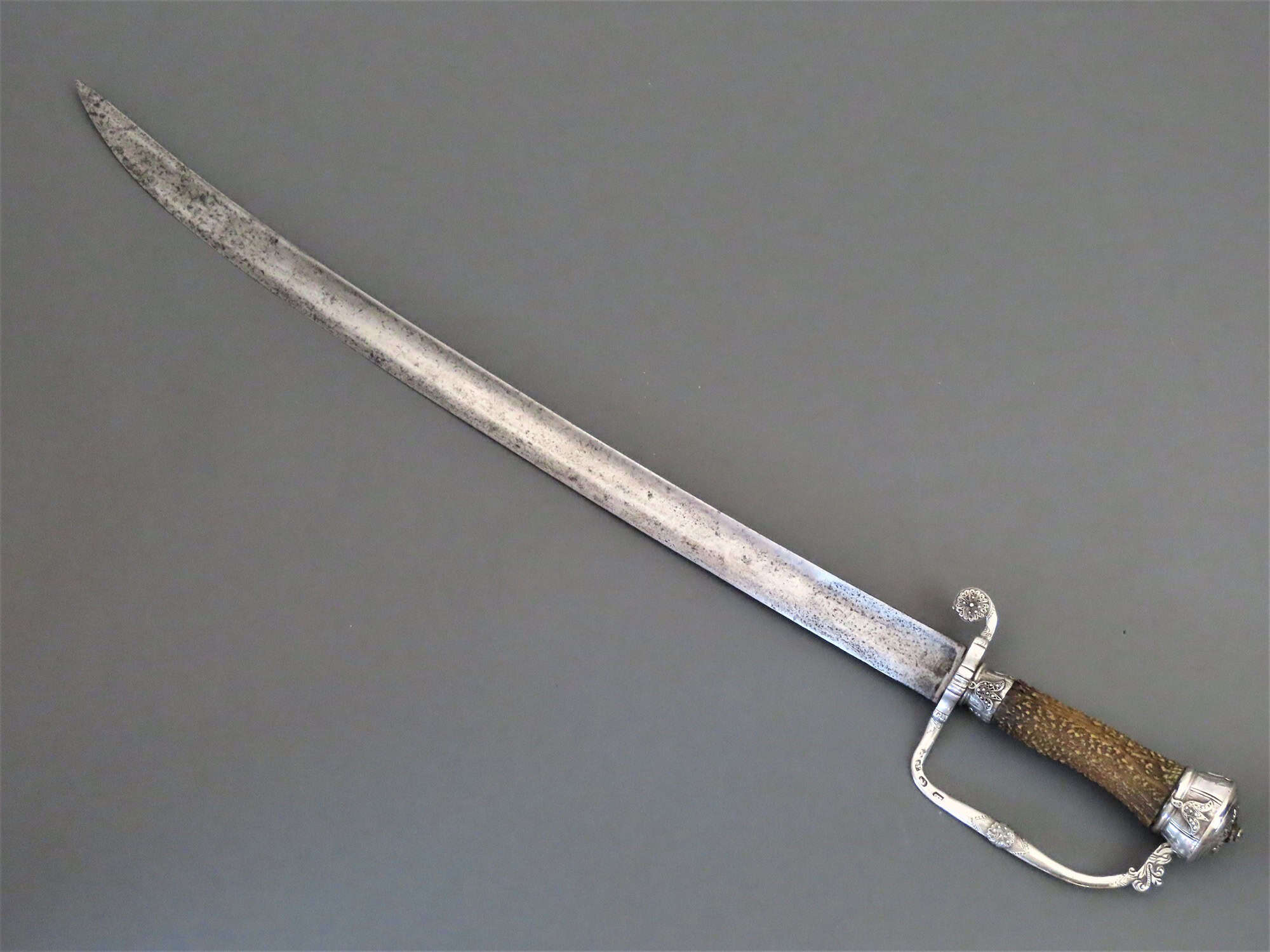
A fine English Silver Hunting Hanger by James Hughes of London Britannia Hallmarked for 1697 / 1698
To enquire about this itemplease click here
Price: £1,800
Ref: 52092424
Item Description
An English Silver Mounted Hunting Hanger with London Britannia Hallmarks for 1697/1698 by the silver smith James Hughes of London. Perhaps unique, in comparison with other surviving swords of this type, the fine quality hilt is applied with delicate and highly detailed decorative silver filigree panels attached to the mounts.
In the 17th and 18th centuries when swords were a popular weapon for gentlemen, hangers were a robust secondary side arm used for self-defence when walking about town and travelling in general. Although referred to as “hunting” hangers, in general they found little use in hunting in London where many were made. Self-defence in crowded areas, and in the tight confines of London’s dangerous alleyways, required a weapon which was
shorter than a sword for close-in use in these confined spaces. Hunting hangers appear in some military portraits of the time and were carried by some officers in the British Army and Navy probably intended for use as cutlasses. Towards the end of their popular use in the mid 18th century, designs for these hangers became more ostentatious for wear as a gentlemans’ accessory.
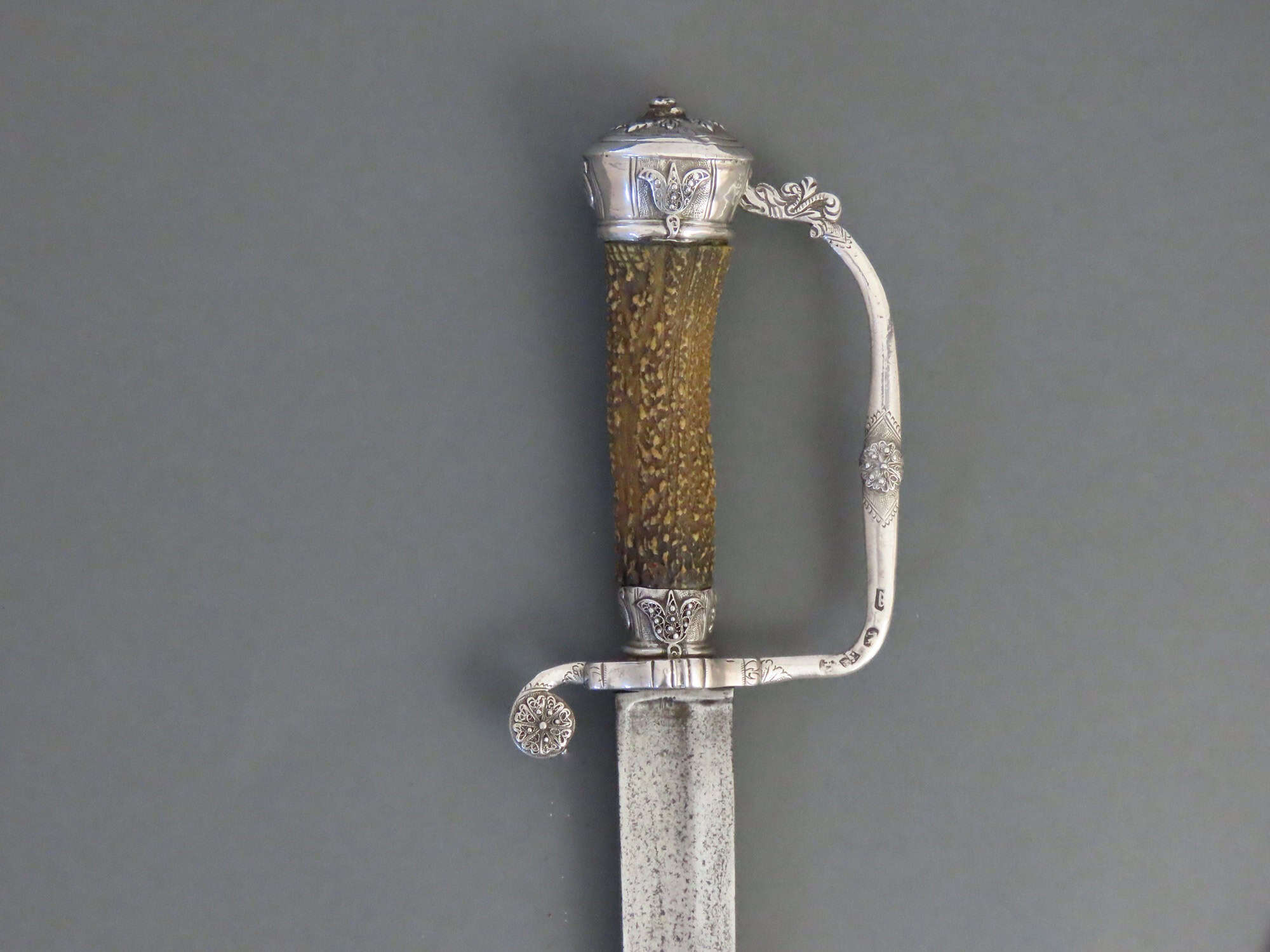
This high-quality hanger was almost certainly a gentleman’s weapon. The knuckle bow is stamped with James Hughes’s Britannia Standard maker’s mark of “HV” (the first and second letters of his surname) in raised relief inside a depressed round shield with a shape above – possibly a crown or a Fleur-de-lys. The lion’s head, date and Britannia Standard stamps lie alongside.
Hughes lived in exciting times as London was remodelled after the turbulence of the Civil War period, plague in 1665 and the Great Fire of 1666. Towards the end of the 17th century the city was more outward looking. International trade was growing through London port, military success was being achieved
abroad and more interest and investment was being expressed in art and culture. Hughes was one of a group of artisans whose high quality work represents the evolving style and fashions of late 17th and early 18th century Baroque London.
The hilt of this sword is comprised of a bold faceted quillon block with a downward facing flattened disc-shaped rear quillon applied each side with a floral filigree panel. The knuckle bow is chased and applied with further filigree panels each side of its swollen middle. The top rises to a foliate monster-head terminal hooked into the pommel-cap. The pommel is formed with a broad cap with a circle of outward facing leaves radiating from the pommel button on top. The sides of the cap are applied with further filigree panels and chased with floral ornament.
The grip is of roe buck antler with a ferrule at its base decorated in a similar manner to the pommel sides. The pommel sides and the base ferrule to the grip are moulded to the contour of the antler grip. Some of the filigree panels are circular in shape and others are shaped as tulips probably in recognition of the Dutch origins of King William III who was on the throne at the time.
The slightly curved single edged blade is of plain form. It is 20 inches long (just under 51 cm). It has a broad shallow fuller which extends from the short ricasso almost to the pointed tip.
James Hughes registered his mark (see Grimwade 1080) as a small worker at Goldsmiths’ Hall probably in 1697 at the introduction of the Britannia Standard. He lived at New Street, Fetter Lane, in the City of London.
The hanger is in fine condition with minor speckling and blemishes to the blade. The blade is 20 inches long (51 cm) and overall, the hanger is 25.5 inches long (64.75 cm).