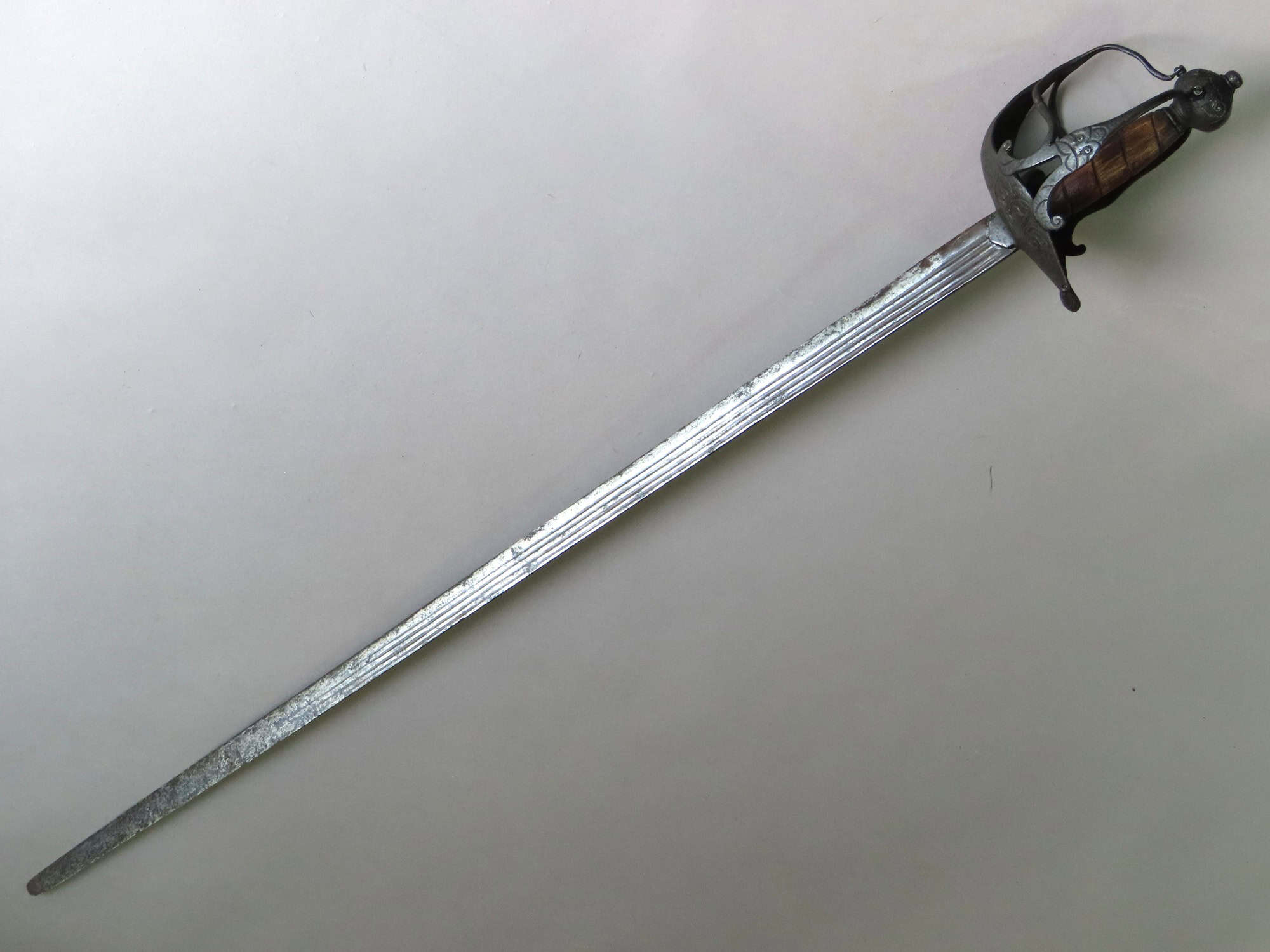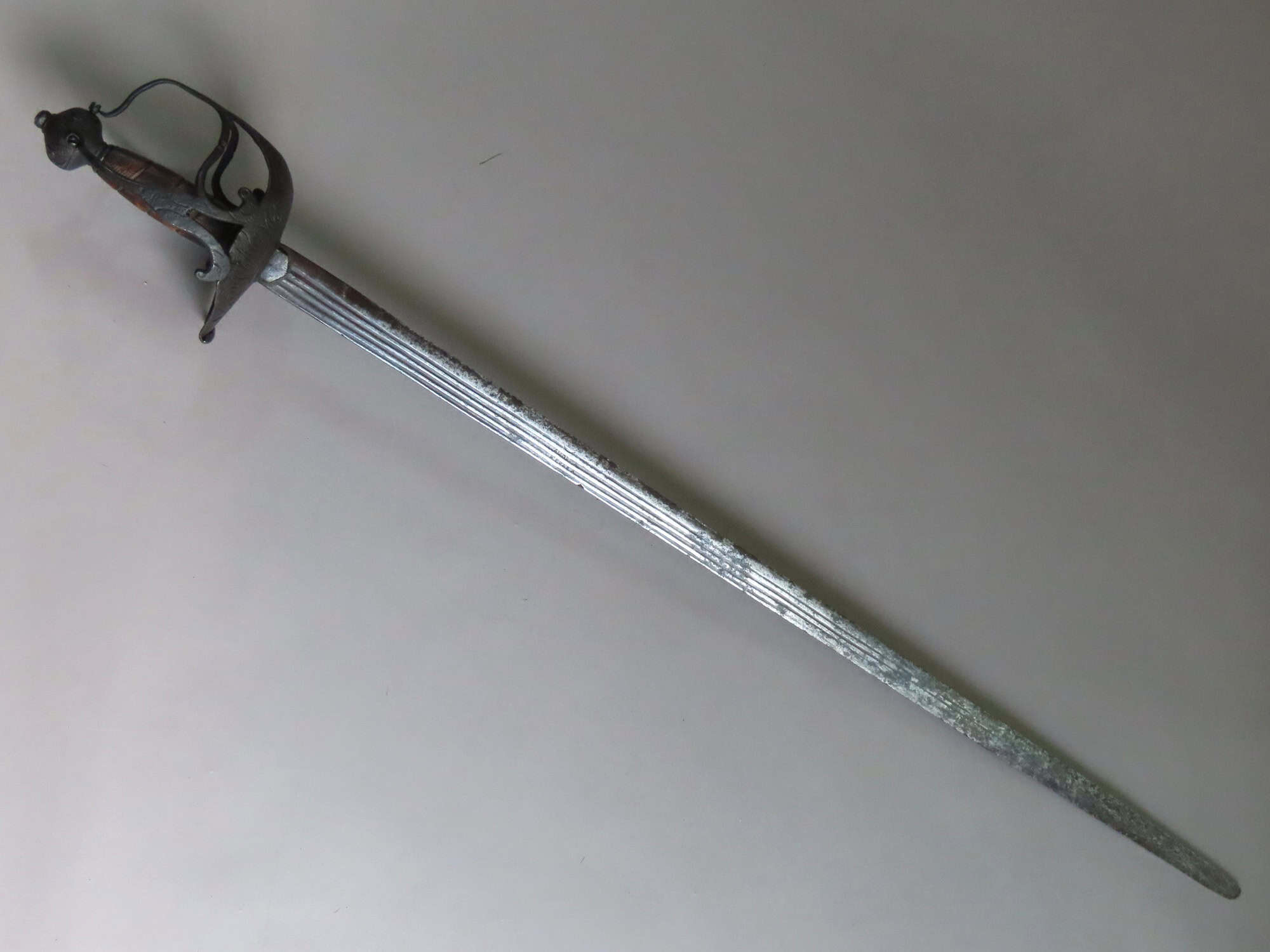
An English Mortuary Sword dating to the second quarter / middle of the 17th century
To enquire about this itemplease click here
Price: £3,300
Ref: 62040763
Item Description
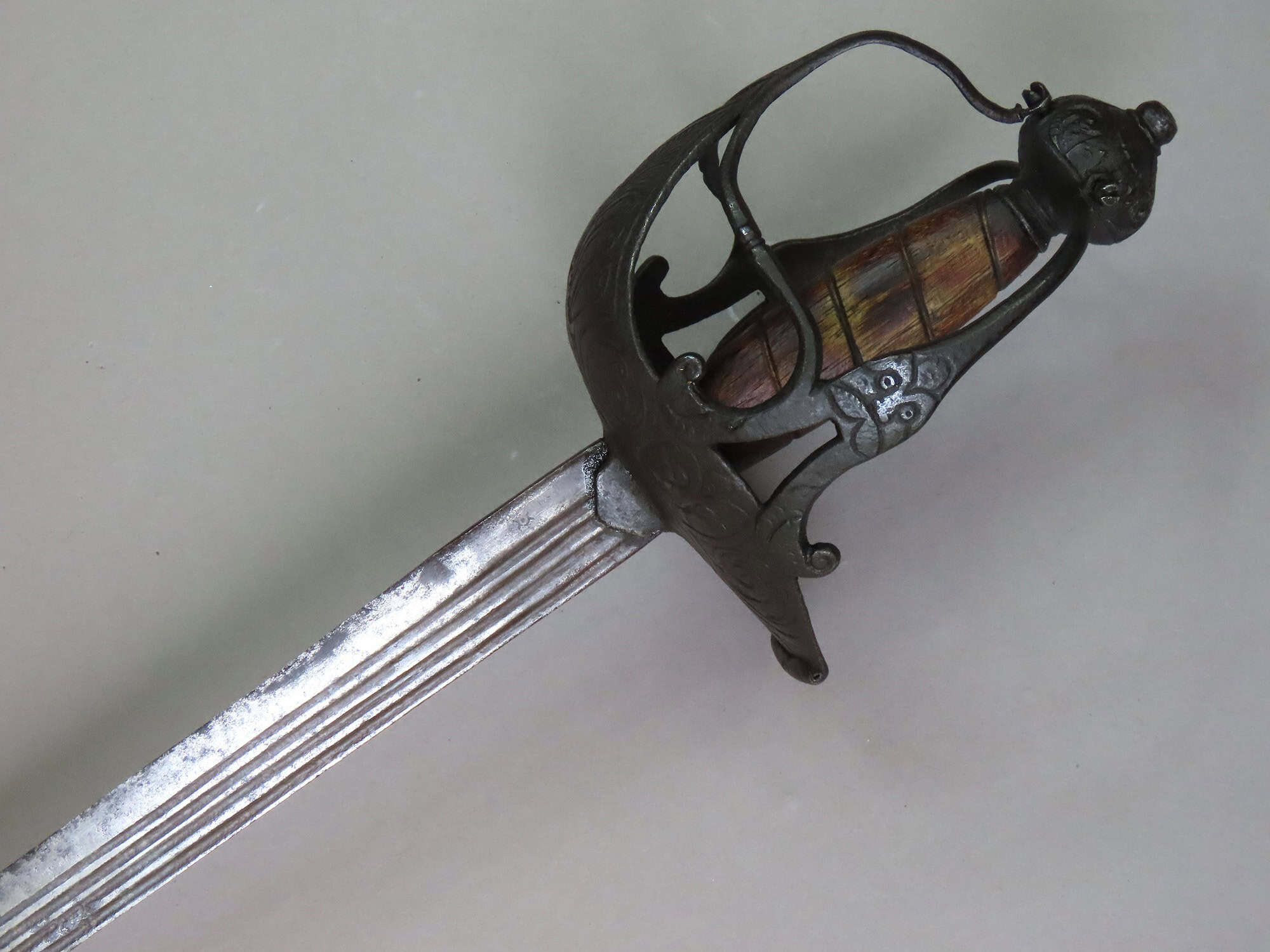
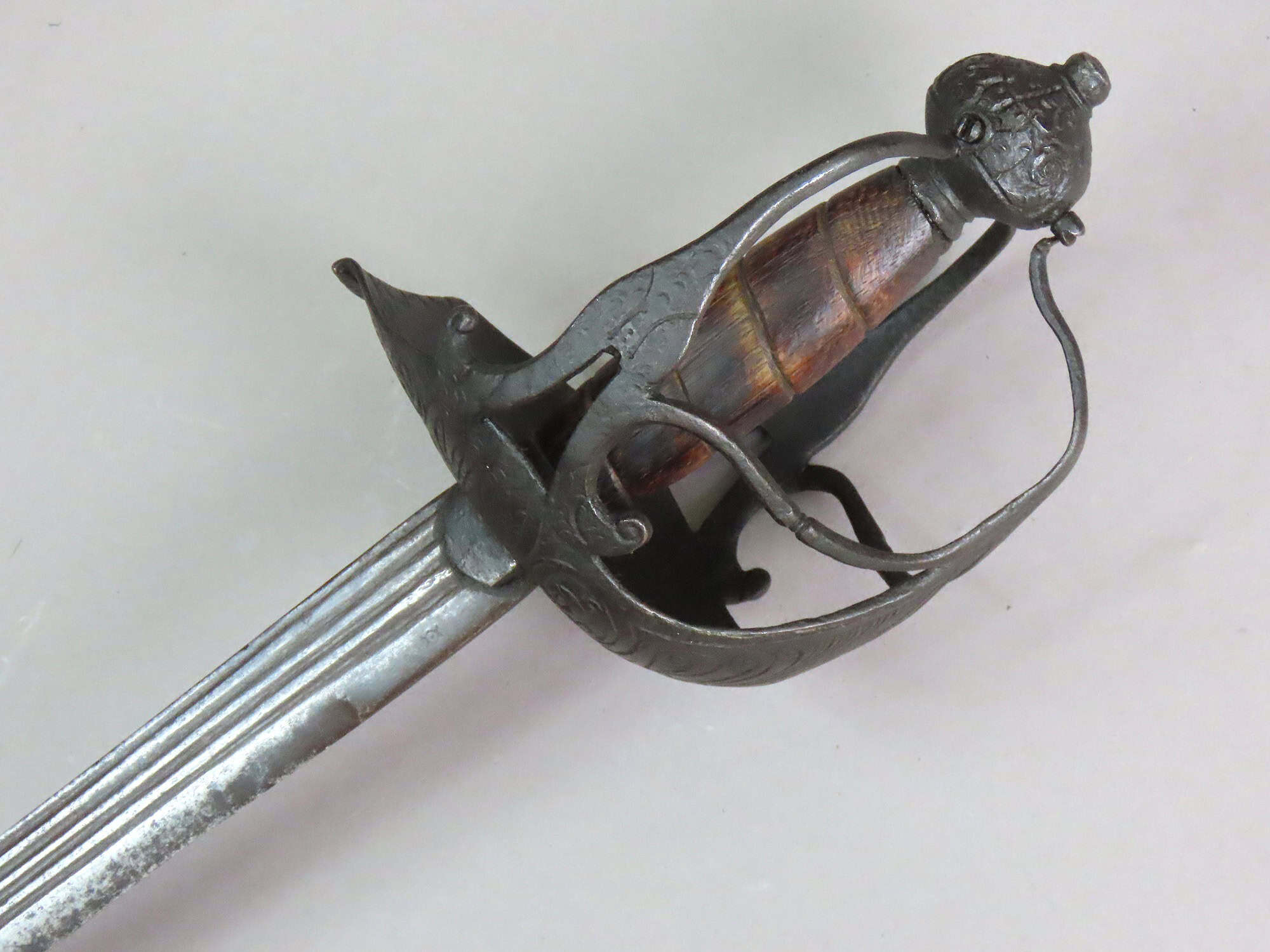
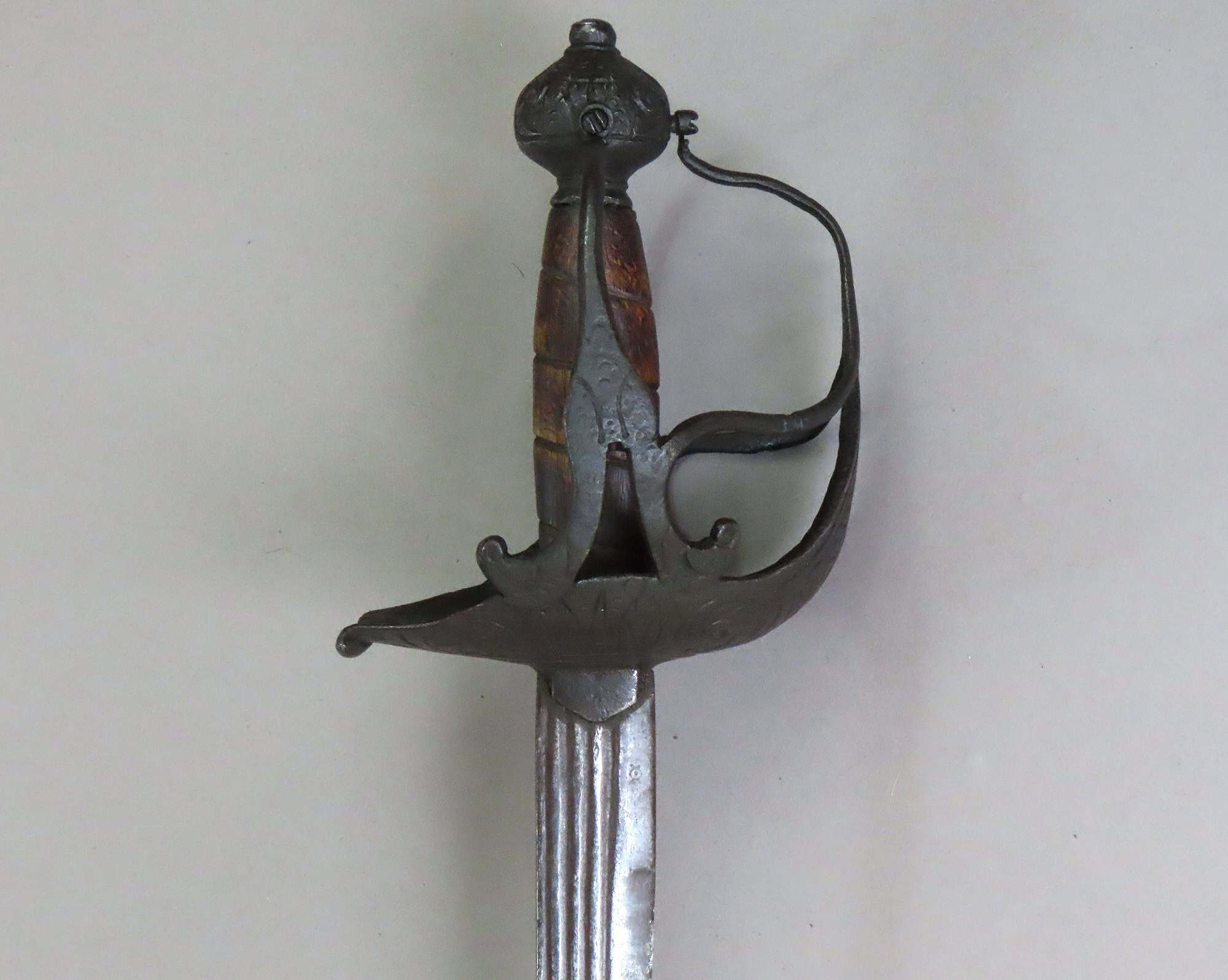
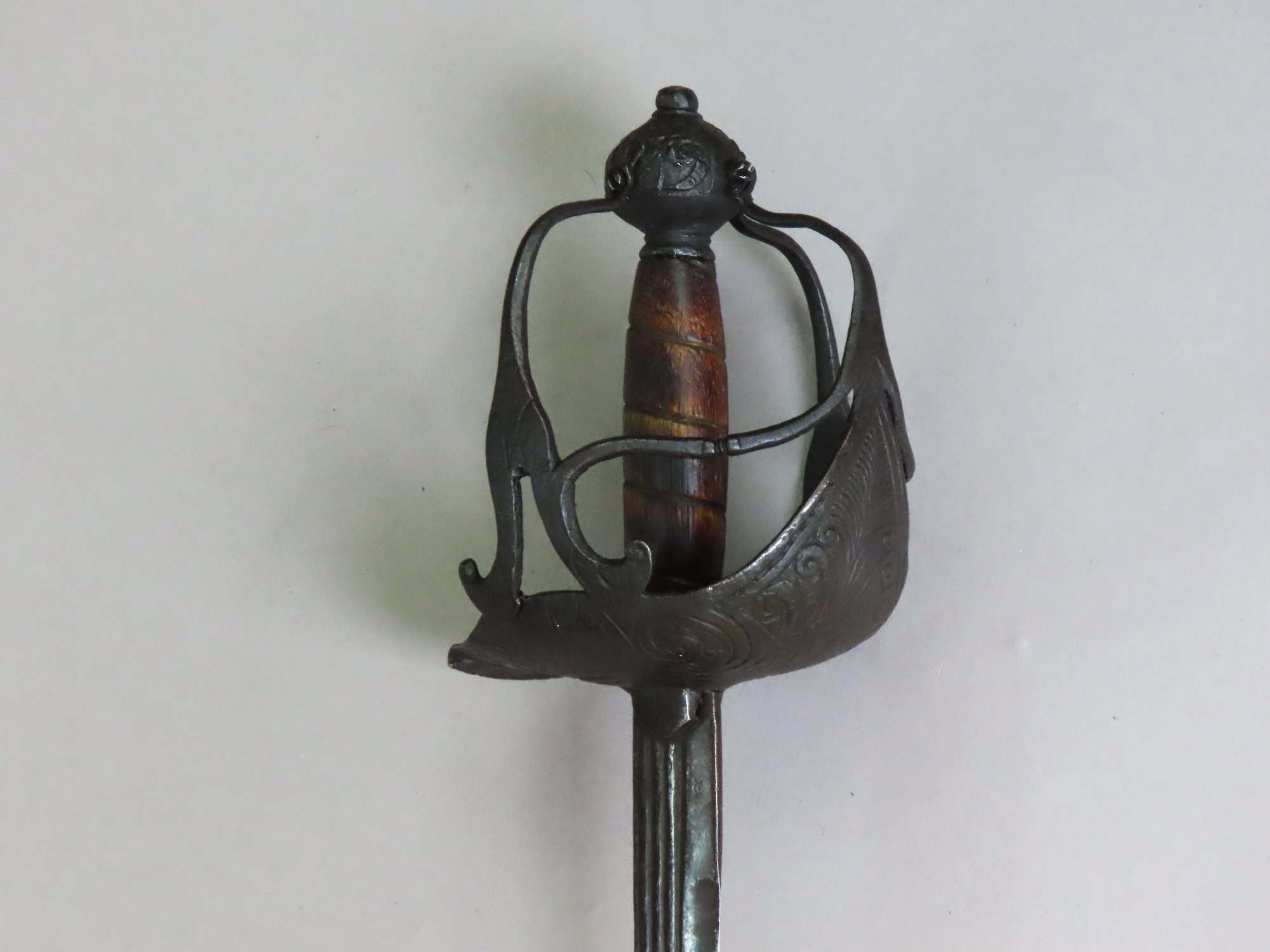
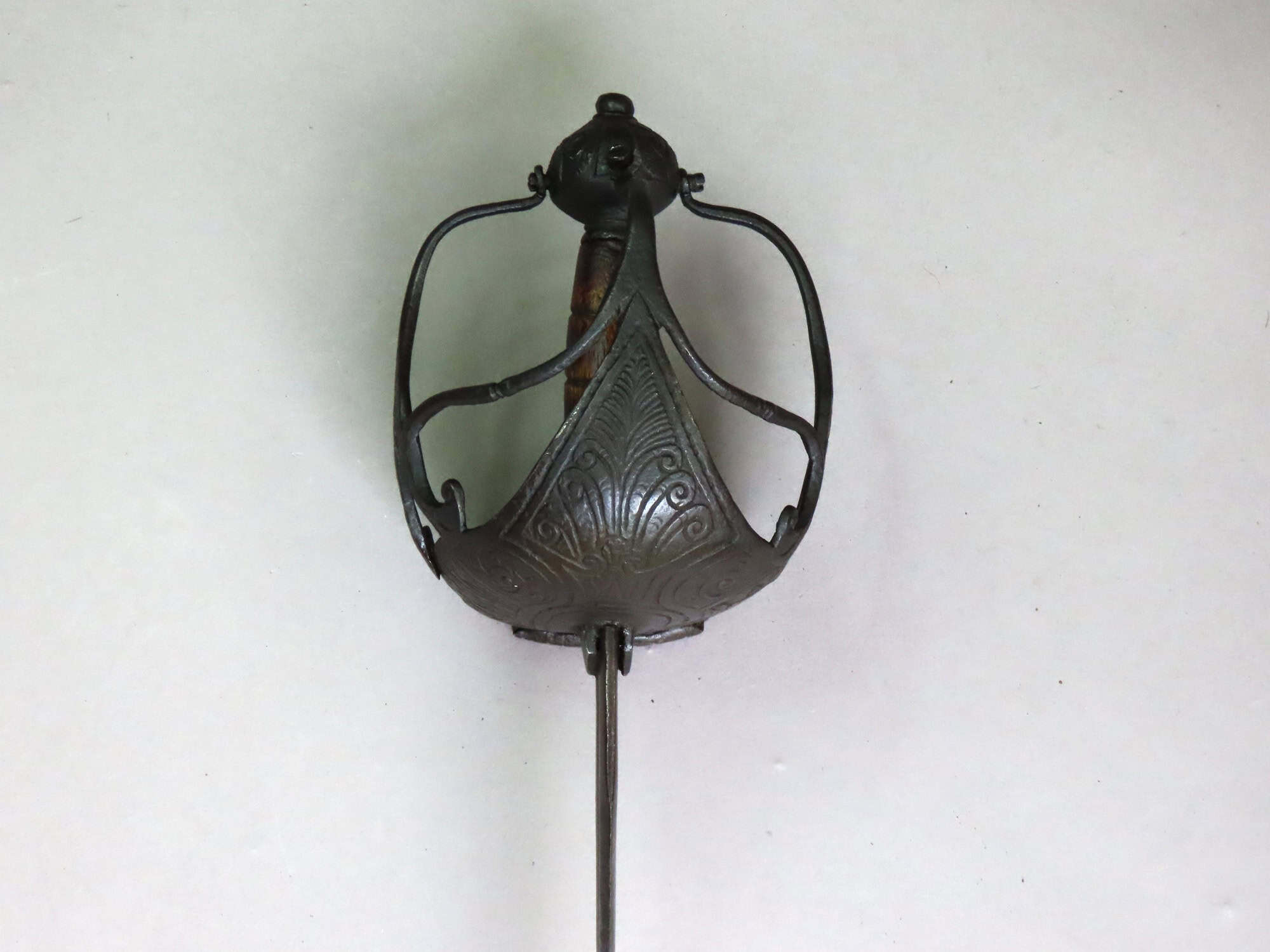
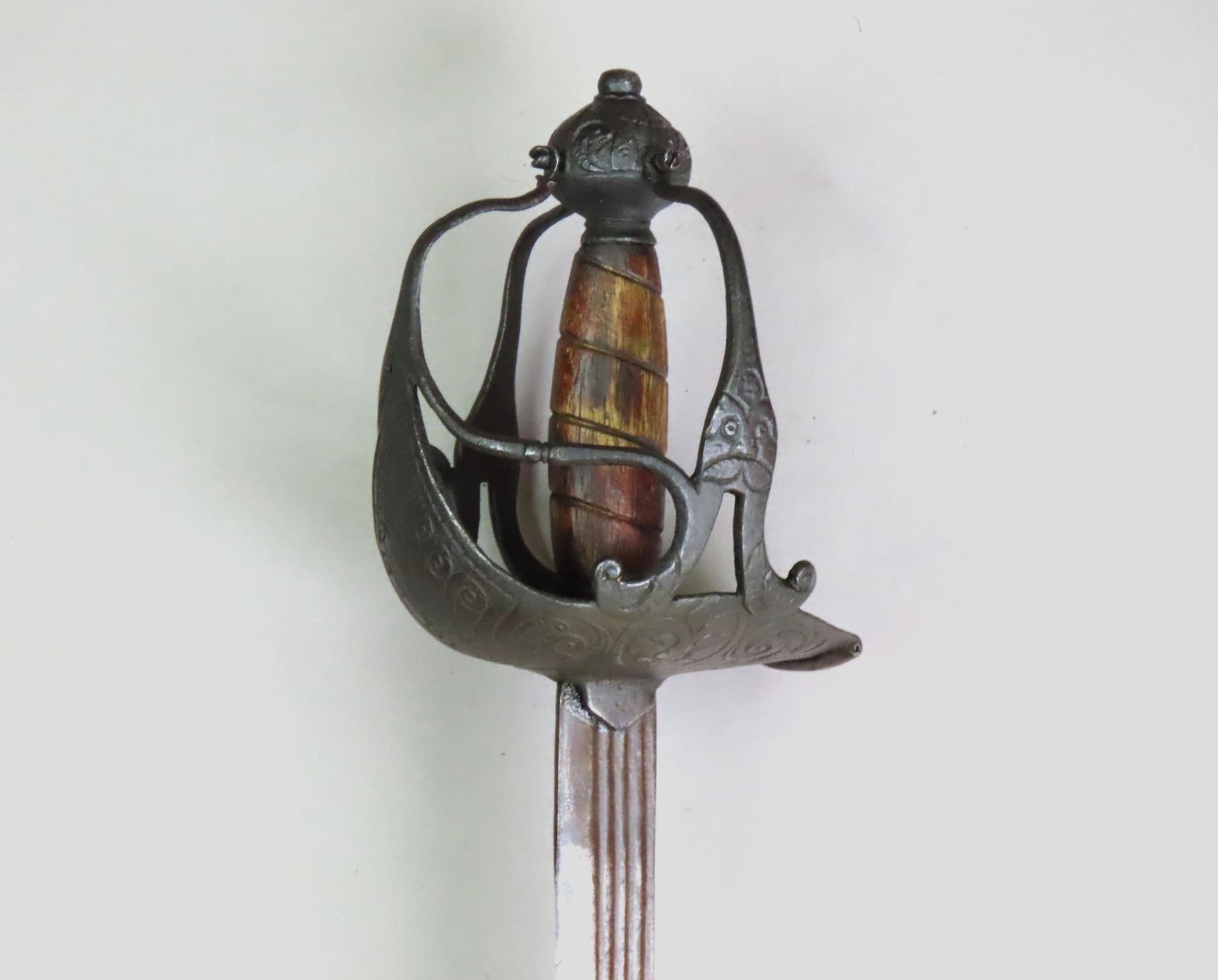
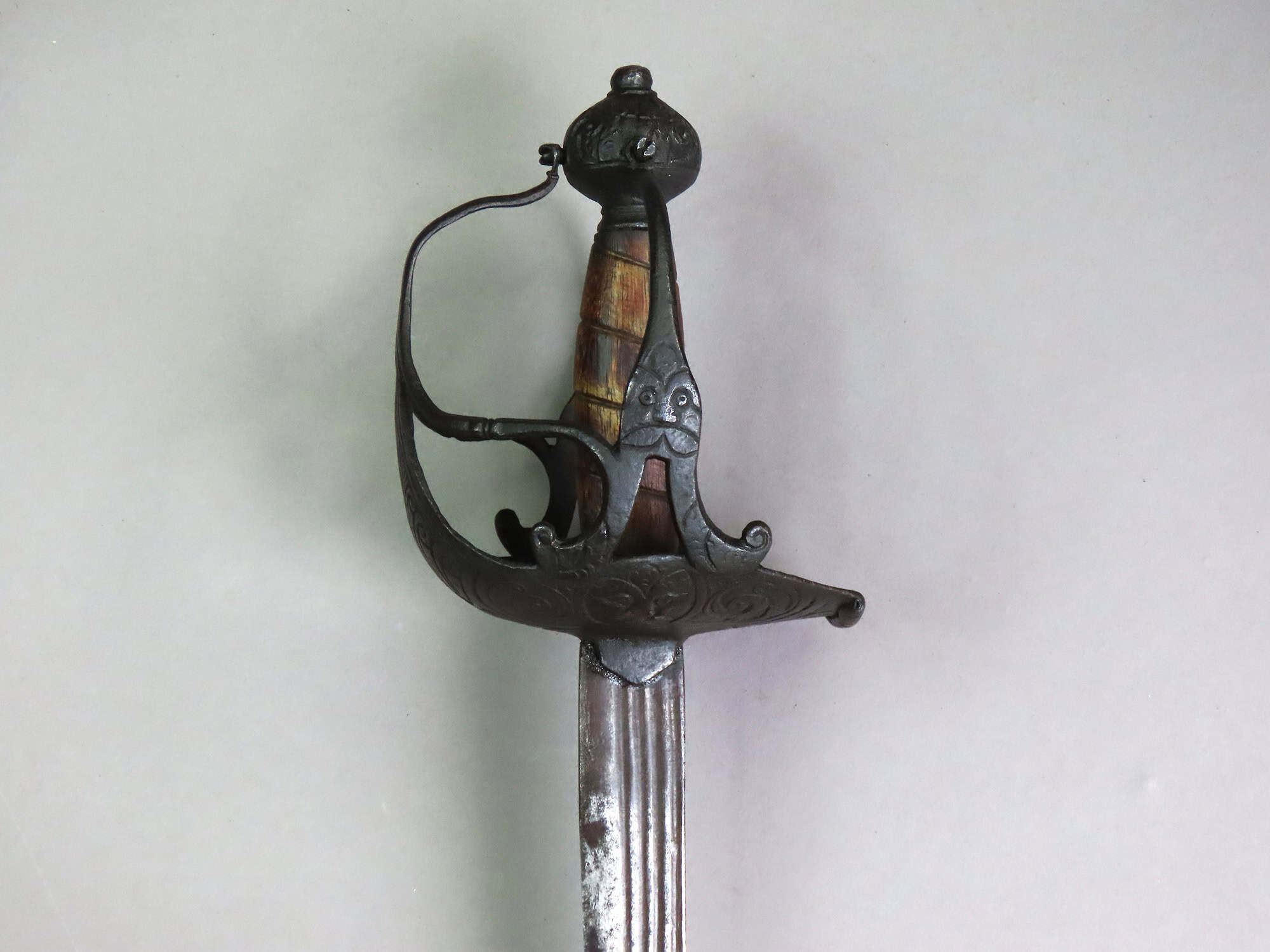
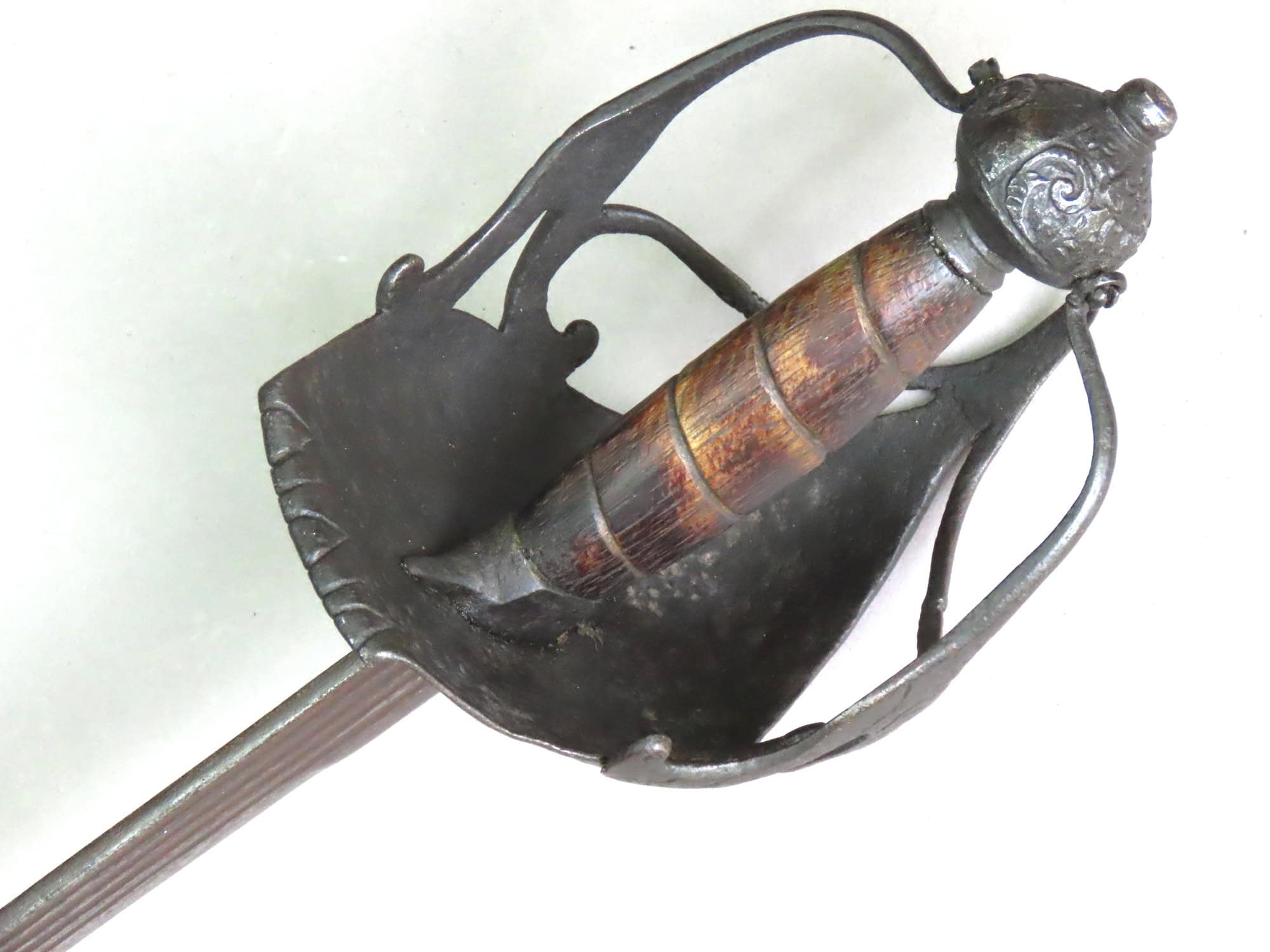
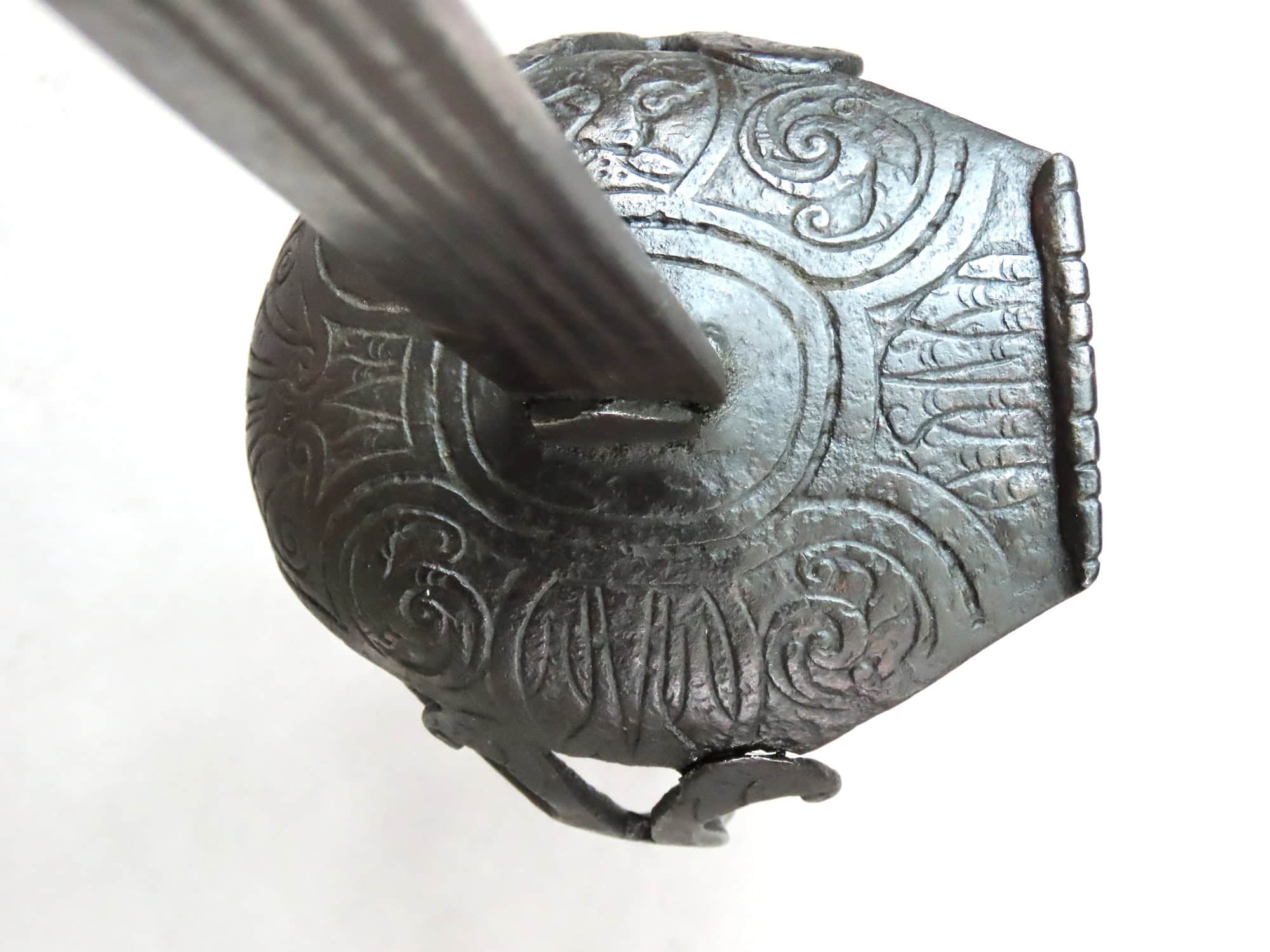
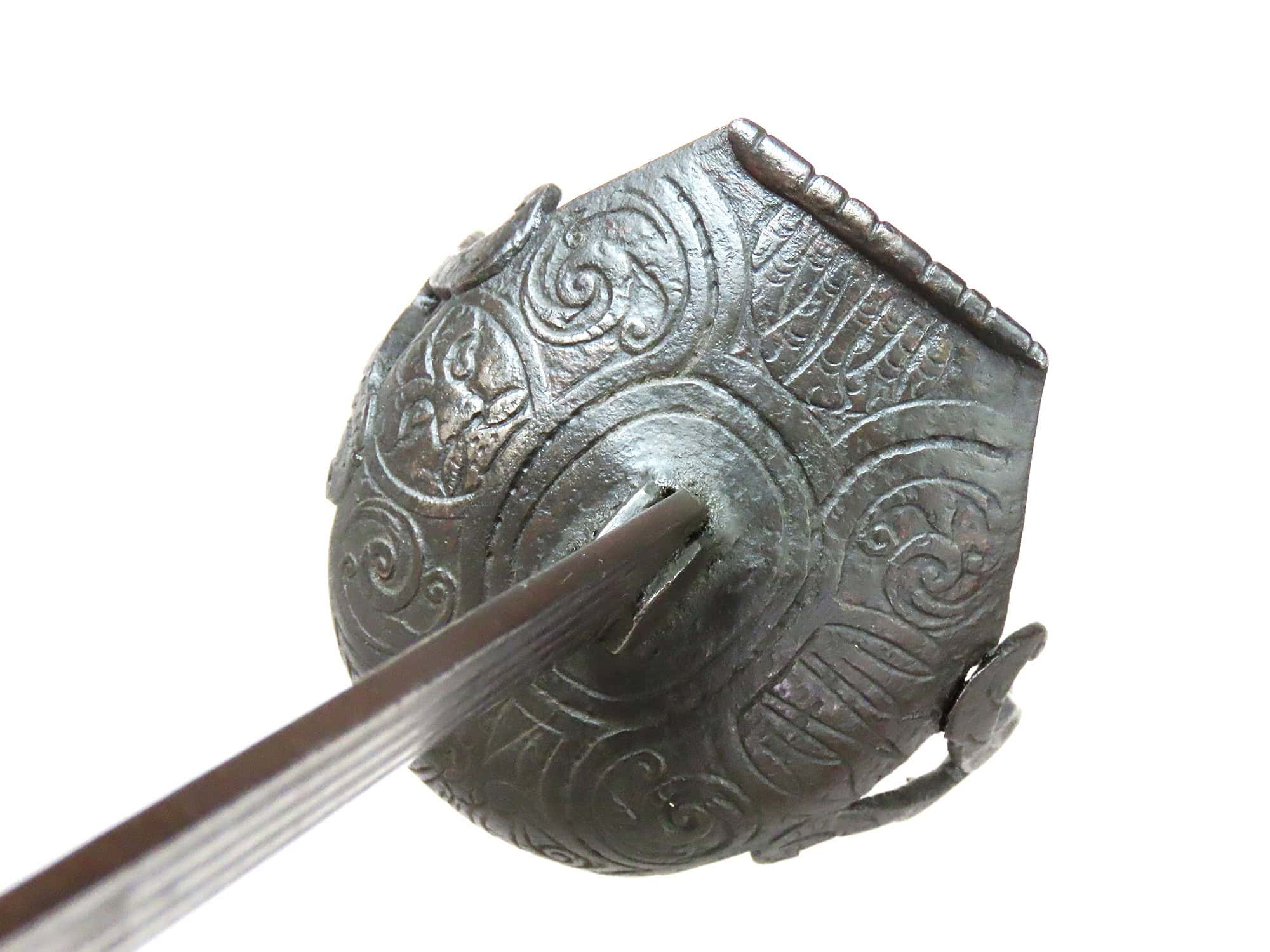
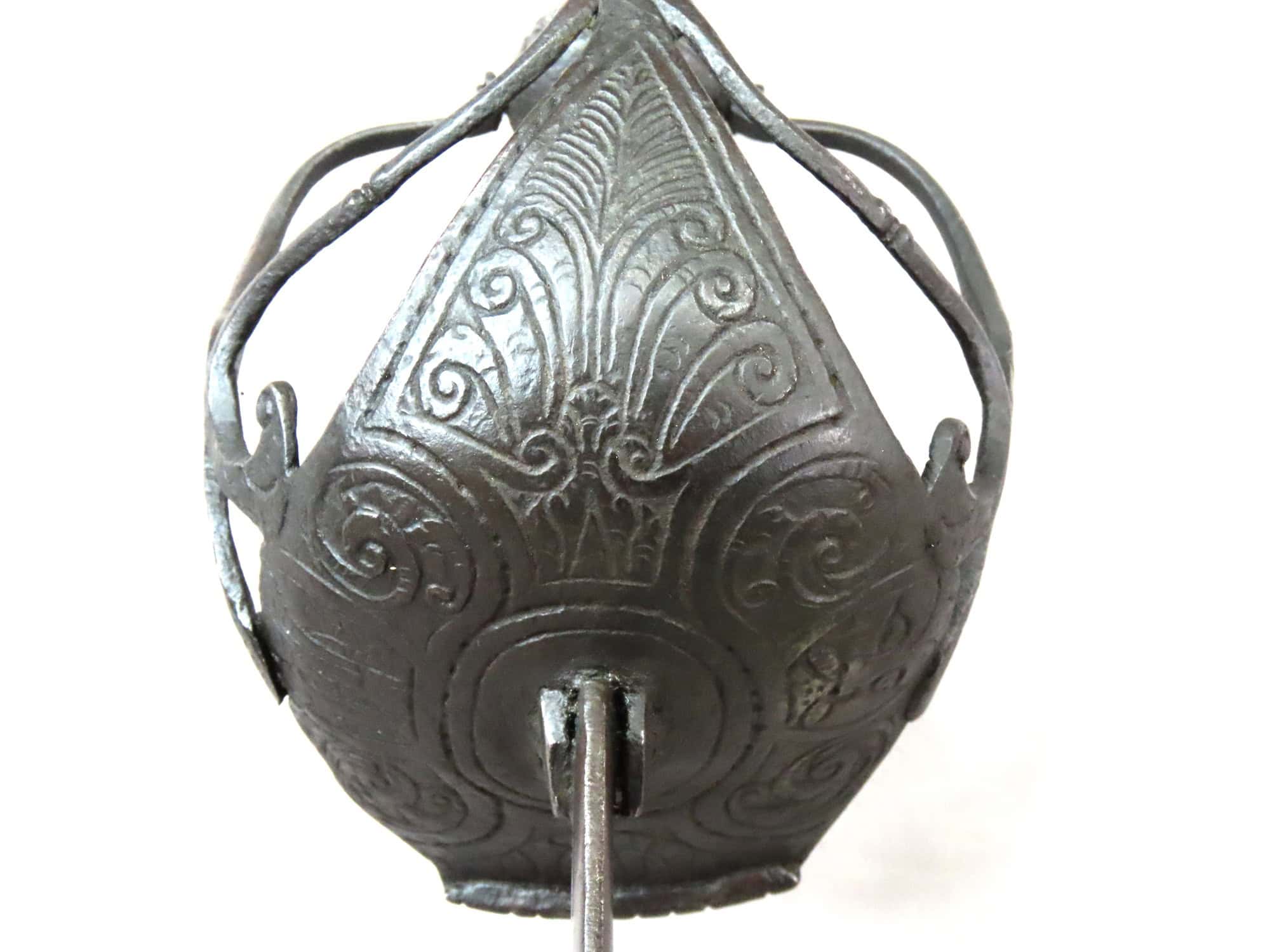
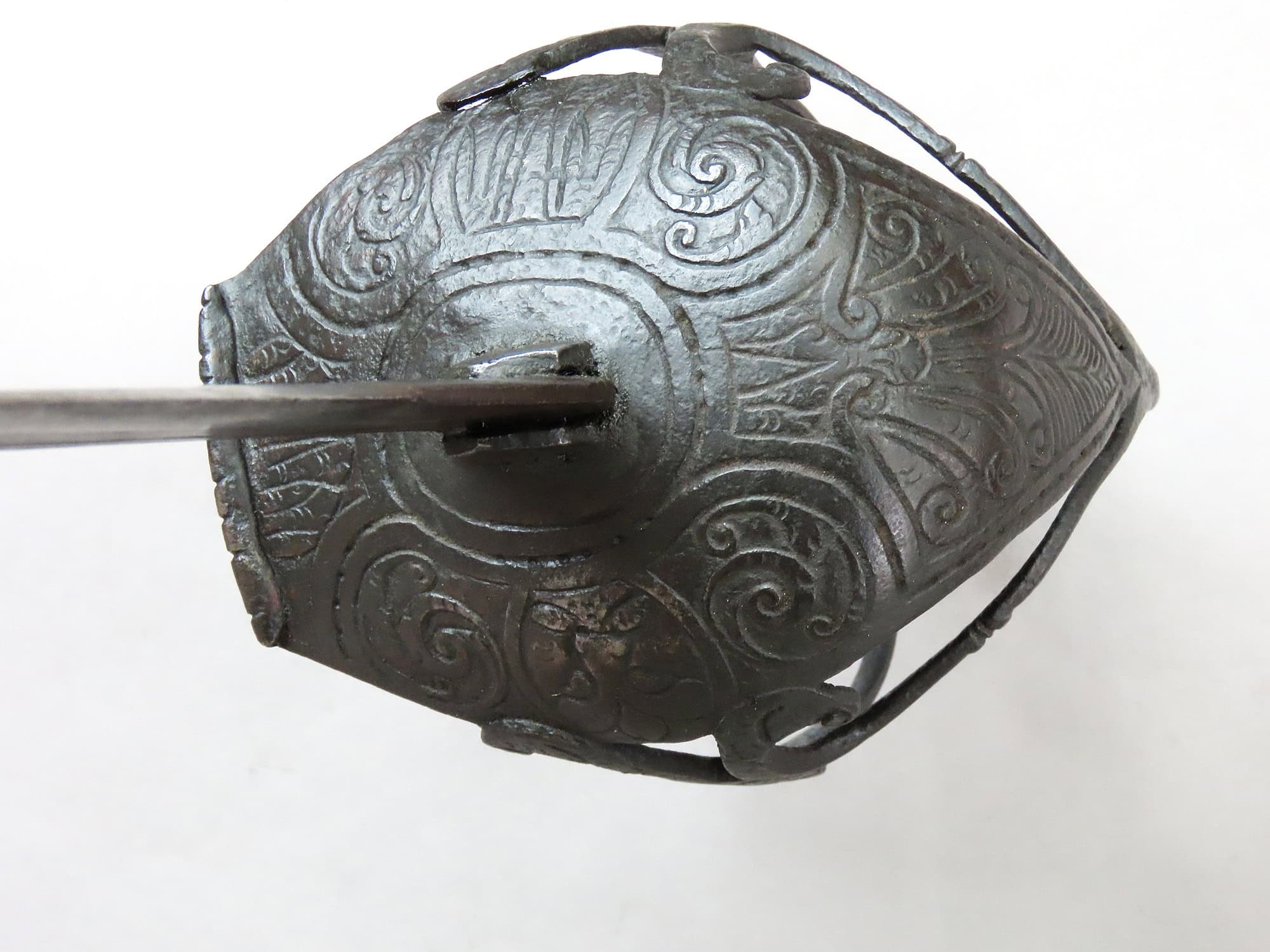
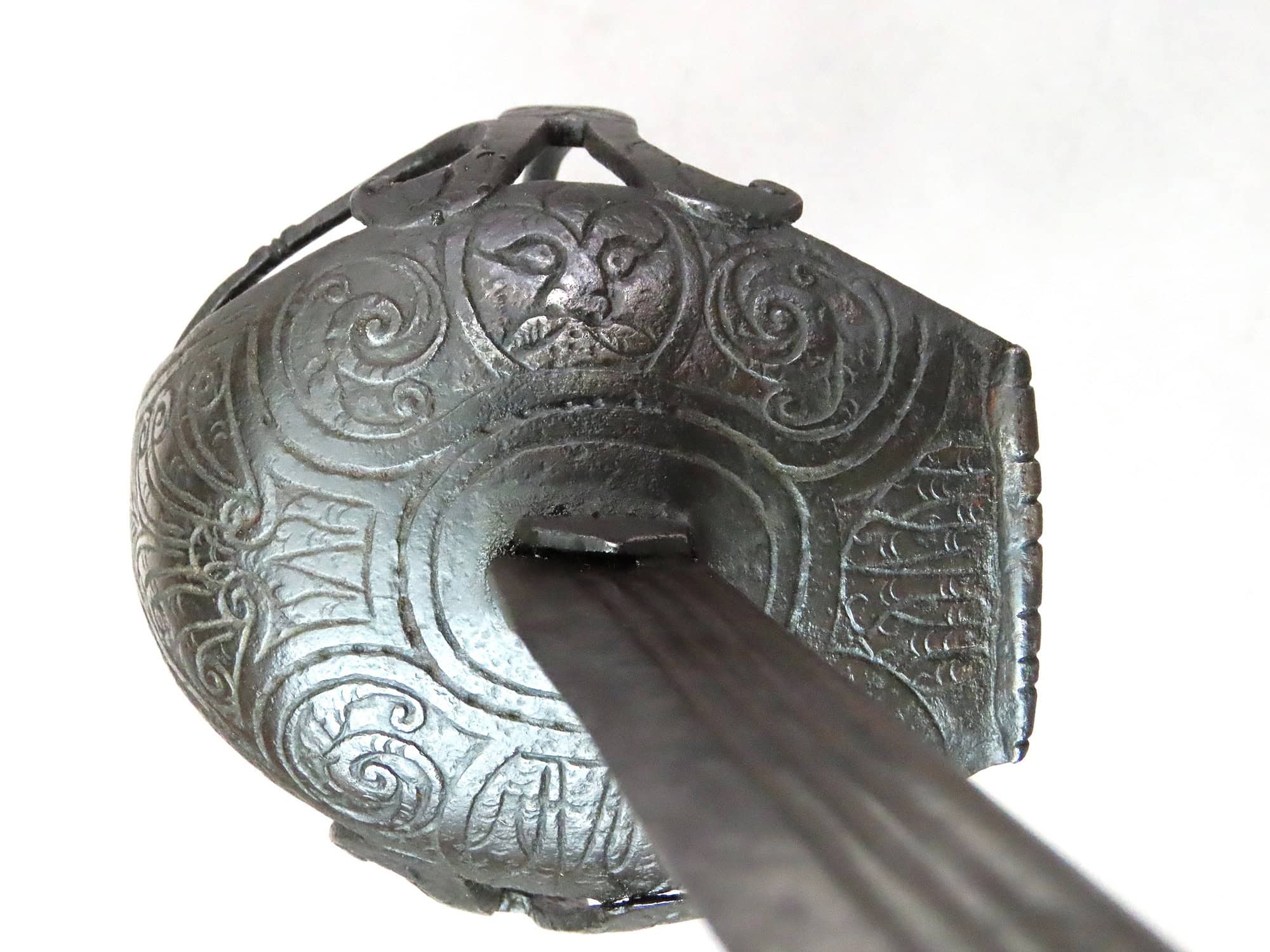
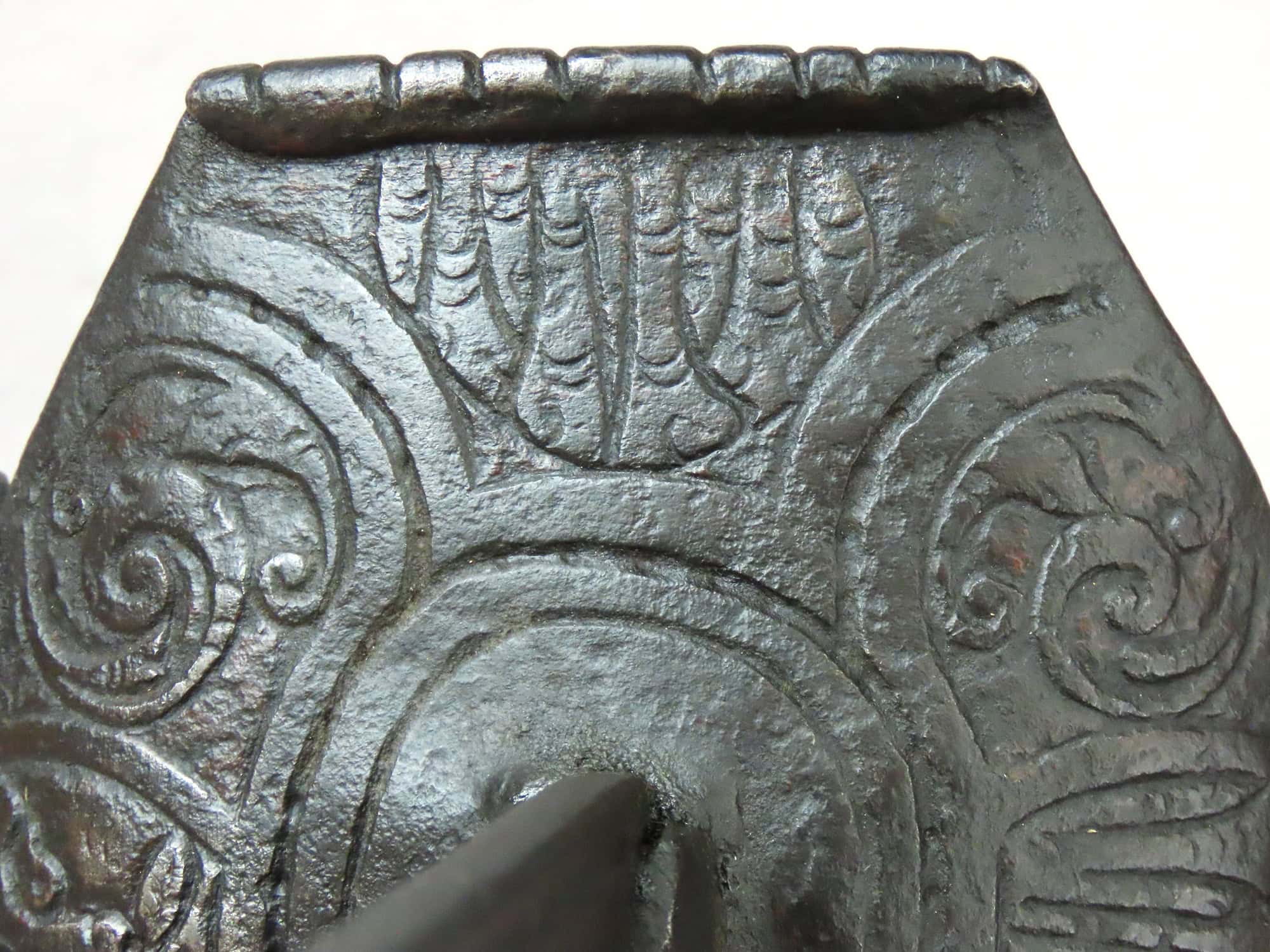
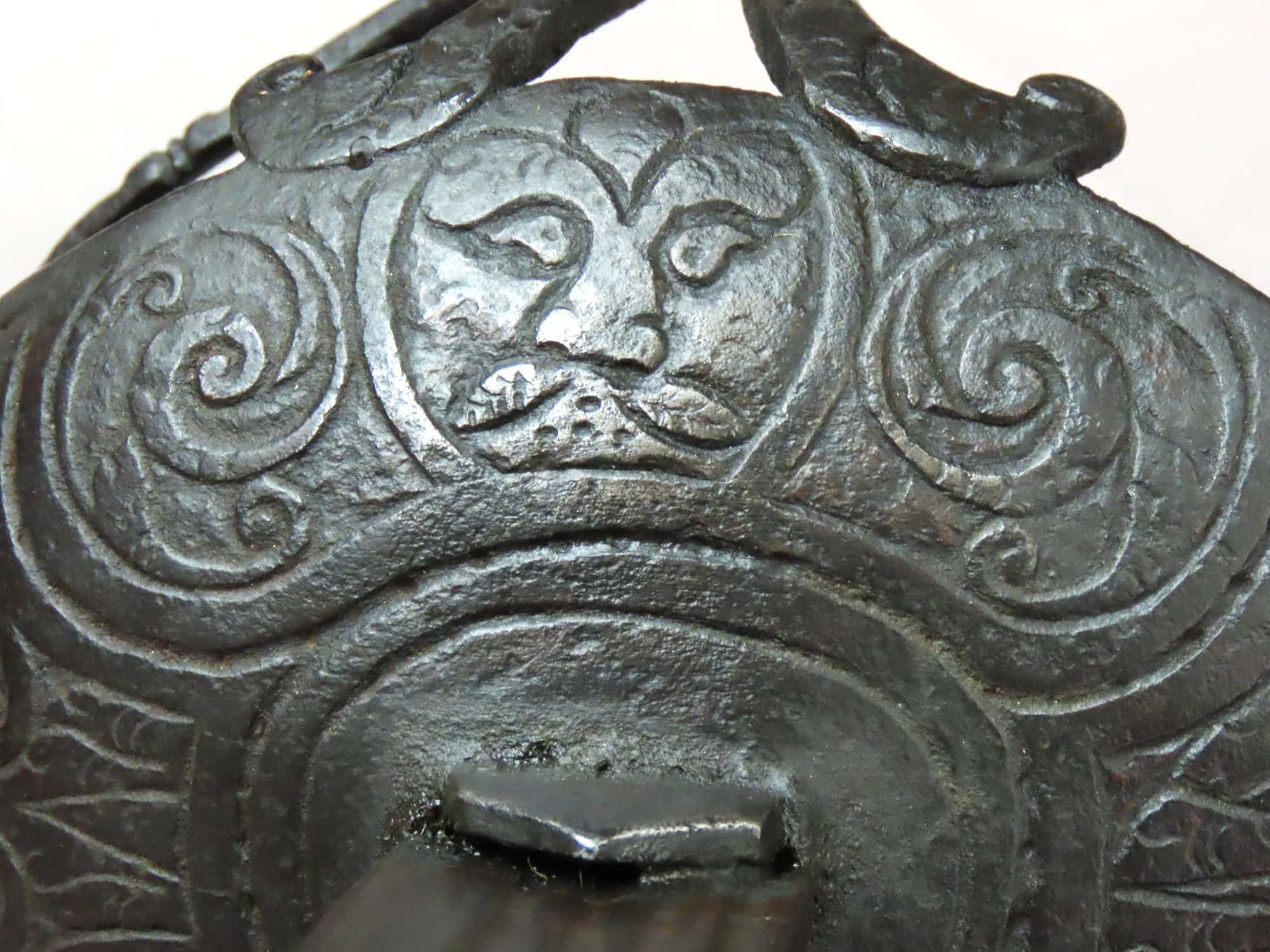
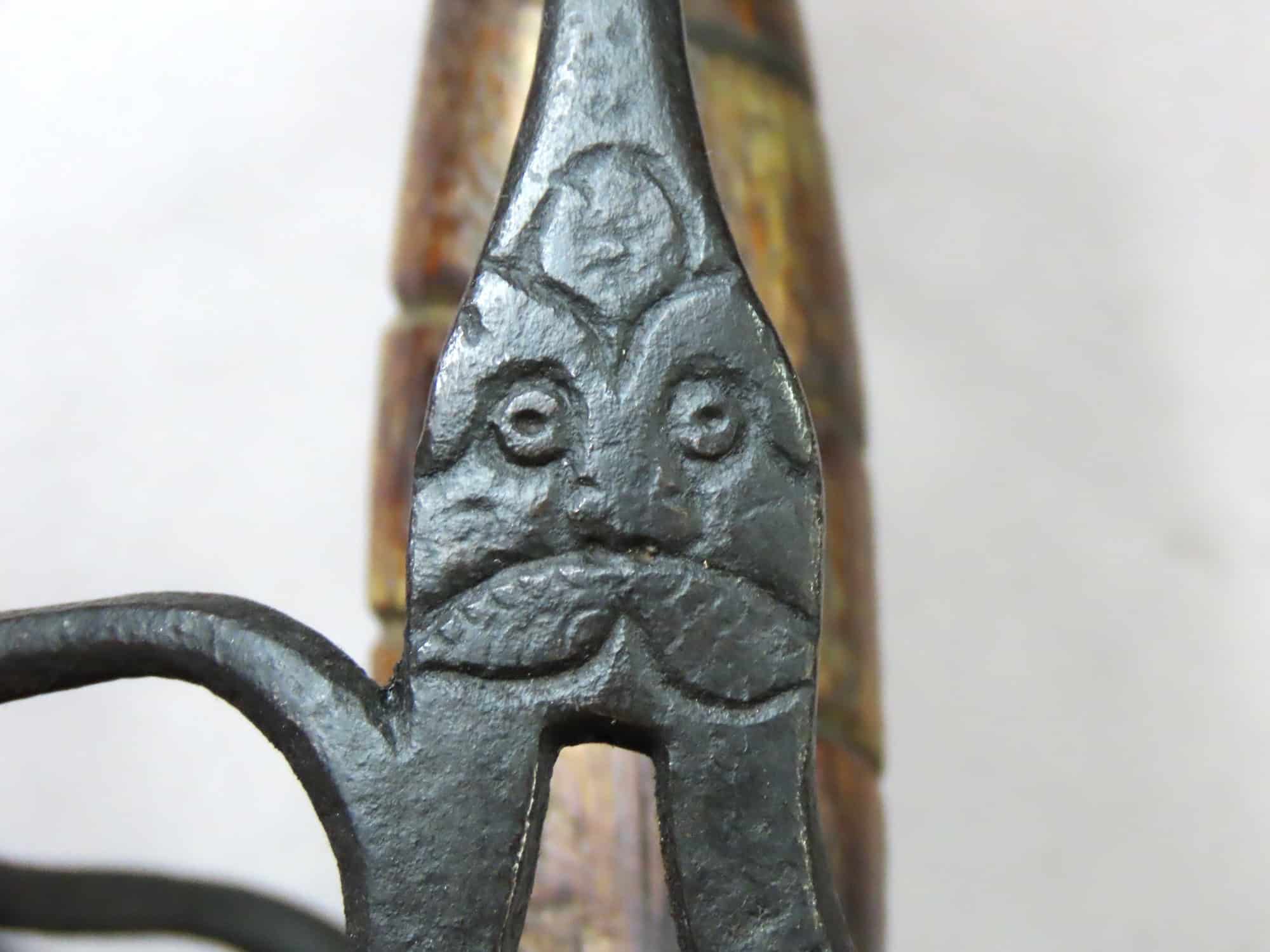
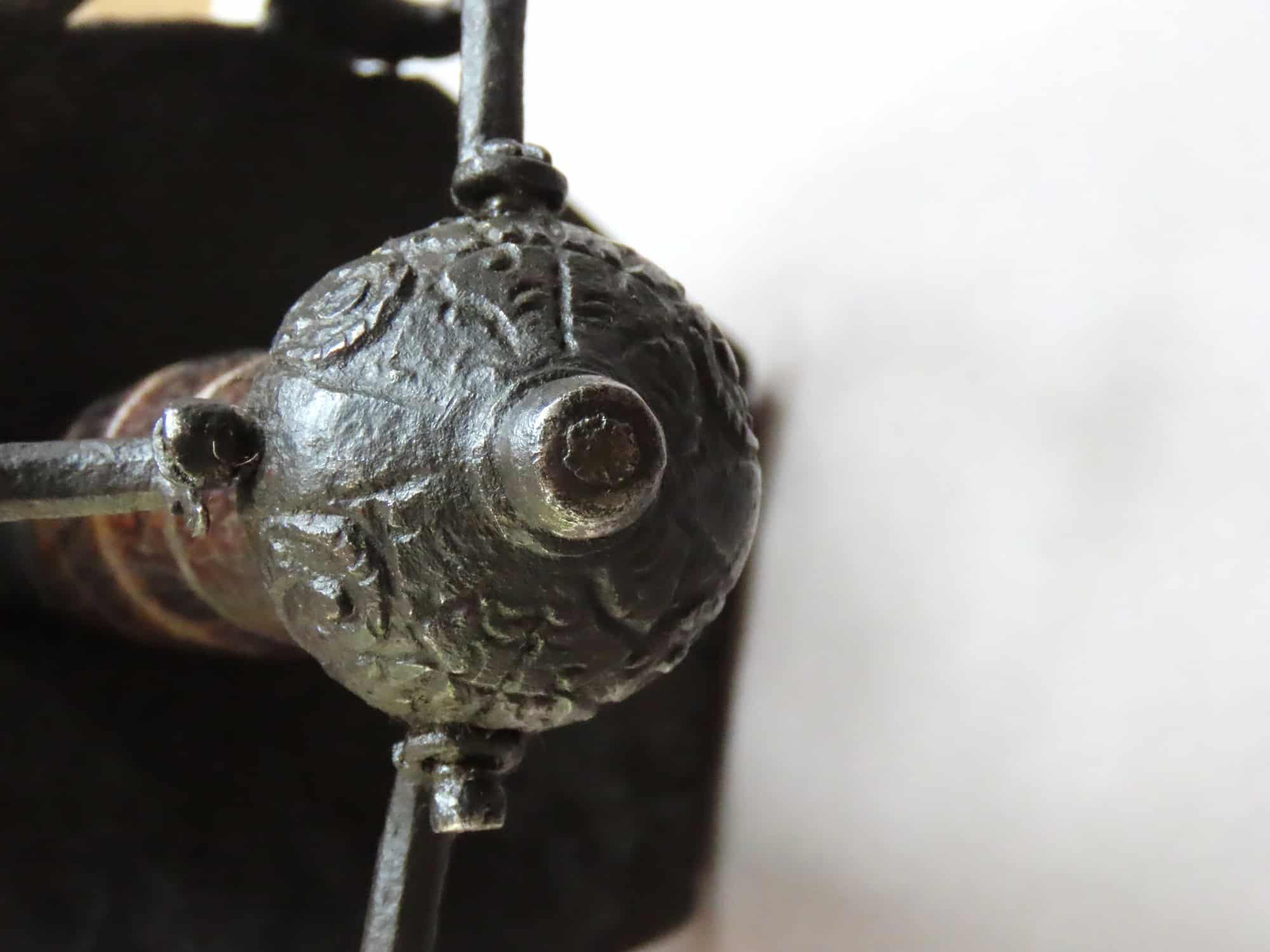
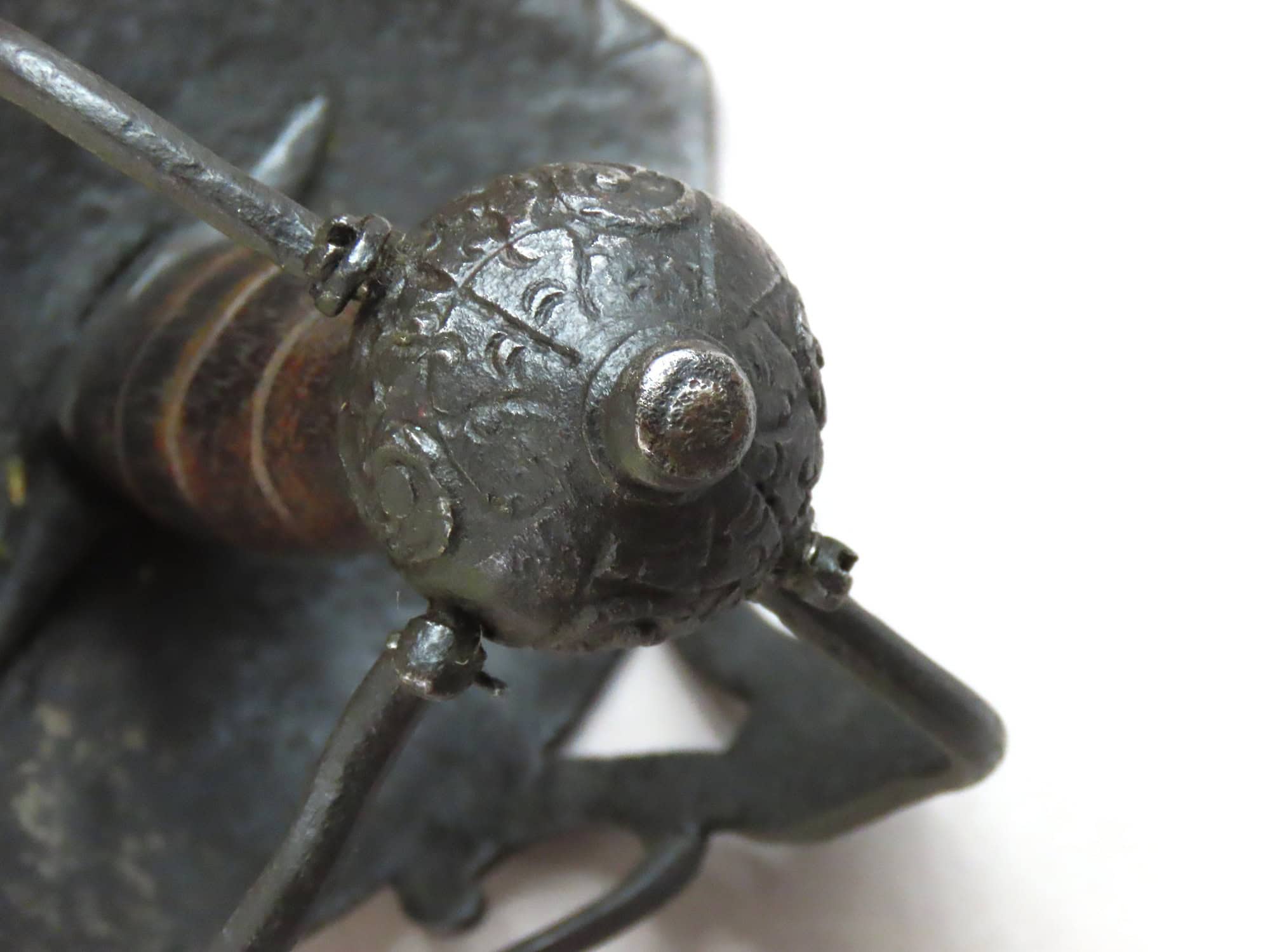
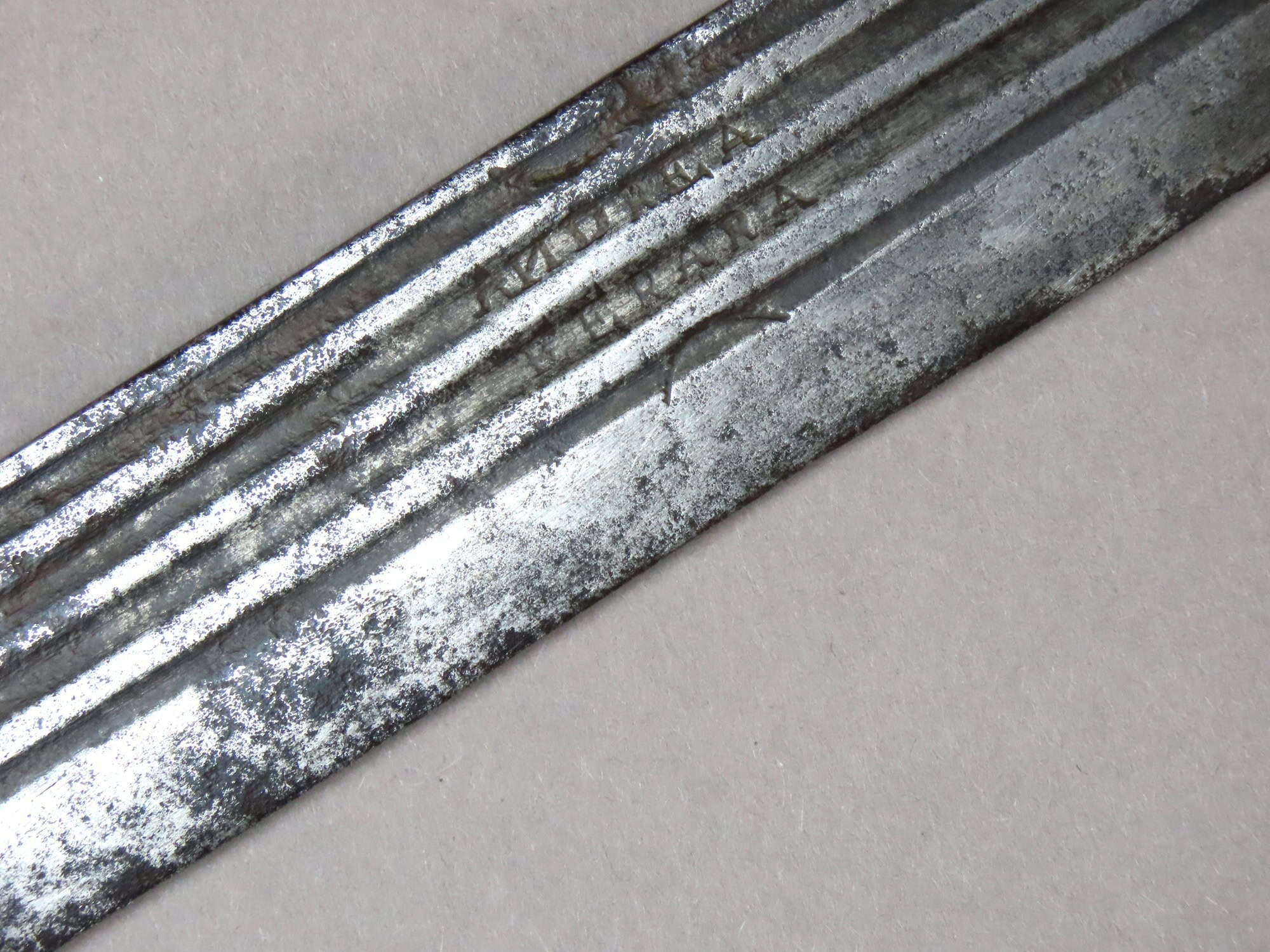
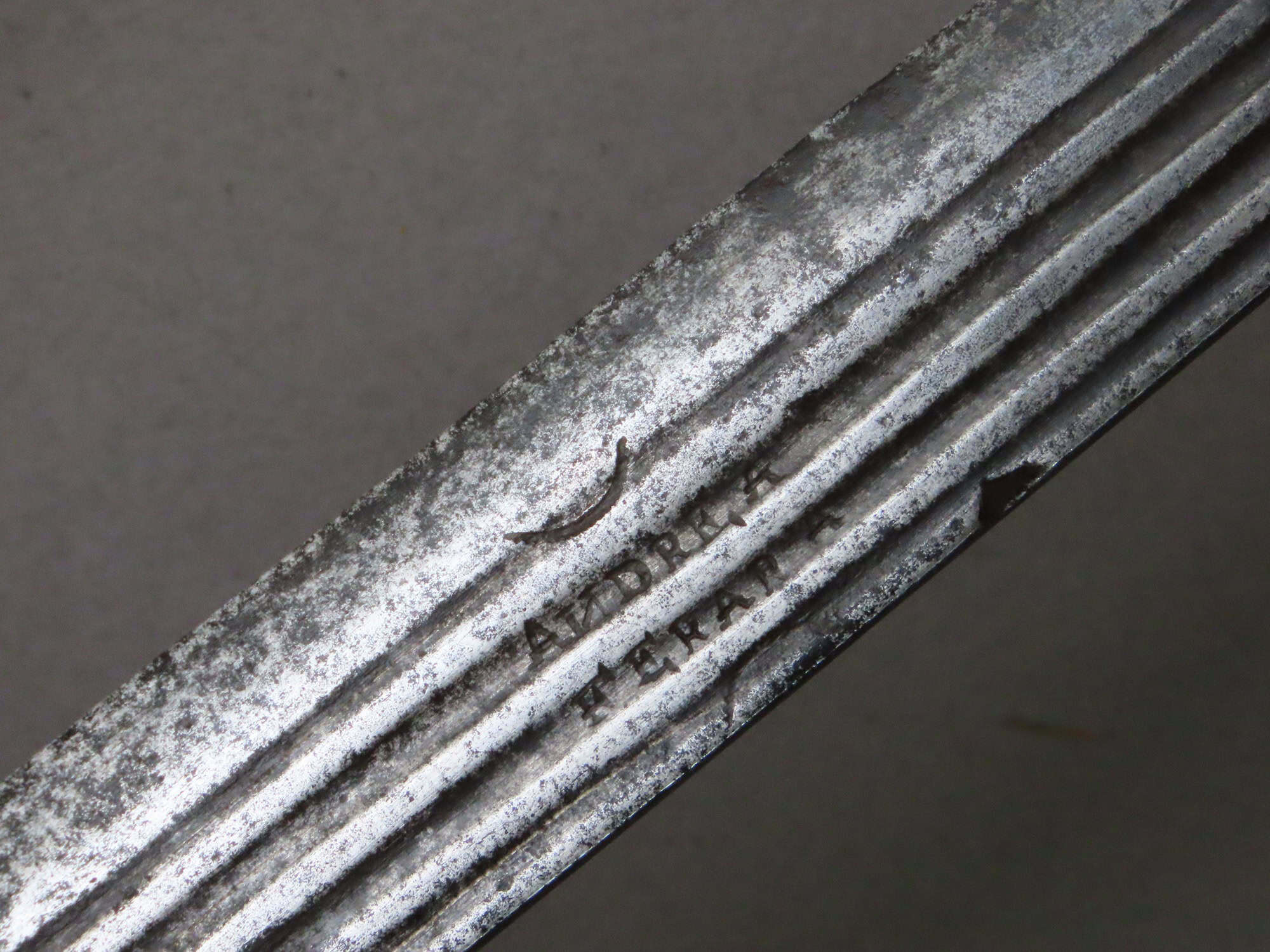
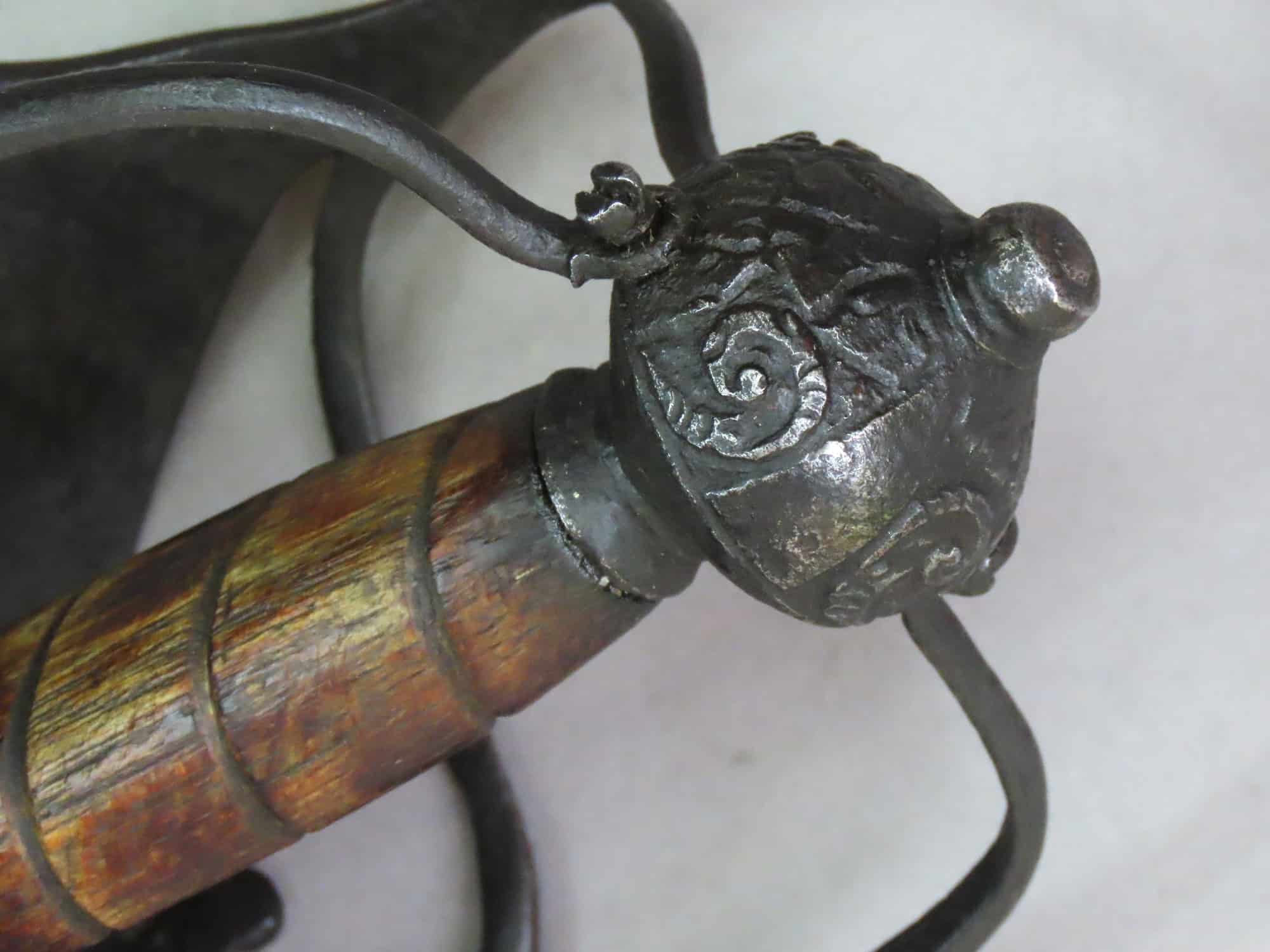
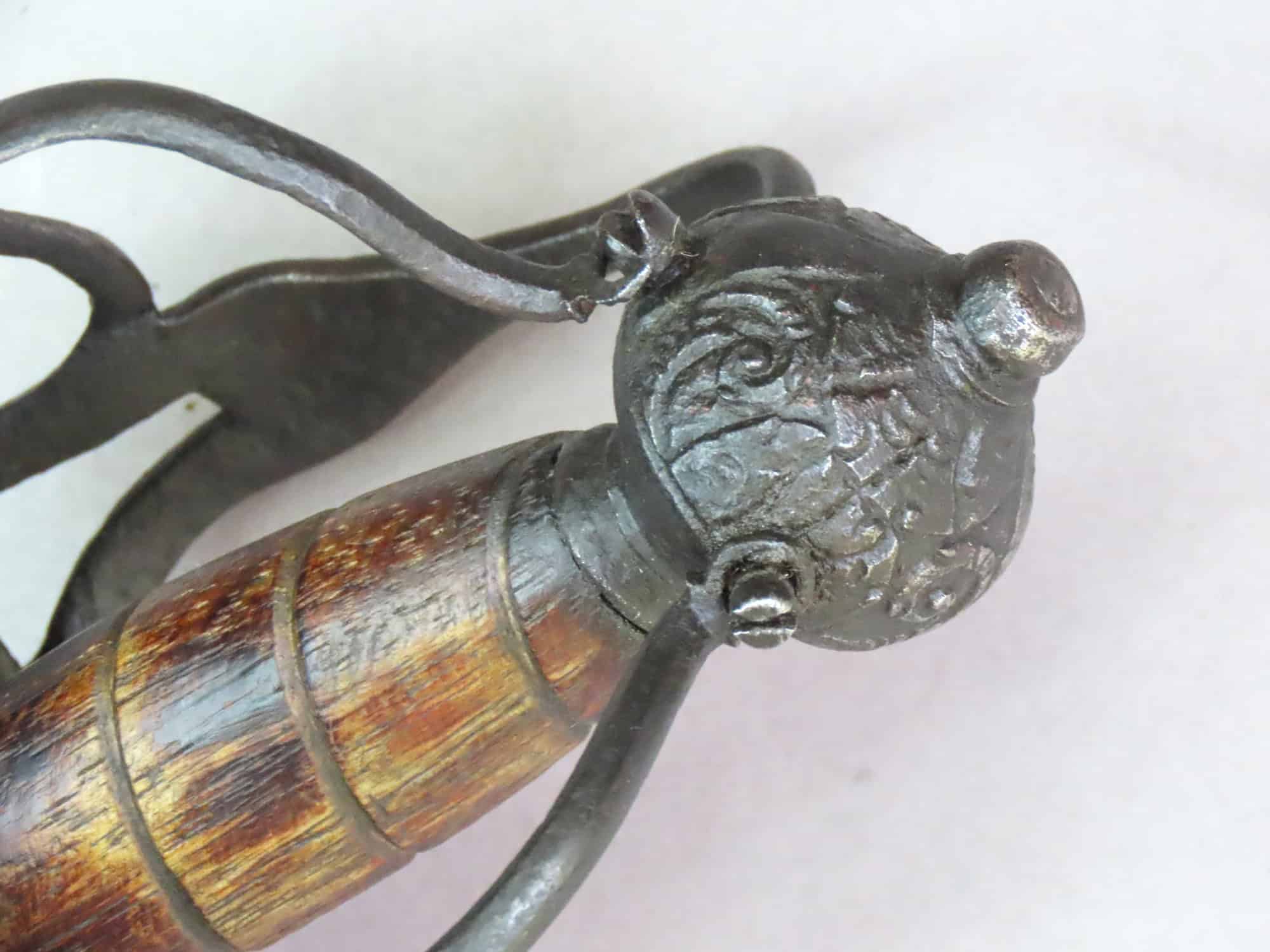
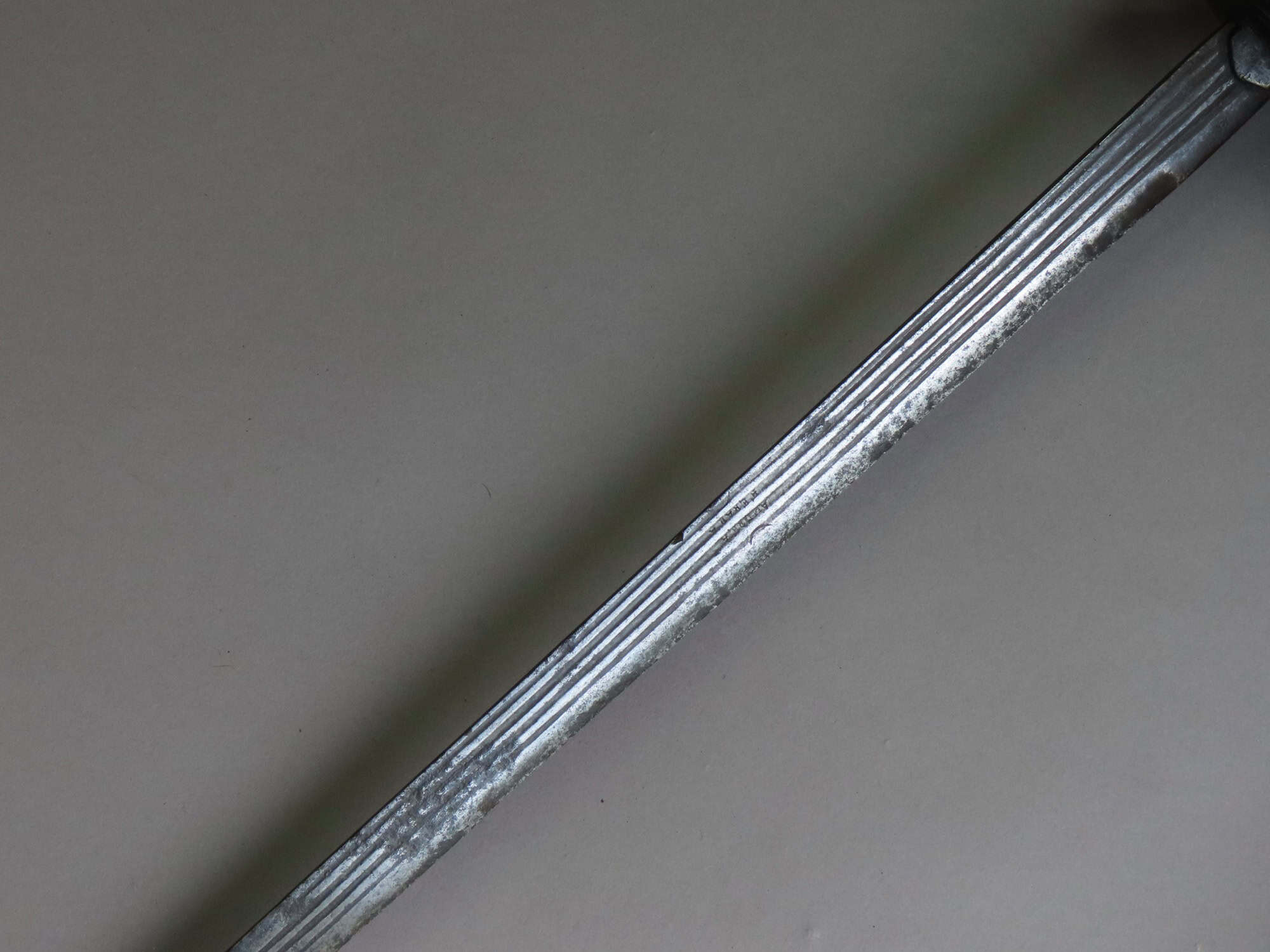
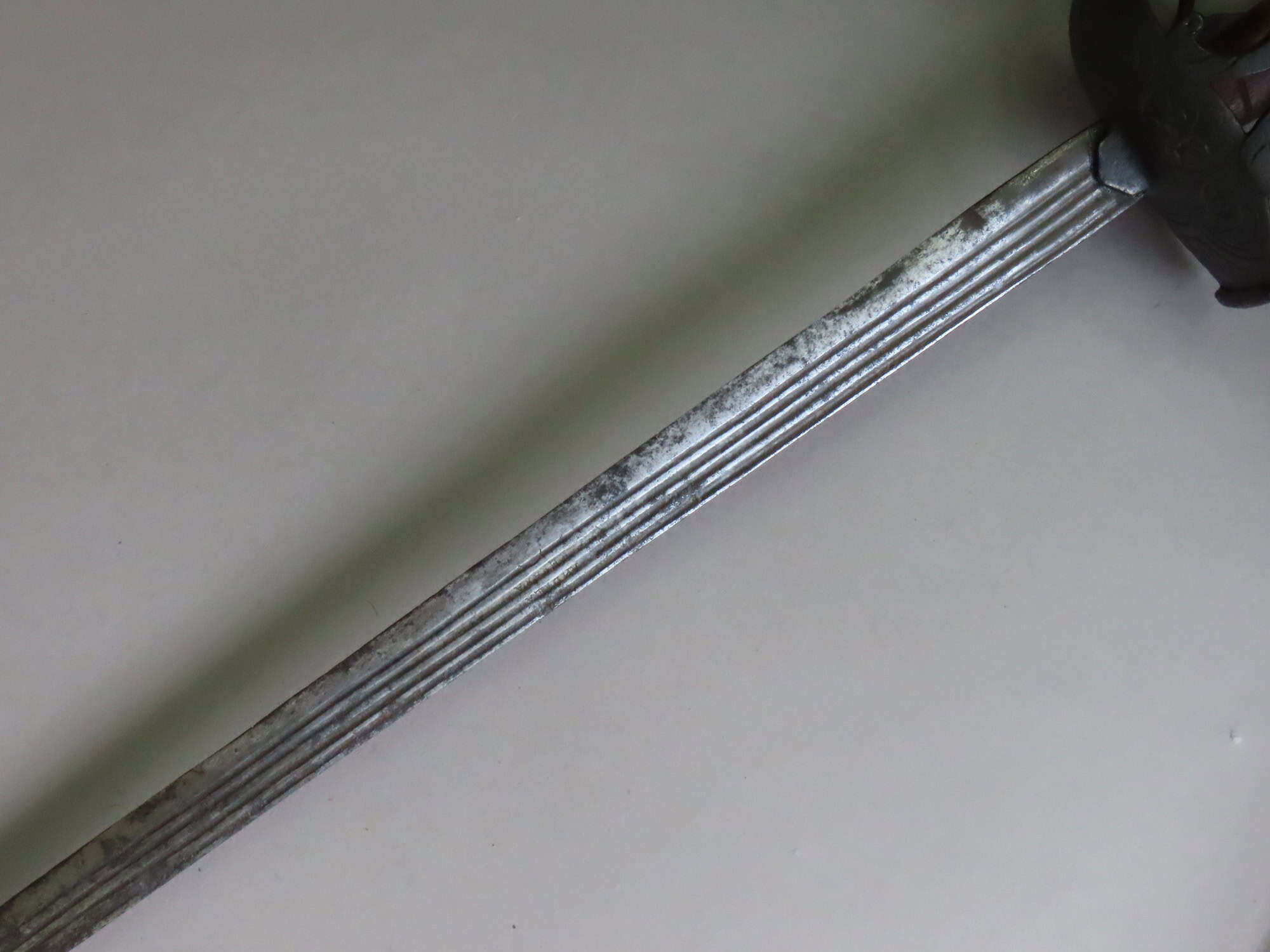
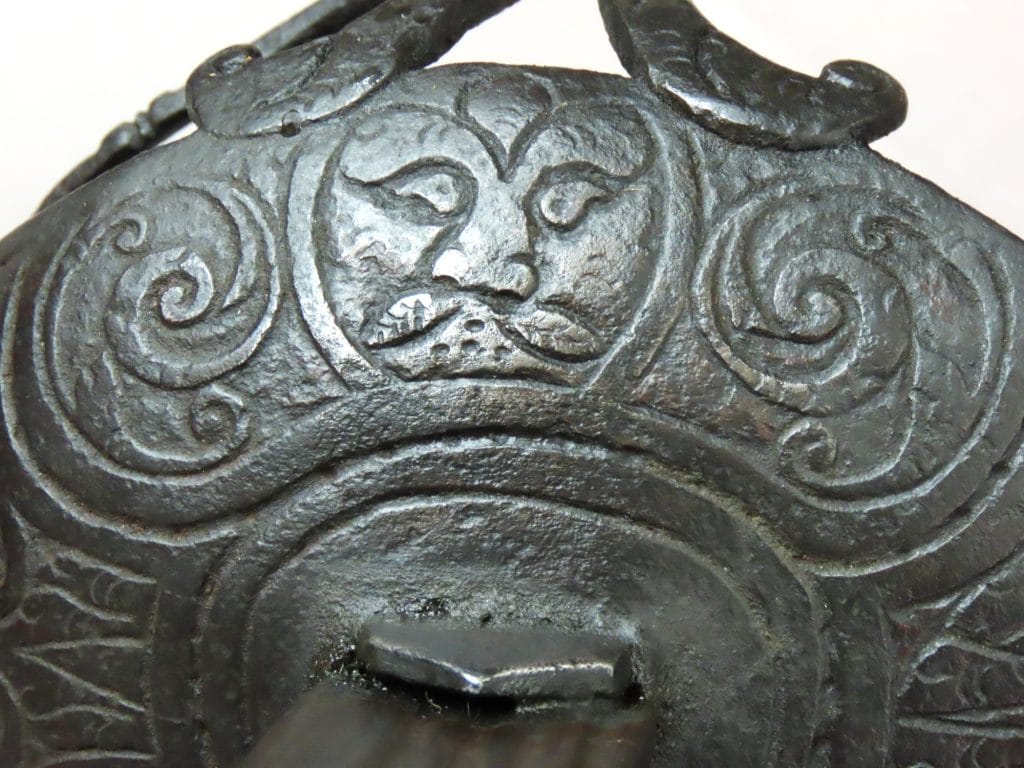
An attractive English “Mortuary” sword with a boldly engraved and chiselled hilt dating to the English Civil War and Protectorate / Commonwealth periods. The sword is in darkly patinated original condition. The designs on the hilt are mainly of foliate sprays and swirls with two “Green Man” heads incorporated into the engraving. The sword is mounted with a robust, single-edged, multi-fullered, ANDREA FERARA marked blade.
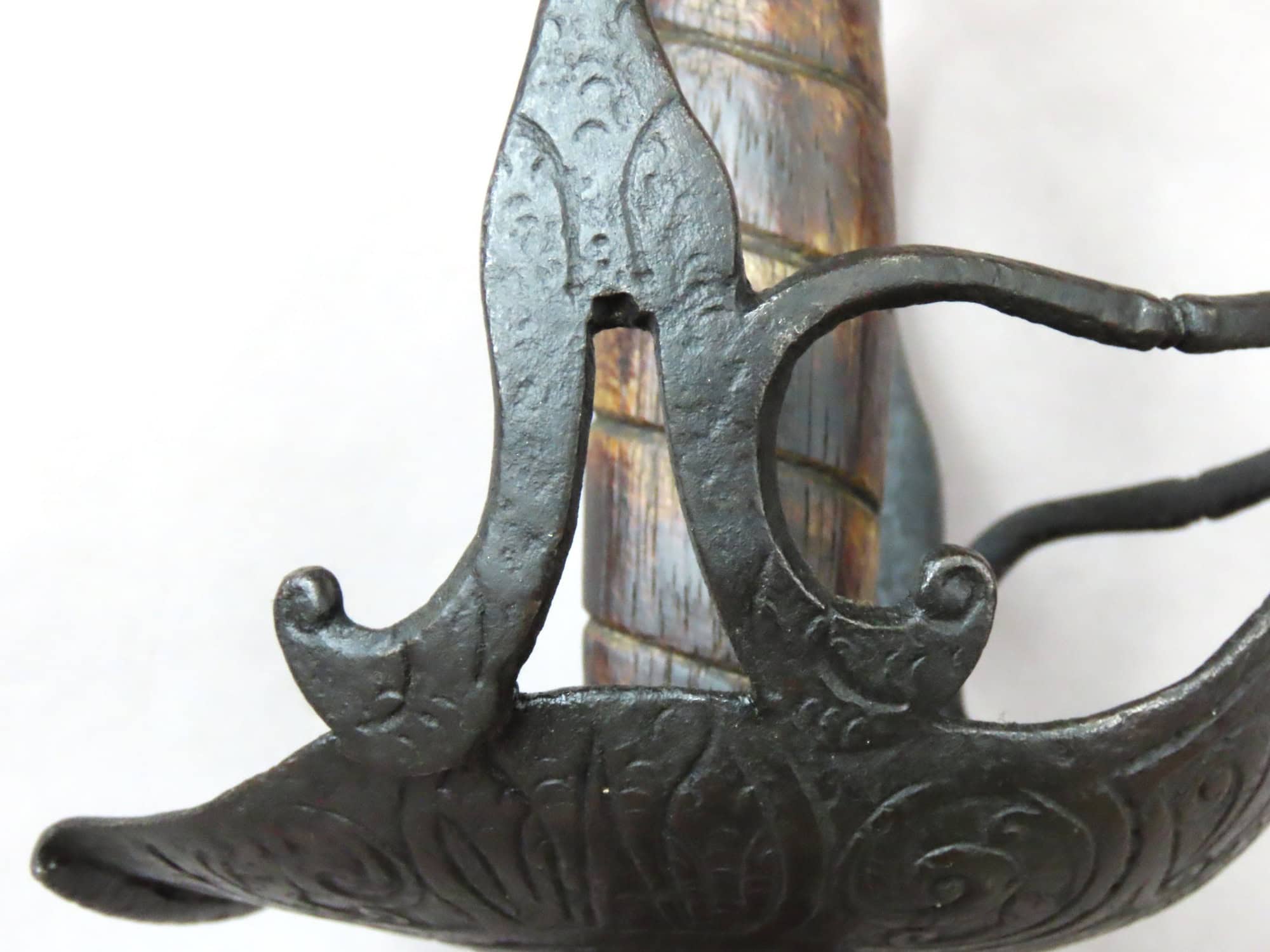
The hilt is of typical form consisting of a broad boat-shaped guard plate from which three curved primary guard bars, the knuckle bow and two side guard bars, extend upwards ending in flattened angled terminals screwed through eyelets into the pommel. Each side guard bar bifurcates at the base to join the guard plate with two counter-facing scrolled terminals. Two downward facing secondary guard bars emanate from each side of the knuckle bow near its middle and join the base of each side guard bar to strengthen the structure.
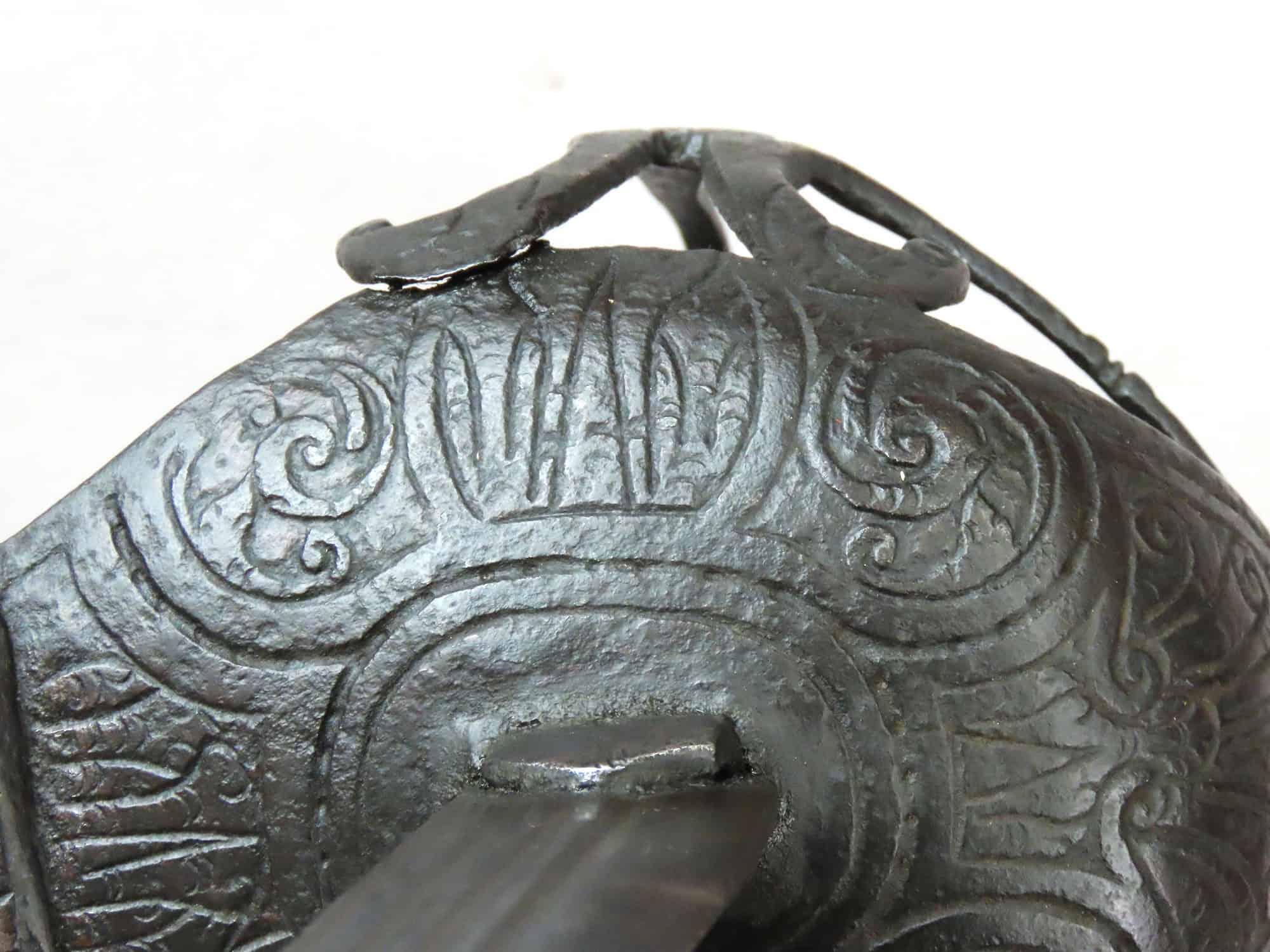
The guard plate is covered with chiselled decoration to the outside. A double roundel surrounds the tang aperture. Between this roundel and the rim of the guard plate a sequence of panels is cut containing foliate sprays, swirls and a green man on one side. One side guard bar is engraved on its middle swelling with foliage and the other contains a further green man image. Both green man images have mustaches formed as leaves. The solid pommel is globular in shape and has an integral button on top and a pronounced flared neck beneath. It is also chiselled with panels of foliate sprays.
The spirally grooved wooden grip is baluster shaped and of oval cross section. It has lost its original wire binding. The grip base sits on an iron flanged plug mounted into the middle of the guard plate from which two langets extend through the tang aperture to flank the blade either side for a short distance from the hilt.
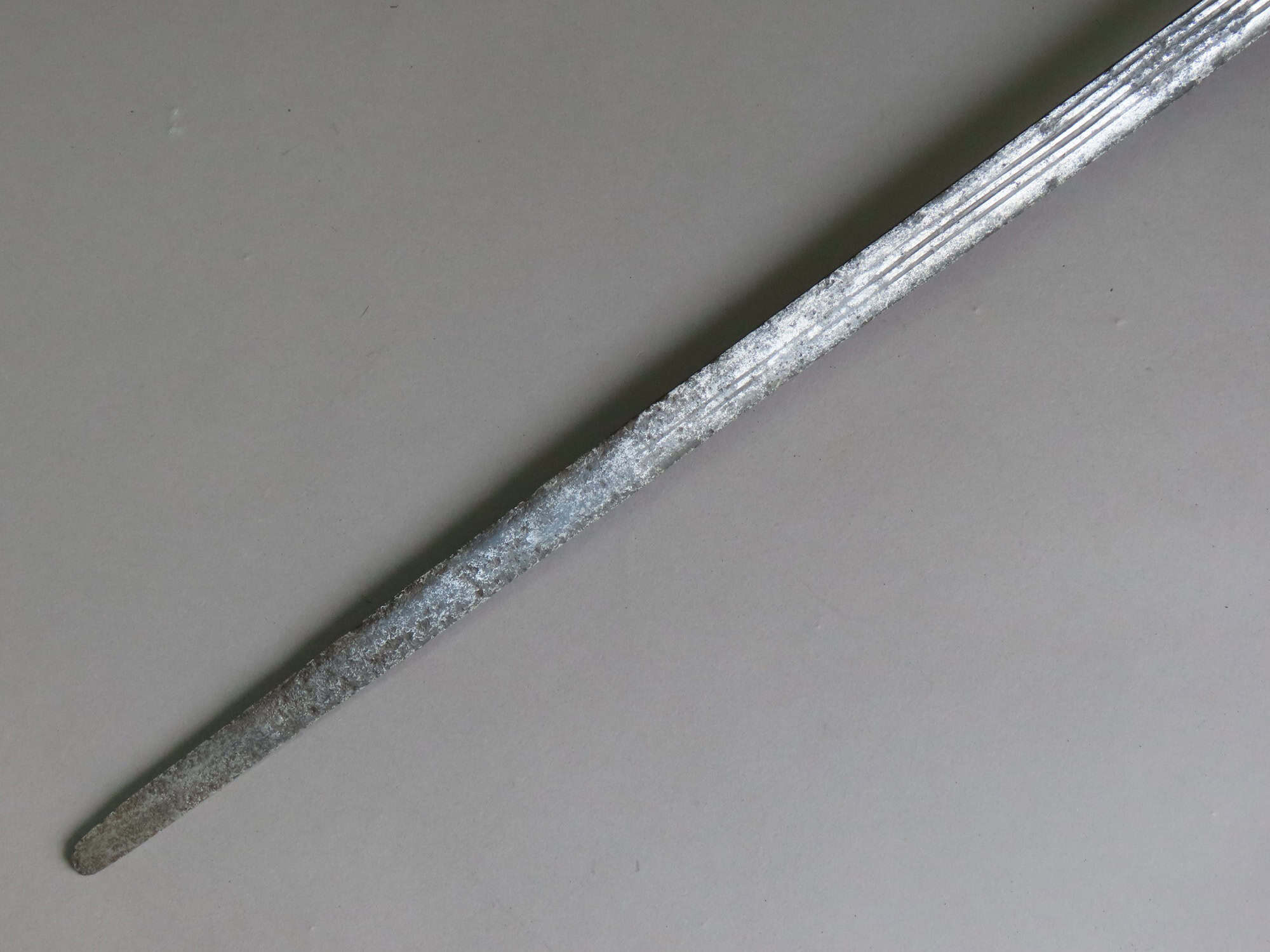
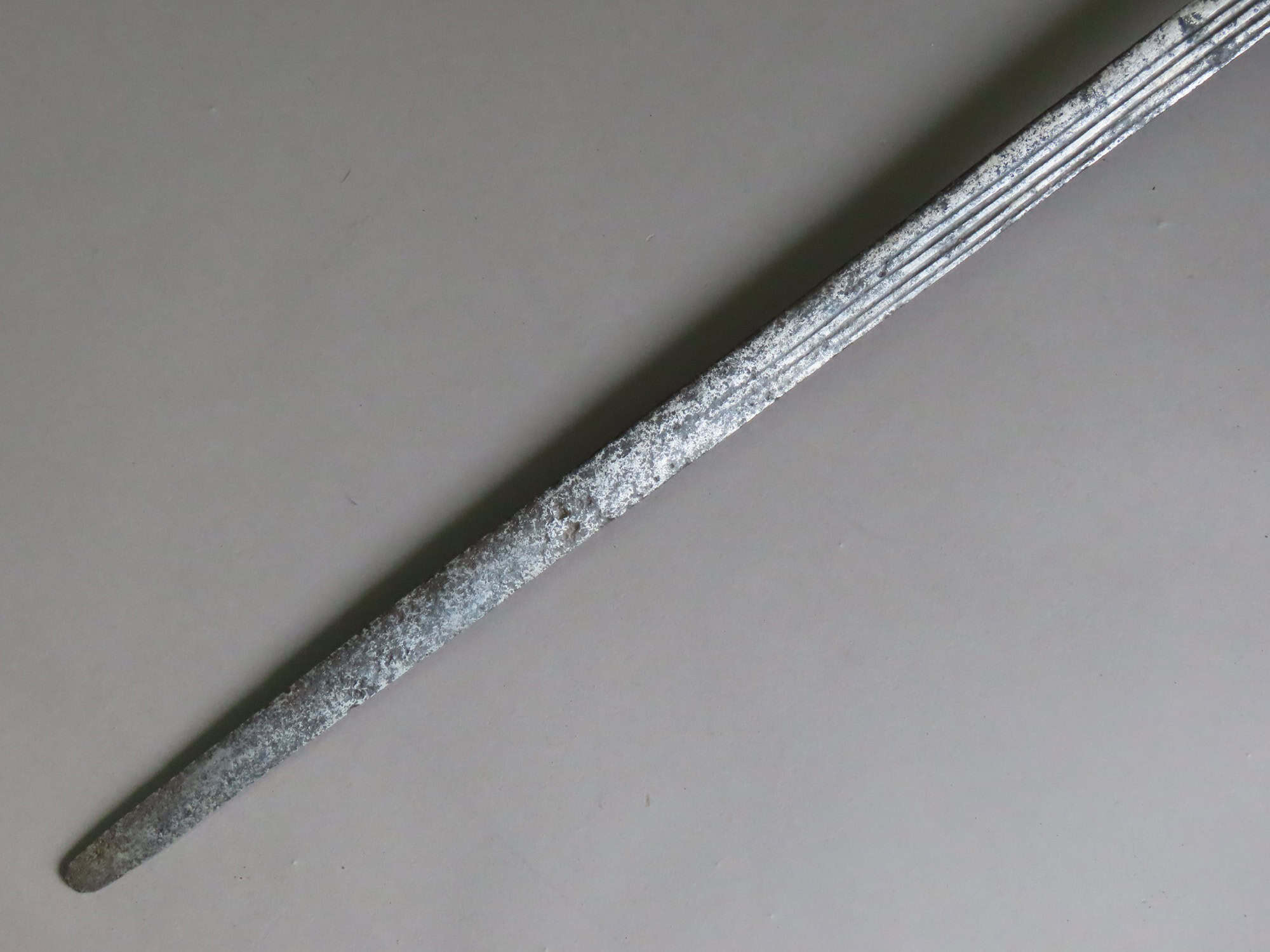
The single-edged blade has a pronounced ricasso extending for 2 inches (5 cm) from the hilt. Stacked beneath the blunt back edge four fullers extend from the hilt and terminate 12 inches from the rounded tip after which the blade becomes double edged. Nine inches from the hilt (23 cm) the uppermost middle fuller is stamped with “ANDREA” and the lowermost with FERARA. The top and bottom fullers are stamped with crescents above and below the name. The name is probably a spurious mark of quality emulating the mark of an earlier bladesmith of this name whose blades gained popularity in Britain.
This blade was probably made in Solingen in Germany which was an important manufacturer of blades for use in the English Civil War. Huge numbers were imported into Britain during this period for use by both Royalist and Parliamentarian sides.
The blade is just under 35 inches (88.5 cm) and overall the sword is 41.25 inches (105 cm) long.
For further examples of Mortuary swords see Stuart C Mowbray’s “British Military Swords”, Mowbray Publishing, 2013, in the section dedicated to Mortuary Swords, pages 178 to 225. And see Cyril Mazansky, British Basket Hilted Swords, Boydell Press 2005, Chapter 11, pages 233 to 280.
The sword is in good, original, tight condition overall with a blackened patination to the hilt. The blade is in a similar condition but becomes patchy and pitted towards the tip. The hilt is firm and in good shape apart from a break to the pommel eyelet for the knucklebow which is missing its top half.
The “Green Man” has Celtic origins in English folklore. These grotesque, bearded, wild-eyed faces are often carved on English weapons of the 17th and 18th centuries. As well as on weapons, the Green Man is depicted amongst foliage in medieval English churches carved on fonts, pillars and lintels. In history the Green Man appeared in traditional springtime rural village fetes and ceremonies as a symbol of growth and fertility for the coming farming season. The figure, dressed in green garlands, was exhibited then sacrificed by ritual decapitation, hence the appearance of the head separated from the body in later designs. The roots of the ceremony lie in Pagan England and the practice was so embedded in rural communities that it survived into the Christian era. Embedded with the ideal of “renewal” the Green Man may have been thought to embody some form of spiritual protection for the owner then later became more of a “good luck” charm in the 17th and 18th centuries as it appears on the sword discussed here.